

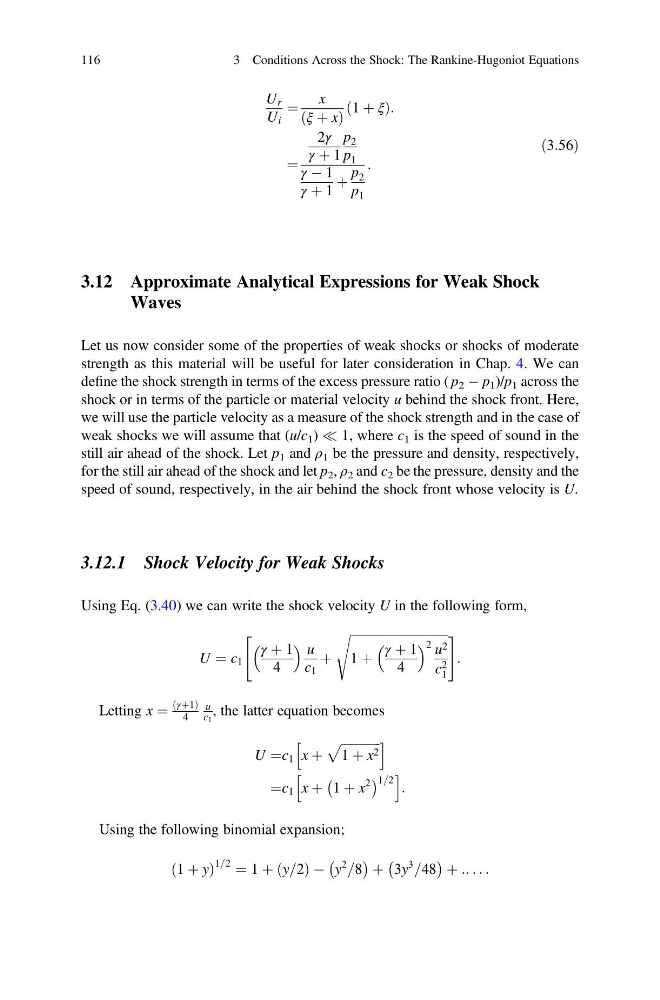
U r
U i
¼
x
ξ þ x
ð
Þ
1 þ ξ
ð
Þ:
¼
2γ
γ þ 1
p 2
p 1
γ À 1
γ þ 1
þ
p 2
p 1
:
ð3:56Þ
3.12 Approximate Analytical Expressions for Weak Shock
Waves
Let us now consider some of the properties of weak shocks or shocks of moderate
strength as this material will be useful for later consideration in Chap. 4. We can
define the shock strength in terms of the excess pressure ratio ( p 2 À p 1 )/p 1 across the
shock or in terms of the particle or material velocity u behind the shock front. Here,
we will use the particle velocity as a measure of the shock strength and in the case of
weak shocks we will assume that (u/c 1 ) ( 1, where c 1 is the speed of sound in the
still air ahead of the shock. Let p 1 and ρ 1 be the pressure and density, respectively,
for the still air ahead of the shock and let p 2 , ρ 2 and c 2 be the pressure, density and the
speed of sound, respectively, in the air behind the shock front whose velocity is U.
3.12.1 Shock Velocity for Weak Shocks
Using Eq. (3.40) we can write the shock velocity U in the following form,
U ¼ c 1
γ þ 1
4
u
c 1
þ
ffiffiffiffiffiffiffiffiffiffiffiffiffiffiffiffiffiffiffiffiffiffiffiffiffiffiffiffiffiffiffi ffi
1 þ
γ þ 1
4
2 u 2
c 2
1
s
"
#
:
Letting x ¼
γþ1
ð
Þ
4
u
c 1
, the latter equation becomes
U ¼c 1 x þ
ffiffiffiffiffiffiffiffiffiffiffiffi ffi
1 þ x 2
p
h
i
¼c 1 x þ 1 þ x
2
À
Á 1=2
h
i
:
Using the following binomial expansion;
1 þ y
ð
Þ
1=2 ¼ 1 þ y=2
ð ÞÀ y
2
=8
À
Á þ 3y
3
=48
À
Á þ :: . . .
116
3 Conditions Across the Shock: The Rankine-Hugoniot Equations
U i
¼
x
ξ þ x
ð
Þ
1 þ ξ
ð
Þ:
¼
2γ
γ þ 1
p 2
p 1
γ À 1
γ þ 1
þ
p 2
p 1
:
ð3:56Þ
3.12 Approximate Analytical Expressions for Weak Shock
Waves
Let us now consider some of the properties of weak shocks or shocks of moderate
strength as this material will be useful for later consideration in Chap. 4. We can
define the shock strength in terms of the excess pressure ratio ( p 2 À p 1 )/p 1 across the
shock or in terms of the particle or material velocity u behind the shock front. Here,
we will use the particle velocity as a measure of the shock strength and in the case of
weak shocks we will assume that (u/c 1 ) ( 1, where c 1 is the speed of sound in the
still air ahead of the shock. Let p 1 and ρ 1 be the pressure and density, respectively,
for the still air ahead of the shock and let p 2 , ρ 2 and c 2 be the pressure, density and the
speed of sound, respectively, in the air behind the shock front whose velocity is U.
3.12.1 Shock Velocity for Weak Shocks
Using Eq. (3.40) we can write the shock velocity U in the following form,
U ¼ c 1
γ þ 1
4
u
c 1
þ
ffiffiffiffiffiffiffiffiffiffiffiffiffiffiffiffiffiffiffiffiffiffiffiffiffiffiffiffiffiffiffi ffi
1 þ
γ þ 1
4
2 u 2
c 2
1
s
"
#
:
Letting x ¼
γþ1
ð
Þ
4
u
c 1
, the latter equation becomes
U ¼c 1 x þ
ffiffiffiffiffiffiffiffiffiffiffiffi ffi
1 þ x 2
p
h
i
¼c 1 x þ 1 þ x
2
À
Á 1=2
h
i
:
Using the following binomial expansion;
1 þ y
ð
Þ
1=2 ¼ 1 þ y=2
ð ÞÀ y
2
=8
À
Á þ 3y
3
=48
À
Á þ :: . . .
116
3 Conditions Across the Shock: The Rankine-Hugoniot Equations