

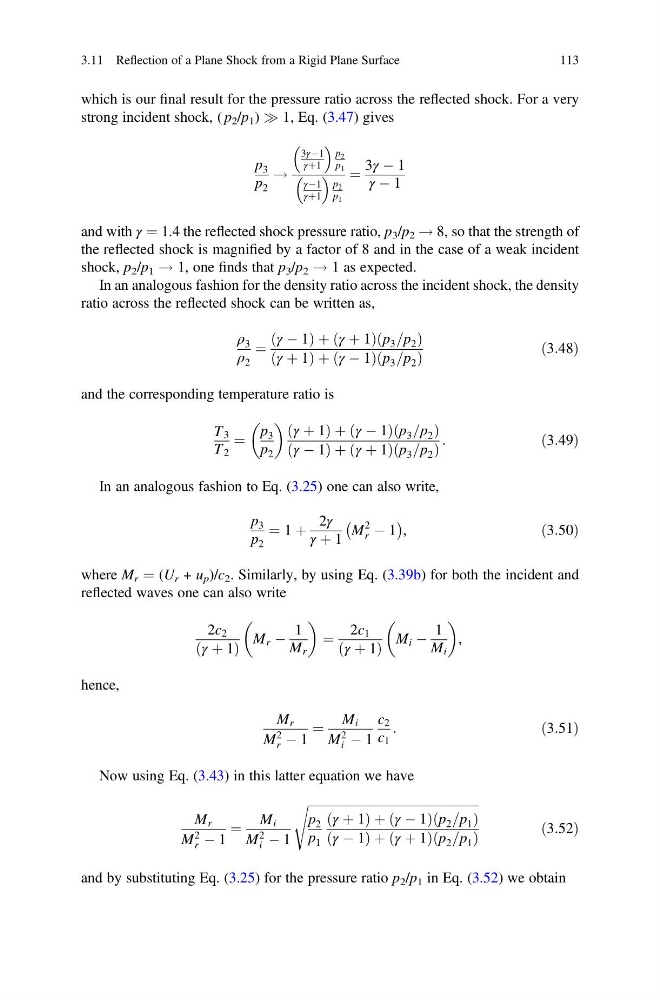
which is our final result for the pressure ratio across the reflected shock. For a very
strong incident shock, ( p 2 /p 1 ) ) 1, Eq. (3.47) gives
p 3
p 2
!
3γÀ1
γþ1
p 2
p 1
γÀ1
γþ1
p 2
p 1
¼
3γ À 1
γ À 1
and with γ ¼ 1.4 the reflected shock pressure ratio, p 3 /p 2 ! 8, so that the strength of
the reflected shock is magnified by a factor of 8 and in the case of a weak incident
shock, p 2 /p 1 ! 1, one finds that p 3 /p 2 ! 1 as expected.
In an analogous fashion for the density ratio across the incident shock, the density
ratio across the reflected shock can be written as,
ρ 3
ρ 2
¼
γ À 1
ð
Þþ γ þ 1
ð
Þ p 3 =p 2
ð
Þ
γ þ 1
ð
Þþ γ À 1
ð
Þ p 3 =p 2
ð
Þ
ð3:48Þ
and the corresponding temperature ratio is
T 3
T 2
¼
p 3
p 2
γ þ 1
ð
Þþ γ À 1
ð
Þ p 3 =p 2
ð
Þ
γ À 1
ð
Þþ γ þ 1
ð
Þ p 3 =p 2
ð
Þ
:
ð3:49Þ
In an analogous fashion to Eq. (3.25) one can also write,
p 3
p 2
¼ 1 þ
2γ
γ þ 1
M
2
r À 1
À
Á
,
ð3:50Þ
where M r ¼ (U r + u p )/c 2 . Similarly, by using Eq. (3.39b) for both the incident and
reflected waves one can also write
2c 2
γ þ 1
ð
Þ
M r À
1
M r
¼
2c 1
γ þ 1
ð
Þ
M i À
1
M i
,
hence,
M r
M
2
r À 1
¼
M i
M
2
i À 1
c 2
c 1
:
ð3:51Þ
Now using Eq. (3.43) in this latter equation we have
M r
M
2
r À 1
¼
M i
M
2
i À 1
ffiffiffiffiffiffiffiffiffiffiffiffiffiffiffiffiffiffiffiffiffiffiffiffiffiffiffiffiffiffiffiffiffiffiffiffiffiffiffiffiffiffiffiffiffiffiffiffiffiffiffiffiffiffiffi
p 2
p 1
γ þ 1
ð
Þþ γ À 1
ð
Þ p 2 =p 1
ð
Þ
γ À 1
ð
Þþ γ þ 1
ð
Þ p 2 =p 1
ð
Þ
s
ð3:52Þ
and by substituting Eq. (3.25) for the pressure ratio p 2 /p 1 in Eq. (3.52) we obtain
3.11 Reflection of a Plane Shock from a Rigid Plane Surface
113
strong incident shock, ( p 2 /p 1 ) ) 1, Eq. (3.47) gives
p 3
p 2
!
3γÀ1
γþ1
p 2
p 1
γÀ1
γþ1
p 2
p 1
¼
3γ À 1
γ À 1
and with γ ¼ 1.4 the reflected shock pressure ratio, p 3 /p 2 ! 8, so that the strength of
the reflected shock is magnified by a factor of 8 and in the case of a weak incident
shock, p 2 /p 1 ! 1, one finds that p 3 /p 2 ! 1 as expected.
In an analogous fashion for the density ratio across the incident shock, the density
ratio across the reflected shock can be written as,
ρ 3
ρ 2
¼
γ À 1
ð
Þþ γ þ 1
ð
Þ p 3 =p 2
ð
Þ
γ þ 1
ð
Þþ γ À 1
ð
Þ p 3 =p 2
ð
Þ
ð3:48Þ
and the corresponding temperature ratio is
T 3
T 2
¼
p 3
p 2
γ þ 1
ð
Þþ γ À 1
ð
Þ p 3 =p 2
ð
Þ
γ À 1
ð
Þþ γ þ 1
ð
Þ p 3 =p 2
ð
Þ
:
ð3:49Þ
In an analogous fashion to Eq. (3.25) one can also write,
p 3
p 2
¼ 1 þ
2γ
γ þ 1
M
2
r À 1
À
Á
,
ð3:50Þ
where M r ¼ (U r + u p )/c 2 . Similarly, by using Eq. (3.39b) for both the incident and
reflected waves one can also write
2c 2
γ þ 1
ð
Þ
M r À
1
M r
¼
2c 1
γ þ 1
ð
Þ
M i À
1
M i
,
hence,
M r
M
2
r À 1
¼
M i
M
2
i À 1
c 2
c 1
:
ð3:51Þ
Now using Eq. (3.43) in this latter equation we have
M r
M
2
r À 1
¼
M i
M
2
i À 1
ffiffiffiffiffiffiffiffiffiffiffiffiffiffiffiffiffiffiffiffiffiffiffiffiffiffiffiffiffiffiffiffiffiffiffiffiffiffiffiffiffiffiffiffiffiffiffiffiffiffiffiffiffiffiffi
p 2
p 1
γ þ 1
ð
Þþ γ À 1
ð
Þ p 2 =p 1
ð
Þ
γ À 1
ð
Þþ γ þ 1
ð
Þ p 2 =p 1
ð
Þ
s
ð3:52Þ
and by substituting Eq. (3.25) for the pressure ratio p 2 /p 1 in Eq. (3.52) we obtain
3.11 Reflection of a Plane Shock from a Rigid Plane Surface
113