

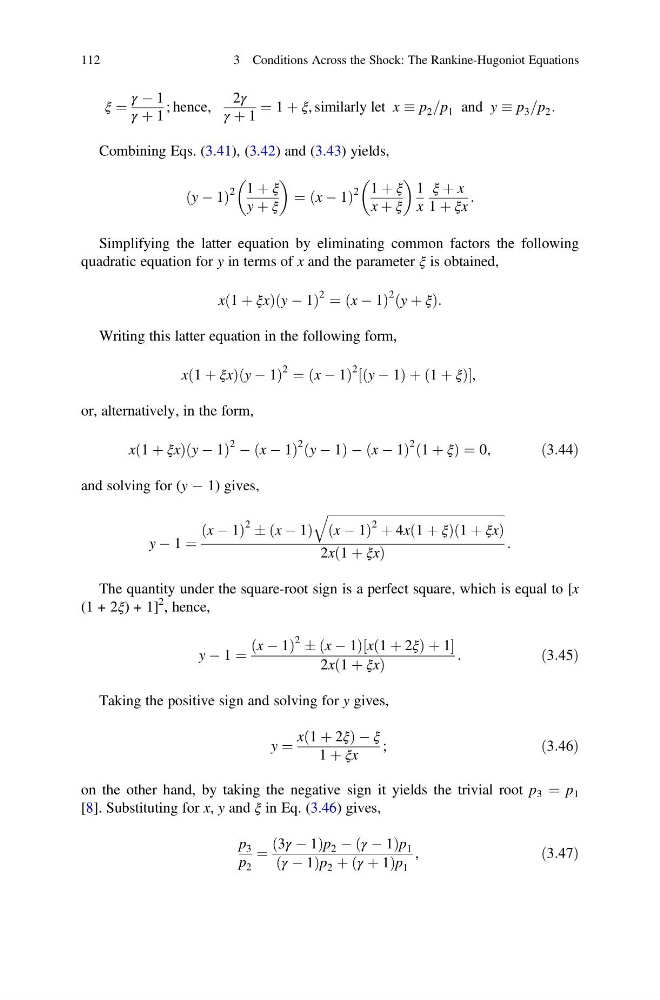
ξ ¼
γ À 1
γ þ 1
; hence,
2γ
γ þ 1
¼ 1 þ ξ, similarly let x p 2 =p 1 and y p 3 =p 2 :
Combining Eqs. (3.41), (3.42) and (3.43) yields,
y À 1
ð
Þ
2 1 þ ξ
y þ ξ
¼ x À 1
ð
Þ
2 1 þ ξ
x þ ξ
1
x
ξ þ x
1 þ ξx
:
Simplifying the latter equation by eliminating common factors the following
quadratic equation for y in terms of x and the parameter ξ is obtained,
x 1 þ ξx
ð
Þ y À 1
ð
Þ
2 ¼ x À 1
ð
Þ
2 y þ ξ
ð
Þ:
Writing this latter equation in the following form,
x 1 þ ξx
ð
Þ y À 1
ð
Þ
2 ¼ x À 1
ð
Þ
2 y À 1
ð
Þþ 1 þ ξ
ð
Þ
½
,
or, alternatively, in the form,
x 1 þ ξx
ð
Þ y À 1
ð
Þ
2 À x À 1
ð
Þ
2 y À 1
ð
ÞÀ x À 1
ð
Þ
2 1 þ ξ
ð
Þ¼0,
ð3:44Þ
and solving for (y À 1) gives,
y À 1 ¼
x À 1
ð
Þ
2 Æ x À 1
ð
Þ
ffiffiffiffiffiffiffiffiffiffiffiffiffiffiffiffiffiffiffiffiffiffiffiffiffiffiffiffiffiffiffiffiffiffiffiffiffiffiffiffiffiffiffiffiffiffiffiffiffiffiffiffiffiffiffiffiffi
x À 1
ð
Þ
2 þ 4x 1 þ ξ
ð
Þ 1 þ ξx
ð
Þ
q
2x 1 þ ξx
ð
Þ
:
The quantity under the square-root sign is a perfect square, which is equal to [x
(1 + 2ξ) + 1]
2 , hence,
y À 1 ¼
x À 1
ð
Þ
2 Æ x À 1
ð
Þx 1 þ 2ξ
ð
Þþ1
½
2x 1 þ ξx
ð
Þ
:
ð3:45Þ
Taking the positive sign and solving for y gives,
y ¼
x 1 þ 2ξ
ð
ÞÀξ
1 þ ξx
;
ð3:46Þ
on the other hand, by taking the negative sign it yields the trivial root p 3 ¼ p 1
[8]. Substituting for x, y and ξ in Eq. (3.46) gives,
p 3
p 2
¼
3γ À 1
ð
Þp 2 À γ À 1
ð
Þp 1
γ À 1
ð
Þp 2 þ γ þ 1
ð
Þp 1
,
ð3:47Þ
112
3 Conditions Across the Shock: The Rankine-Hugoniot Equations
γ À 1
γ þ 1
; hence,
2γ
γ þ 1
¼ 1 þ ξ, similarly let x p 2 =p 1 and y p 3 =p 2 :
Combining Eqs. (3.41), (3.42) and (3.43) yields,
y À 1
ð
Þ
2 1 þ ξ
y þ ξ
¼ x À 1
ð
Þ
2 1 þ ξ
x þ ξ
1
x
ξ þ x
1 þ ξx
:
Simplifying the latter equation by eliminating common factors the following
quadratic equation for y in terms of x and the parameter ξ is obtained,
x 1 þ ξx
ð
Þ y À 1
ð
Þ
2 ¼ x À 1
ð
Þ
2 y þ ξ
ð
Þ:
Writing this latter equation in the following form,
x 1 þ ξx
ð
Þ y À 1
ð
Þ
2 ¼ x À 1
ð
Þ
2 y À 1
ð
Þþ 1 þ ξ
ð
Þ
½
,
or, alternatively, in the form,
x 1 þ ξx
ð
Þ y À 1
ð
Þ
2 À x À 1
ð
Þ
2 y À 1
ð
ÞÀ x À 1
ð
Þ
2 1 þ ξ
ð
Þ¼0,
ð3:44Þ
and solving for (y À 1) gives,
y À 1 ¼
x À 1
ð
Þ
2 Æ x À 1
ð
Þ
ffiffiffiffiffiffiffiffiffiffiffiffiffiffiffiffiffiffiffiffiffiffiffiffiffiffiffiffiffiffiffiffiffiffiffiffiffiffiffiffiffiffiffiffiffiffiffiffiffiffiffiffiffiffiffiffiffi
x À 1
ð
Þ
2 þ 4x 1 þ ξ
ð
Þ 1 þ ξx
ð
Þ
q
2x 1 þ ξx
ð
Þ
:
The quantity under the square-root sign is a perfect square, which is equal to [x
(1 + 2ξ) + 1]
2 , hence,
y À 1 ¼
x À 1
ð
Þ
2 Æ x À 1
ð
Þx 1 þ 2ξ
ð
Þþ1
½
2x 1 þ ξx
ð
Þ
:
ð3:45Þ
Taking the positive sign and solving for y gives,
y ¼
x 1 þ 2ξ
ð
ÞÀξ
1 þ ξx
;
ð3:46Þ
on the other hand, by taking the negative sign it yields the trivial root p 3 ¼ p 1
[8]. Substituting for x, y and ξ in Eq. (3.46) gives,
p 3
p 2
¼
3γ À 1
ð
Þp 2 À γ À 1
ð
Þp 1
γ À 1
ð
Þp 2 þ γ þ 1
ð
Þp 1
,
ð3:47Þ
112
3 Conditions Across the Shock: The Rankine-Hugoniot Equations