

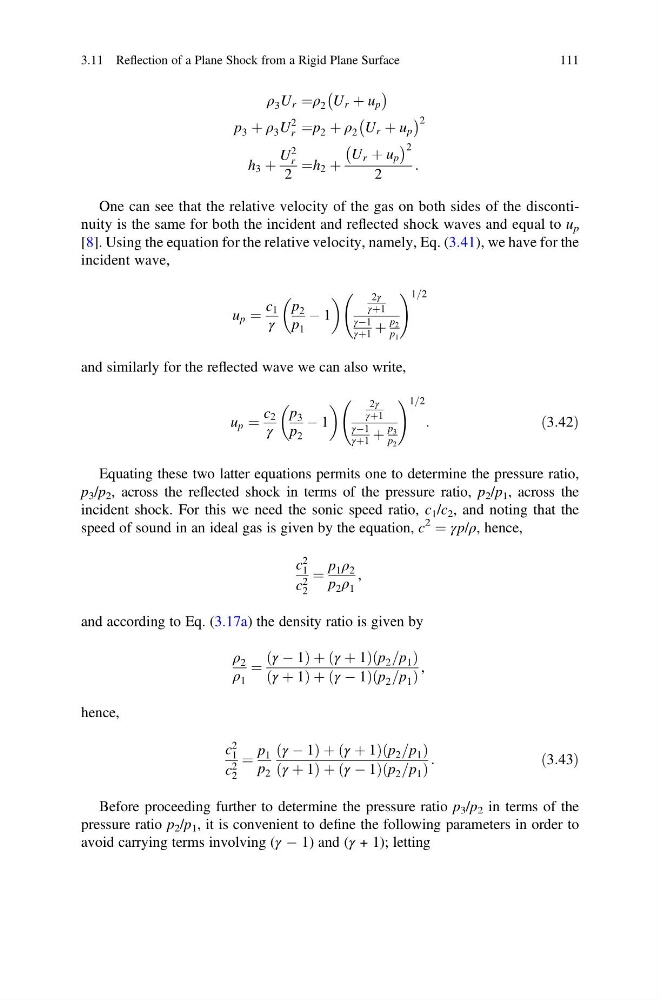
ρ 3 U r ¼ρ 2 U r þ u p
À
Á
p 3 þ ρ 3 U
2
r ¼p 2 þ ρ 2 U r þ u p
À
Á 2
h 3 þ
U
2
r
2
¼h 2 þ
U r þ u p
À
Á 2
2
:
One can see that the relative velocity of the gas on both sides of the discontinuity is the same for both the incident and reflected shock waves and equal to u p
[8]. Using the equation for the relative velocity, namely, Eq. (3.41), we have for the
incident wave,
u p ¼
c 1
γ
p 2
p 1
À 1
2γ
γþ1
γÀ1
γþ1 þ
p 2
p 1
! 1=2
and similarly for the reflected wave we can also write,
u p ¼
c 2
γ
p 3
p 2
À 1
2γ
γþ1
γÀ1
γþ1 þ
p 3
p 2
! 1=2
:
ð3:42Þ
Equating these two latter equations permits one to determine the pressure ratio,
p 3 /p 2 , across the reflected shock in terms of the pressure ratio, p 2 /p 1 , across the
incident shock. For this we need the sonic speed ratio, c 1 /c 2 , and noting that the
speed of sound in an ideal gas is given by the equation, c
2
¼ γp/ρ, hence,
c
2
1
c 2
2
¼
p 1 ρ 2
p 2 ρ 1
,
and according to Eq. (3.17a) the density ratio is given by
ρ 2
ρ 1
¼
γ À 1
ð
Þþ γ þ 1
ð
Þ p 2 =p 1
ð
Þ
γ þ 1
ð
Þþ γ À 1
ð
Þ p 2 =p 1
ð
Þ
,
hence,
c
2
1
c 2
2
¼
p 1
p 2
γ À 1
ð
Þþ γ þ 1
ð
Þ p 2 =p 1
ð
Þ
γ þ 1
ð
Þþ γ À 1
ð
Þ p 2 =p 1
ð
Þ
:
ð3:43Þ
Before proceeding further to determine the pressure ratio p 3 /p 2 in terms of the
pressure ratio p 2 /p 1 , it is convenient to define the following parameters in order to
avoid carrying terms involving (γ À 1) and (γ + 1); letting
3.11 Reflection of a Plane Shock from a Rigid Plane Surface
111
À
Á
p 3 þ ρ 3 U
2
r ¼p 2 þ ρ 2 U r þ u p
À
Á 2
h 3 þ
U
2
r
2
¼h 2 þ
U r þ u p
À
Á 2
2
:
One can see that the relative velocity of the gas on both sides of the discontinuity is the same for both the incident and reflected shock waves and equal to u p
[8]. Using the equation for the relative velocity, namely, Eq. (3.41), we have for the
incident wave,
u p ¼
c 1
γ
p 2
p 1
À 1
2γ
γþ1
γÀ1
γþ1 þ
p 2
p 1
! 1=2
and similarly for the reflected wave we can also write,
u p ¼
c 2
γ
p 3
p 2
À 1
2γ
γþ1
γÀ1
γþ1 þ
p 3
p 2
! 1=2
:
ð3:42Þ
Equating these two latter equations permits one to determine the pressure ratio,
p 3 /p 2 , across the reflected shock in terms of the pressure ratio, p 2 /p 1 , across the
incident shock. For this we need the sonic speed ratio, c 1 /c 2 , and noting that the
speed of sound in an ideal gas is given by the equation, c
2
¼ γp/ρ, hence,
c
2
1
c 2
2
¼
p 1 ρ 2
p 2 ρ 1
,
and according to Eq. (3.17a) the density ratio is given by
ρ 2
ρ 1
¼
γ À 1
ð
Þþ γ þ 1
ð
Þ p 2 =p 1
ð
Þ
γ þ 1
ð
Þþ γ À 1
ð
Þ p 2 =p 1
ð
Þ
,
hence,
c
2
1
c 2
2
¼
p 1
p 2
γ À 1
ð
Þþ γ þ 1
ð
Þ p 2 =p 1
ð
Þ
γ þ 1
ð
Þþ γ À 1
ð
Þ p 2 =p 1
ð
Þ
:
ð3:43Þ
Before proceeding further to determine the pressure ratio p 3 /p 2 in terms of the
pressure ratio p 2 /p 1 , it is convenient to define the following parameters in order to
avoid carrying terms involving (γ À 1) and (γ + 1); letting
3.11 Reflection of a Plane Shock from a Rigid Plane Surface
111