

p 2
p 1
À 1 ¼
ρ 1 U
2
1
ρ 1 RT 1
1 À
U 2
U 1
¼
γU
2
1
γRT 1
1 À
U 2
U 1
¼γM
2
1 1 À
U 2
U 1
:
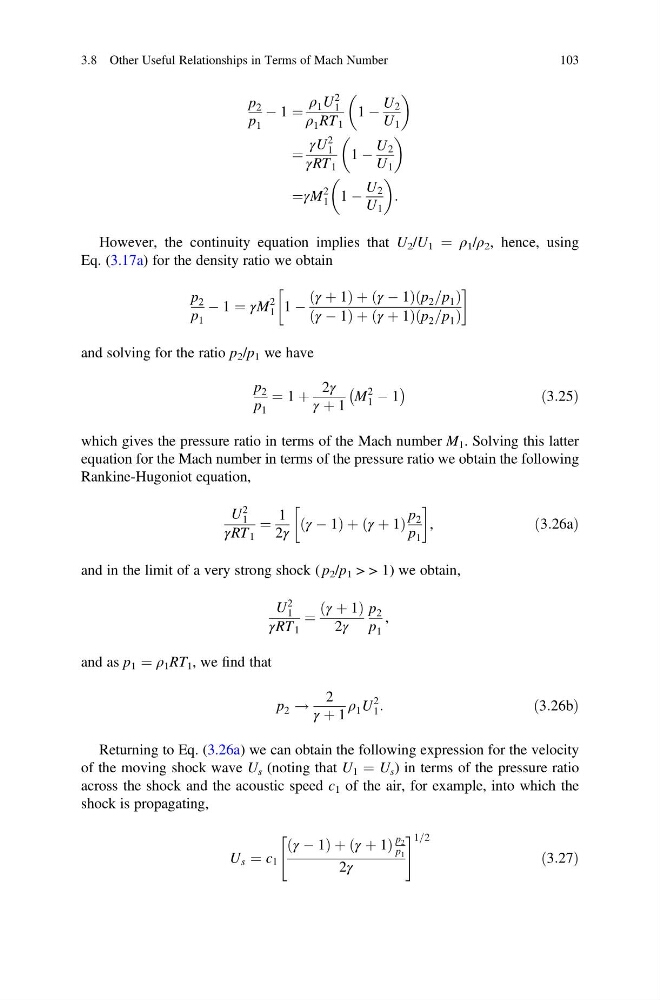
However, the continuity equation implies that U 2 /U 1 ¼ ρ 1 /ρ 2 , hence, using
Eq. (3.17a) for the density ratio we obtain
p 2
p 1
À 1 ¼ γM
2
1 1 À
γ þ 1
ð
Þþ γ À 1
ð
Þ p 2 =p 1
ð
Þ
γ À 1
ð
Þþ γ þ 1
ð
Þ p 2 =p 1
ð
Þ
!
and solving for the ratio p 2 /p 1 we have
p 2
p 1
¼ 1 þ
2γ
γ þ 1
M
2
1 À 1
À
Á
ð3:25Þ
which gives the pressure ratio in terms of the Mach number M 1 . Solving this latter
equation for the Mach number in terms of the pressure ratio we obtain the following
Rankine-Hugoniot equation,
U
2
1
γRT 1
¼
1
2γ
γ À 1
ð
Þþ γ þ 1
ð
Þ
p 2
p 1
!
,
ð3:26aÞ
and in the limit of a very strong shock ( p 2 /p 1 > > 1) we obtain,
U
2
1
γRT 1
¼
γ þ 1
ð
Þ
2γ
p 2
p 1
,
and as p 1 ¼ ρ 1 RT 1 , we find that
p 2 !
2
γ þ 1
ρ 1 U
2
1 :
ð3:26bÞ
Returning to Eq. (3.26a) we can obtain the following expression for the velocity
of the moving shock wave U s (noting that U 1 ¼ U s ) in terms of the pressure ratio
across the shock and the acoustic speed c 1 of the air, for example, into which the
shock is propagating,
U s ¼ c 1
γ À 1
ð
Þþ γ þ 1
ð
Þ
p 2
p 1
2γ
"
# 1=2
ð3:27Þ
3.8 Other Useful Relationships in Terms of Mach Number
103
p 1
À 1 ¼
ρ 1 U
2
1
ρ 1 RT 1
1 À
U 2
U 1
¼
γU
2
1
γRT 1
1 À
U 2
U 1
¼γM
2
1 1 À
U 2
U 1
:
However, the continuity equation implies that U 2 /U 1 ¼ ρ 1 /ρ 2 , hence, using
Eq. (3.17a) for the density ratio we obtain
p 2
p 1
À 1 ¼ γM
2
1 1 À
γ þ 1
ð
Þþ γ À 1
ð
Þ p 2 =p 1
ð
Þ
γ À 1
ð
Þþ γ þ 1
ð
Þ p 2 =p 1
ð
Þ
!
and solving for the ratio p 2 /p 1 we have
p 2
p 1
¼ 1 þ
2γ
γ þ 1
M
2
1 À 1
À
Á
ð3:25Þ
which gives the pressure ratio in terms of the Mach number M 1 . Solving this latter
equation for the Mach number in terms of the pressure ratio we obtain the following
Rankine-Hugoniot equation,
U
2
1
γRT 1
¼
1
2γ
γ À 1
ð
Þþ γ þ 1
ð
Þ
p 2
p 1
!
,
ð3:26aÞ
and in the limit of a very strong shock ( p 2 /p 1 > > 1) we obtain,
U
2
1
γRT 1
¼
γ þ 1
ð
Þ
2γ
p 2
p 1
,
and as p 1 ¼ ρ 1 RT 1 , we find that
p 2 !
2
γ þ 1
ρ 1 U
2
1 :
ð3:26bÞ
Returning to Eq. (3.26a) we can obtain the following expression for the velocity
of the moving shock wave U s (noting that U 1 ¼ U s ) in terms of the pressure ratio
across the shock and the acoustic speed c 1 of the air, for example, into which the
shock is propagating,
U s ¼ c 1
γ À 1
ð
Þþ γ þ 1
ð
Þ
p 2
p 1
2γ
"
# 1=2
ð3:27Þ
3.8 Other Useful Relationships in Terms of Mach Number
103