

Similarly, using Eq. (3.17a) that relates the pressure ratio to the density ratio we
can establish the following relationship;
ρ 2
ρ 1
¼
γ þ 1
ð
ÞM
2
1
γ À 1
ð
ÞM
2
1 þ 2
Â
Ã
ð3:28Þ
and, in addition, one can also show that
T 2
T 1
¼
2γM
2
1 À γ À 1
ð
Þ
Â
à γ À 1
ð
ÞM
2
1 þ 2
Â
Ã
γ þ 1
ð
Þ
2 M
2
1
ð3:29Þ
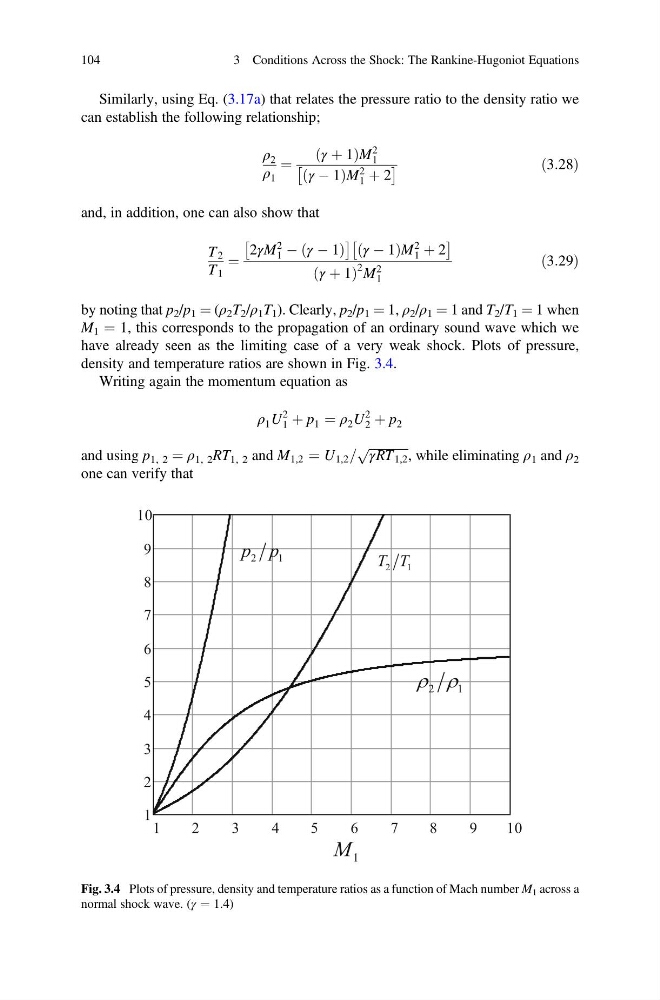
by noting that p 2 /p 1 ¼ (ρ 2 T 2 /ρ 1 T 1 ). Clearly, p 2 /p 1 ¼ 1, ρ 2 /ρ 1 ¼ 1 and T 2 /T 1 ¼ 1 when
M 1 ¼ 1, this corresponds to the propagation of an ordinary sound wave which we
have already seen as the limiting case of a very weak shock. Plots of pressure,
density and temperature ratios are shown in Fig. 3.4.
Writing again the momentum equation as
ρ 1 U
2
1 þ p 1 ¼ ρ 2 U
2
2 þ p 2
and using p 1, 2 ¼ ρ 1, 2 RT 1, 2 and M 1,2 ¼ U 1,2 =
ffiffiffiffiffiffiffiffiffiffiffiffiffi
γRT 1,2
p
, while eliminating ρ 1 and ρ 2
one can verify that
Fig. 3.4 Plots of pressure, density and temperature ratios as a function of Mach number M 1 across a
normal shock wave. (γ ¼ 1.4)
104
3 Conditions Across the Shock: The Rankine-Hugoniot Equations
can establish the following relationship;
ρ 2
ρ 1
¼
γ þ 1
ð
ÞM
2
1
γ À 1
ð
ÞM
2
1 þ 2
Â
Ã
ð3:28Þ
and, in addition, one can also show that
T 2
T 1
¼
2γM
2
1 À γ À 1
ð
Þ
Â
à γ À 1
ð
ÞM
2
1 þ 2
Â
Ã
γ þ 1
ð
Þ
2 M
2
1
ð3:29Þ
by noting that p 2 /p 1 ¼ (ρ 2 T 2 /ρ 1 T 1 ). Clearly, p 2 /p 1 ¼ 1, ρ 2 /ρ 1 ¼ 1 and T 2 /T 1 ¼ 1 when
M 1 ¼ 1, this corresponds to the propagation of an ordinary sound wave which we
have already seen as the limiting case of a very weak shock. Plots of pressure,
density and temperature ratios are shown in Fig. 3.4.
Writing again the momentum equation as
ρ 1 U
2
1 þ p 1 ¼ ρ 2 U
2
2 þ p 2
and using p 1, 2 ¼ ρ 1, 2 RT 1, 2 and M 1,2 ¼ U 1,2 =
ffiffiffiffiffiffiffiffiffiffiffiffiffi
γRT 1,2
p
, while eliminating ρ 1 and ρ 2
one can verify that
Fig. 3.4 Plots of pressure, density and temperature ratios as a function of Mach number M 1 across a
normal shock wave. (γ ¼ 1.4)
104
3 Conditions Across the Shock: The Rankine-Hugoniot Equations