

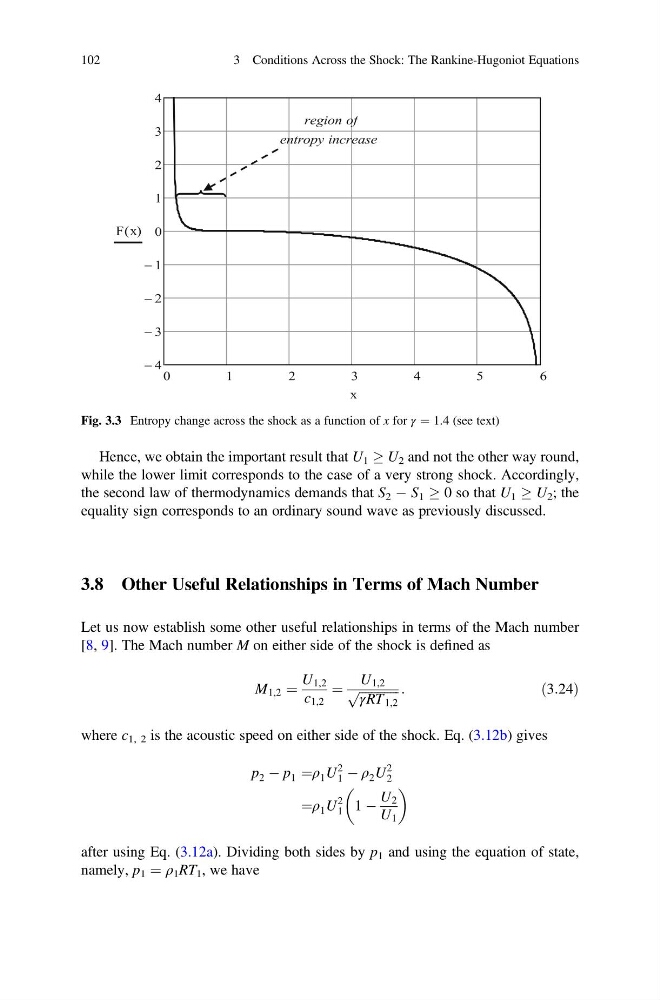
Hence, we obtain the important result that U 1 ! U 2 and not the other way round,
while the lower limit corresponds to the case of a very strong shock. Accordingly,
the second law of thermodynamics demands that S 2 À S 1 ! 0 so that U 1 ! U 2 ; the
equality sign corresponds to an ordinary sound wave as previously discussed.
3.8 Other Useful Relationships in Terms of Mach Number
Let us now establish some other useful relationships in terms of the Mach number
[8, 9]. The Mach number M on either side of the shock is defined as
M 1,2 ¼
U 1,2
c 1,2
¼
U 1,2
ffiffiffiffiffiffiffiffiffiffiffiffiffi
γRT 1,2
p
:
ð3:24Þ
where c 1, 2 is the acoustic speed on either side of the shock. Eq. (3.12b) gives
p 2 À p 1 ¼ρ 1 U
2
1 À ρ 2 U
2
2
¼ρ 1 U
2
1 1 À
U 2
U 1
after using Eq. (3.12a). Dividing both sides by p 1 and using the equation of state,
namely, p 1 ¼ ρ 1 RT 1 , we have
Fig. 3.3 Entropy change across the shock as a function of x for γ ¼ 1.4 (see text)
102
3 Conditions Across the Shock: The Rankine-Hugoniot Equations
while the lower limit corresponds to the case of a very strong shock. Accordingly,
the second law of thermodynamics demands that S 2 À S 1 ! 0 so that U 1 ! U 2 ; the
equality sign corresponds to an ordinary sound wave as previously discussed.
3.8 Other Useful Relationships in Terms of Mach Number
Let us now establish some other useful relationships in terms of the Mach number
[8, 9]. The Mach number M on either side of the shock is defined as
M 1,2 ¼
U 1,2
c 1,2
¼
U 1,2
ffiffiffiffiffiffiffiffiffiffiffiffiffi
γRT 1,2
p
:
ð3:24Þ
where c 1, 2 is the acoustic speed on either side of the shock. Eq. (3.12b) gives
p 2 À p 1 ¼ρ 1 U
2
1 À ρ 2 U
2
2
¼ρ 1 U
2
1 1 À
U 2
U 1
after using Eq. (3.12a). Dividing both sides by p 1 and using the equation of state,
namely, p 1 ¼ ρ 1 RT 1 , we have
Fig. 3.3 Entropy change across the shock as a function of x for γ ¼ 1.4 (see text)
102
3 Conditions Across the Shock: The Rankine-Hugoniot Equations