

36
CHAPTER 4. THE MAGNETICALLY ORDERED STATE
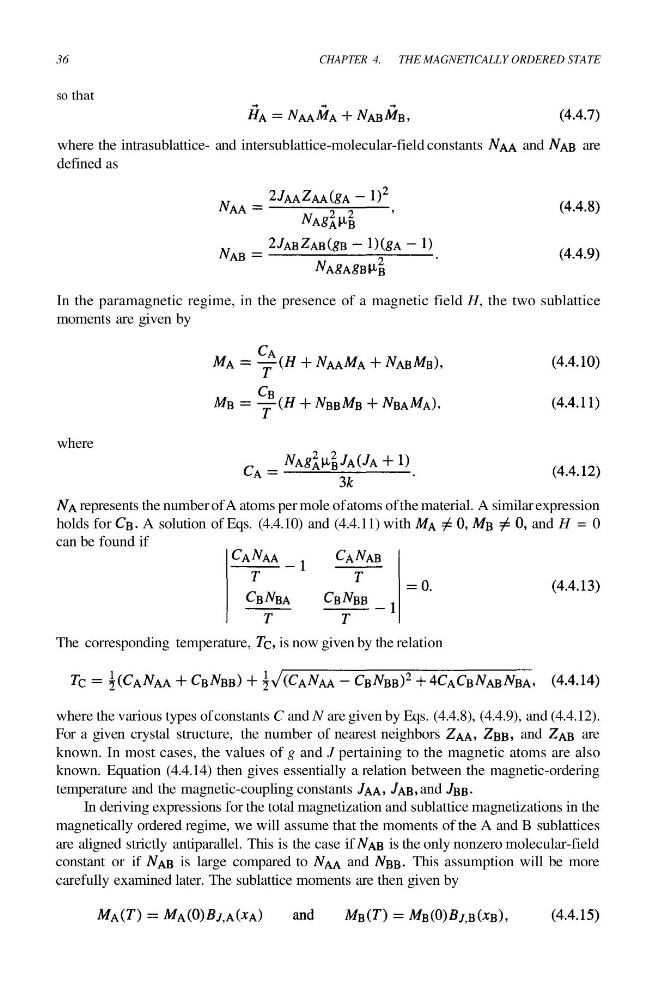
so that
where the intrasublattice- and intersublattice-molecular-field constants
and
are
defined as
In the paramagnetic regime, in the presence of a magnetic field H, the two sublattice
moments are given by
where
H = 0
represents the number of A atoms per mole of atoms of the material. A similar expression
holds for
A solution of Eqs. (4.4.10) and (4.4.11) with
and
can be found if
The corresponding temperature,
is now given by the relation
where the various types of constants C and N are given by Eqs. (4.4.8), (4.4.9), and (4.4.12).
For a given crystal structure, the number of nearest neighbors
known. In most cases, the values of g and J pertaining to the magnetic atoms are also
known. Equation (4.4.14) then gives essentially a relation between the magnetic-ordering
temperature and the magnetic-coupling constants
and
and
are
In deriving expressions for the total magnetization and sublattice magnetizations in the
magnetically ordered regime, we will assume that the moments of the A and B sublattices
are aligned strictly antiparallel. This is the case if
is the only nonzero molecular-field
constant or if
is large compared to
and
This assumption will be more
carefully examined later. The sublattice moments are then given by
CHAPTER 4. THE MAGNETICALLY ORDERED STATE
so that
where the intrasublattice- and intersublattice-molecular-field constants
and
are
defined as
In the paramagnetic regime, in the presence of a magnetic field H, the two sublattice
moments are given by
where
H = 0
represents the number of A atoms per mole of atoms of the material. A similar expression
holds for
A solution of Eqs. (4.4.10) and (4.4.11) with
and
can be found if
The corresponding temperature,
is now given by the relation
where the various types of constants C and N are given by Eqs. (4.4.8), (4.4.9), and (4.4.12).
For a given crystal structure, the number of nearest neighbors
known. In most cases, the values of g and J pertaining to the magnetic atoms are also
known. Equation (4.4.14) then gives essentially a relation between the magnetic-ordering
temperature and the magnetic-coupling constants
and
and
are
In deriving expressions for the total magnetization and sublattice magnetizations in the
magnetically ordered regime, we will assume that the moments of the A and B sublattices
are aligned strictly antiparallel. This is the case if
is the only nonzero molecular-field
constant or if
is large compared to
and
This assumption will be more
carefully examined later. The sublattice moments are then given by