

37
SECTION 4.4. FERRIMAGNETISM
where
and
are the Brillouin functions corresponding to the quantum
numbers
and
respectively, and where
It is to be noted that the two expressions for
and
in Eq. (4.4.15) are coupled
equations since
The applied field H is assumed to be zero in Eqs. (4.4.17) and (4.4.18), since we are
interested in the spontaneous moment
The temperature dependence of
can
be derived from the expression
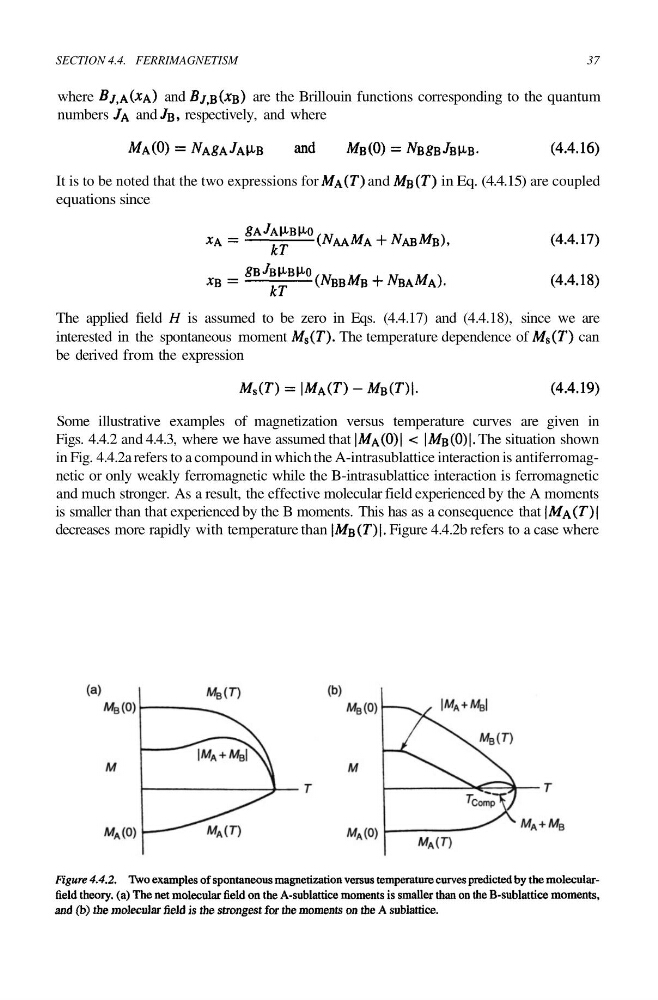
Some illustrative examples of magnetization versus temperature curves are given in
Figs. 4.4.2 and 4.4.3, where we have assumed that
The situation shown
in Fig. 4.4.2a refers to a compound in which the A-intrasublattice interaction is antiferromagnetic or only weakly ferromagnetic while the B-intrasublattice interaction is ferromagnetic
and much stronger. As a result, the effective molecular field experienced by the A moments
is smaller than that experienced by the B moments. This has as a consequence that
decreases more rapidly with temperature than
Figure 4.4.2b refers to a case where
SECTION 4.4. FERRIMAGNETISM
where
and
are the Brillouin functions corresponding to the quantum
numbers
and
respectively, and where
It is to be noted that the two expressions for
and
in Eq. (4.4.15) are coupled
equations since
The applied field H is assumed to be zero in Eqs. (4.4.17) and (4.4.18), since we are
interested in the spontaneous moment
The temperature dependence of
can
be derived from the expression
Some illustrative examples of magnetization versus temperature curves are given in
Figs. 4.4.2 and 4.4.3, where we have assumed that
The situation shown
in Fig. 4.4.2a refers to a compound in which the A-intrasublattice interaction is antiferromagnetic or only weakly ferromagnetic while the B-intrasublattice interaction is ferromagnetic
and much stronger. As a result, the effective molecular field experienced by the A moments
is smaller than that experienced by the B moments. This has as a consequence that
decreases more rapidly with temperature than
Figure 4.4.2b refers to a case where