

35
SECTION 4.4. FERR1MAGNET1SM
In general,
and
are positive quantities but this is not strictly necessary. For instance,
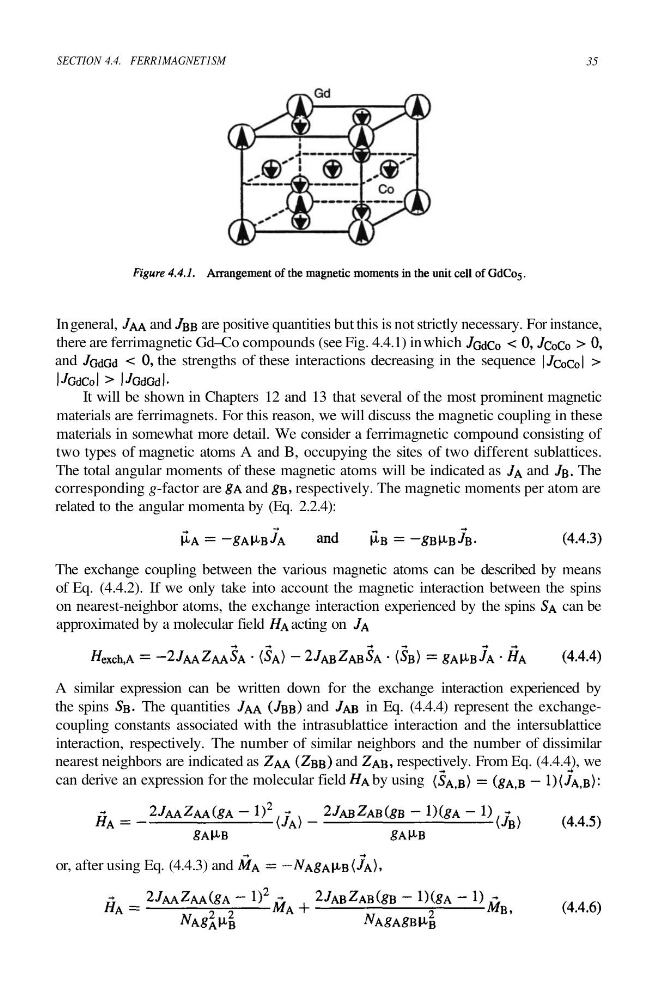
there are ferrimagnetic Gd–Co compounds (see Fig. 4.4.1) in which
and
the strengths of these interactions decreasing in the sequence
It will be shown in Chapters 12 and 13 that several of the most prominent magnetic
materials are ferrimagnets. For this reason, we will discuss the magnetic coupling in these
materials in somewhat more detail. We consider a ferrimagnetic compound consisting of
two types of magnetic atoms A and B, occupying the sites of two different sublattices.
The total angular moments of these magnetic atoms will be indicated as
and
The
corresponding g-factor are
and
respectively. The magnetic moments per atom are
related to the angular momenta by (Eq. 2.2.4):
The exchange coupling between the various magnetic atoms can be described by means
of Eq. (4.4.2). If we only take into account the magnetic interaction between the spins
on nearest-neighbor atoms, the exchange interaction experienced by the spins
can be
approximated by a molecular field
acting on
A similar expression can be written down for the exchange interaction experienced by
the spins
The quantities
and
in Eq. (4.4.4) represent the exchangecoupling constants associated with the intrasublattice interaction and the intersublattice
interaction, respectively. The number of similar neighbors and the number of dissimilar
nearest neighbors are indicated as
and
respectively. From Eq. (4.4.4), we
can derive an expression for the molecular field
by using
or, after using Eq. (4.4.3) and
SECTION 4.4. FERR1MAGNET1SM
In general,
and
are positive quantities but this is not strictly necessary. For instance,
there are ferrimagnetic Gd–Co compounds (see Fig. 4.4.1) in which
and
the strengths of these interactions decreasing in the sequence
It will be shown in Chapters 12 and 13 that several of the most prominent magnetic
materials are ferrimagnets. For this reason, we will discuss the magnetic coupling in these
materials in somewhat more detail. We consider a ferrimagnetic compound consisting of
two types of magnetic atoms A and B, occupying the sites of two different sublattices.
The total angular moments of these magnetic atoms will be indicated as
and
The
corresponding g-factor are
and
respectively. The magnetic moments per atom are
related to the angular momenta by (Eq. 2.2.4):
The exchange coupling between the various magnetic atoms can be described by means
of Eq. (4.4.2). If we only take into account the magnetic interaction between the spins
on nearest-neighbor atoms, the exchange interaction experienced by the spins
can be
approximated by a molecular field
acting on
A similar expression can be written down for the exchange interaction experienced by
the spins
The quantities
and
in Eq. (4.4.4) represent the exchangecoupling constants associated with the intrasublattice interaction and the intersublattice
interaction, respectively. The number of similar neighbors and the number of dissimilar
nearest neighbors are indicated as
and
respectively. From Eq. (4.4.4), we
can derive an expression for the molecular field
by using
or, after using Eq. (4.4.3) and