

117
SECTION 12.5. MAGNETIC ANISOTROPY AND EXCHANGE COUPLING
crystal-field parameter
is positive. Using Eq. (12.5.2) and the data listed in Table 5.2.1,
one finds
This shows that only
compounds with the former six elements can be regarded
as suitable for permanent magnets. However, for strong magnets one needs a high magnetization. This is realized only if the moments of the R atoms are parallel to the moments
of the Fe atoms, meaning that the R-sublattice magnetization must be coupled parallel to
the Fe-sublattice magnetization. Numerous experimental investigations and band-structure
calculations have shown that the magnetic-coupling constant describing the magnetic coupling between these two sublattices equals about
Substituting
this value for
in Eq. (4.4.9), together with
and the values listed for
in Table 2.2.1, one finds that
for R = Ce, Pr, and Nd, but that
for R = Tb, Dy, and Ho. For
compounds with the latter three
elements, the moments of the two magnetic sublattices point in opposite directions and
consequently lead to a total magnetization value which is too low for permanent magnets.
Let us now turn to the three remaining compounds
and
Cerium is known to have an unstable valence. The reason for this is that it
has only one 4f electron in the trivalent state (see Table 2.1.1). In metallic systems, an electronic configuration of lower energy can often be reached when this electron is promoted to
the conduction band, whereby the Ce ion adopts the tetravalent state. This usually happens
when Ce is combined with 3d transition metals. For the Ce ion, the loss of its 4f electron
implies the loss of its localized 4f moment and the corresponding rare-earth-ion anisotropy.
The magnetic anisotropy in
is therefore only due to the Fe sublattice, which is
too small for permanent-magnet applications.
Most of the powerful modern permanent-magnet materials are based on
The reason why
has not qualified is not a physical one. The natural abundance of
Pr is much lower than that of Nd which implies that the price of the former is higher than
that of the latter and consequently hampers large-scale industrial applications of
The above discussion may have shown which arguments are behind the remarkable fact
that for a given technological application only one out of the 15 available rare-earth elements
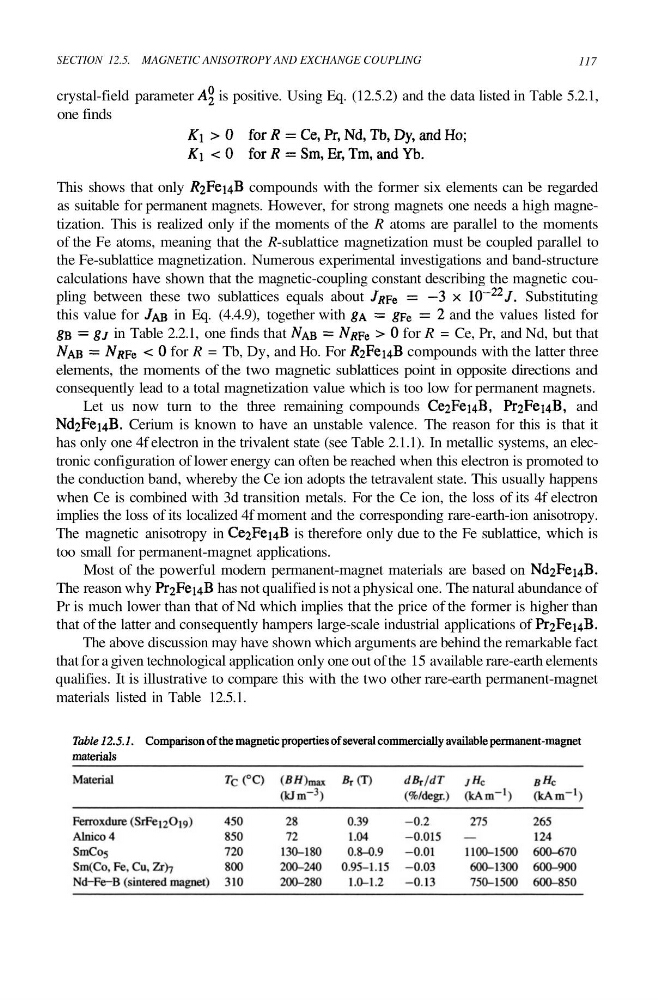
qualifies. It is illustrative to compare this with the two other rare-earth permanent-magnet
materials listed in Table 12.5.1.
SECTION 12.5. MAGNETIC ANISOTROPY AND EXCHANGE COUPLING
crystal-field parameter
is positive. Using Eq. (12.5.2) and the data listed in Table 5.2.1,
one finds
This shows that only
compounds with the former six elements can be regarded
as suitable for permanent magnets. However, for strong magnets one needs a high magnetization. This is realized only if the moments of the R atoms are parallel to the moments
of the Fe atoms, meaning that the R-sublattice magnetization must be coupled parallel to
the Fe-sublattice magnetization. Numerous experimental investigations and band-structure
calculations have shown that the magnetic-coupling constant describing the magnetic coupling between these two sublattices equals about
Substituting
this value for
in Eq. (4.4.9), together with
and the values listed for
in Table 2.2.1, one finds that
for R = Ce, Pr, and Nd, but that
for R = Tb, Dy, and Ho. For
compounds with the latter three
elements, the moments of the two magnetic sublattices point in opposite directions and
consequently lead to a total magnetization value which is too low for permanent magnets.
Let us now turn to the three remaining compounds
and
Cerium is known to have an unstable valence. The reason for this is that it
has only one 4f electron in the trivalent state (see Table 2.1.1). In metallic systems, an electronic configuration of lower energy can often be reached when this electron is promoted to
the conduction band, whereby the Ce ion adopts the tetravalent state. This usually happens
when Ce is combined with 3d transition metals. For the Ce ion, the loss of its 4f electron
implies the loss of its localized 4f moment and the corresponding rare-earth-ion anisotropy.
The magnetic anisotropy in
is therefore only due to the Fe sublattice, which is
too small for permanent-magnet applications.
Most of the powerful modern permanent-magnet materials are based on
The reason why
has not qualified is not a physical one. The natural abundance of
Pr is much lower than that of Nd which implies that the price of the former is higher than
that of the latter and consequently hampers large-scale industrial applications of
The above discussion may have shown which arguments are behind the remarkable fact
that for a given technological application only one out of the 15 available rare-earth elements
qualifies. It is illustrative to compare this with the two other rare-earth permanent-magnet
materials listed in Table 12.5.1.