

116
CHAPTER 12. PERMANENT MAGNETS
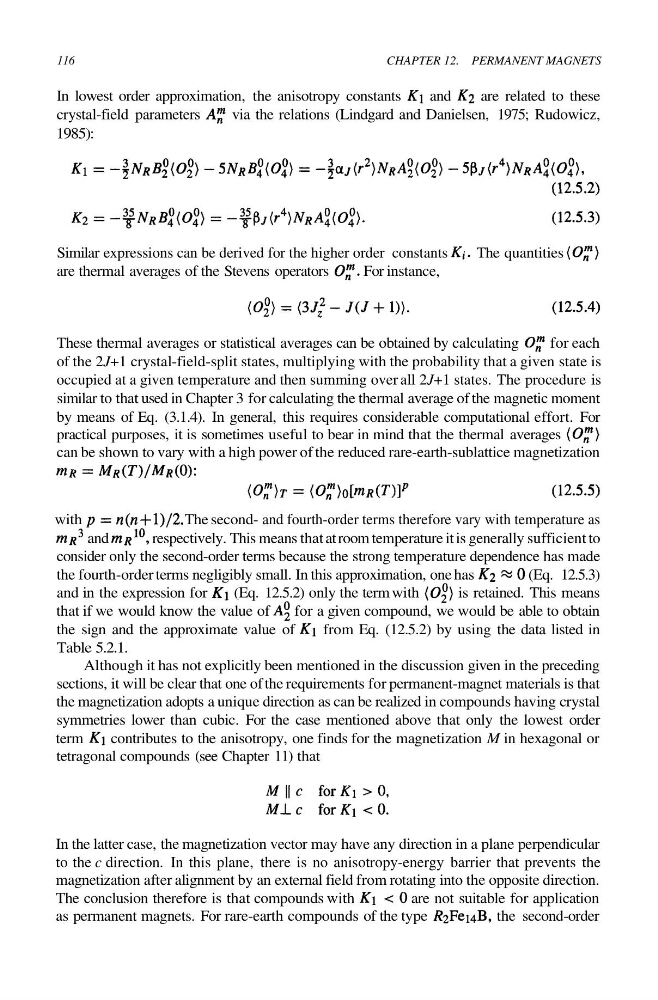
In lowest order approximation, the anisotropy constants
and
are related to these
crystal-field parameters
via the relations (Lindgard and Danielsen, 1975; Rudowicz,
1985):
Similar expressions can be derived for the higher order constants
The quantities
are thermal averages of the Stevens operators
For instance,
These thermal averages or statistical averages can be obtained by calculating
for each
of the 2J+1 crystal-field-split states, multiplying with the probability that a given state is
occupied at a given temperature and then summing over all 2J+1 states. The procedure is
similar to that used in Chapter 3 for calculating the thermal average of the magnetic moment
practical purposes, it is sometimes useful to bear in mind that the thermal averages
can be shown to vary with a high power of the reduced rare-earth-sublattice magnetization
by means of Eq. (3.1.4). In general, this requires considerable computational effort. For
with
and fourth-order terms therefore vary with temperature as
The secondand
respectively. This means that at room temperature it is generally sufficient to
consider only the second-order terms because the strong temperature dependence has made
the fourth-order terms negligibly small. In this approximation, one has
(Eq. 12.5.3)
and in the expression for
(Eq. 12.5.2) only the term with
is retained. This means
that if we would know the value of
for a given compound, we would be able to obtain
the sign and the approximate value of
from Eq. (12.5.2) by using the data listed in
Table 5.2.1.
Although it has not explicitly been mentioned in the discussion given in the preceding
sections, it will be clear that one of the requirements for permanent-magnet materials is that
the magnetization adopts a unique direction as can be realized in compounds having crystal
symmetries lower than cubic. For the case mentioned above that only the lowest order
term
contributes to the anisotropy, one finds for the magnetization M in hexagonal or
tetragonal compounds (see Chapter 11) that
In the latter case, the magnetization vector may have any direction in a plane perpendicular
to the c direction. In this plane, there is no anisotropy-energy barrier that prevents the
magnetization after alignment by an external field from rotating into the opposite direction.
The conclusion therefore is that compounds with
are not suitable for application
as permanent magnets. For rare-earth compounds of the type
the second-order
CHAPTER 12. PERMANENT MAGNETS
In lowest order approximation, the anisotropy constants
and
are related to these
crystal-field parameters
via the relations (Lindgard and Danielsen, 1975; Rudowicz,
1985):
Similar expressions can be derived for the higher order constants
The quantities
are thermal averages of the Stevens operators
For instance,
These thermal averages or statistical averages can be obtained by calculating
for each
of the 2J+1 crystal-field-split states, multiplying with the probability that a given state is
occupied at a given temperature and then summing over all 2J+1 states. The procedure is
similar to that used in Chapter 3 for calculating the thermal average of the magnetic moment
practical purposes, it is sometimes useful to bear in mind that the thermal averages
can be shown to vary with a high power of the reduced rare-earth-sublattice magnetization
by means of Eq. (3.1.4). In general, this requires considerable computational effort. For
with
and fourth-order terms therefore vary with temperature as
The secondand
respectively. This means that at room temperature it is generally sufficient to
consider only the second-order terms because the strong temperature dependence has made
the fourth-order terms negligibly small. In this approximation, one has
(Eq. 12.5.3)
and in the expression for
(Eq. 12.5.2) only the term with
is retained. This means
that if we would know the value of
for a given compound, we would be able to obtain
the sign and the approximate value of
from Eq. (12.5.2) by using the data listed in
Table 5.2.1.
Although it has not explicitly been mentioned in the discussion given in the preceding
sections, it will be clear that one of the requirements for permanent-magnet materials is that
the magnetization adopts a unique direction as can be realized in compounds having crystal
symmetries lower than cubic. For the case mentioned above that only the lowest order
term
contributes to the anisotropy, one finds for the magnetization M in hexagonal or
tetragonal compounds (see Chapter 11) that
In the latter case, the magnetization vector may have any direction in a plane perpendicular
to the c direction. In this plane, there is no anisotropy-energy barrier that prevents the
magnetization after alignment by an external field from rotating into the opposite direction.
The conclusion therefore is that compounds with
are not suitable for application
as permanent magnets. For rare-earth compounds of the type
the second-order