

118
CHAPTER 12. PERMANENT MAGNETS
It can be seen in Table 12.5.1 that the advantage of
and
over
is their much higher Curie temperature. These materials are preferred as permanent magnets
in electrical machines having a high use temperature, as in several automotive and aircraft
applications with use temperatures in the range 200–300°C. The reason why, of the
and
series of compounds, only the compounds with R = Sm qualify for permanentmagnet materials can be sketched along the same lines as given above for
Because
is also negative, high total magnetization values are only obtained when R belongs
to the light rare-earth elements. In contradistinction to the crystal structure of the
compounds, one has for the
and
series that
Using again Eq. (12.5.2)
and the data listed in Table 5.2.1, one finds
This leaves R = Sm as the only possible rare-earth element that can be used in
and
permanent magnets.
At temperatures below room temperature it is no longer legitimate to ignore the fourthat room temperature the
value of
order term in Eqs. (12.5.2) and (12.5.3). Although, in
is only approximately 1% of
the fourth-order term will dominate at low
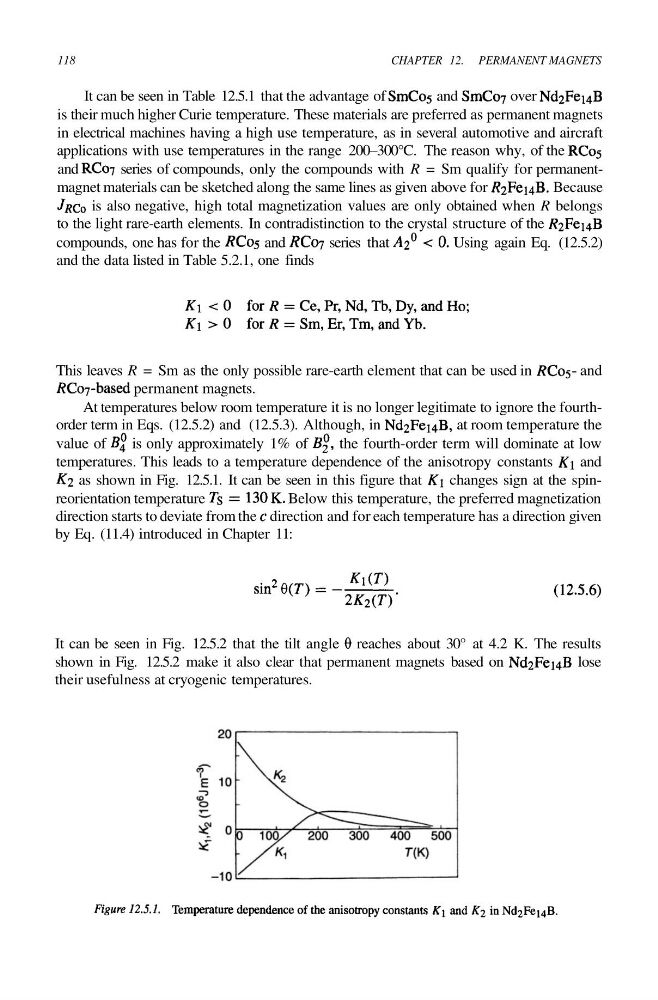
temperatures. This leads to a temperature dependence of the anisotropy constants
and
as shown in Fig. 12.5.1. It can be seen in this figure that
changes sign at the spinreorientation temperature
Below this temperature, the preferred magnetization
direction starts to deviate from the direction and for each temperature has a direction given
by Eq. (11.4) introduced in Chapter 11:
It can be seen in Fig. 12.5.2 that the tilt angle reaches about 30° at 4.2 K. The results
shown in Fig. 12.5.2 make it also clear that permanent magnets based on
their usefulness at cryogenic temperatures.
lose
CHAPTER 12. PERMANENT MAGNETS
It can be seen in Table 12.5.1 that the advantage of
and
over
is their much higher Curie temperature. These materials are preferred as permanent magnets
in electrical machines having a high use temperature, as in several automotive and aircraft
applications with use temperatures in the range 200–300°C. The reason why, of the
and
series of compounds, only the compounds with R = Sm qualify for permanentmagnet materials can be sketched along the same lines as given above for
Because
is also negative, high total magnetization values are only obtained when R belongs
to the light rare-earth elements. In contradistinction to the crystal structure of the
compounds, one has for the
and
series that
Using again Eq. (12.5.2)
and the data listed in Table 5.2.1, one finds
This leaves R = Sm as the only possible rare-earth element that can be used in
and
permanent magnets.
At temperatures below room temperature it is no longer legitimate to ignore the fourthat room temperature the
value of
order term in Eqs. (12.5.2) and (12.5.3). Although, in
is only approximately 1% of
the fourth-order term will dominate at low
temperatures. This leads to a temperature dependence of the anisotropy constants
and
as shown in Fig. 12.5.1. It can be seen in this figure that
changes sign at the spinreorientation temperature
Below this temperature, the preferred magnetization
direction starts to deviate from the direction and for each temperature has a direction given
by Eq. (11.4) introduced in Chapter 11:
It can be seen in Fig. 12.5.2 that the tilt angle reaches about 30° at 4.2 K. The results
shown in Fig. 12.5.2 make it also clear that permanent magnets based on
their usefulness at cryogenic temperatures.
lose