

Elements of Quantum Theory
75
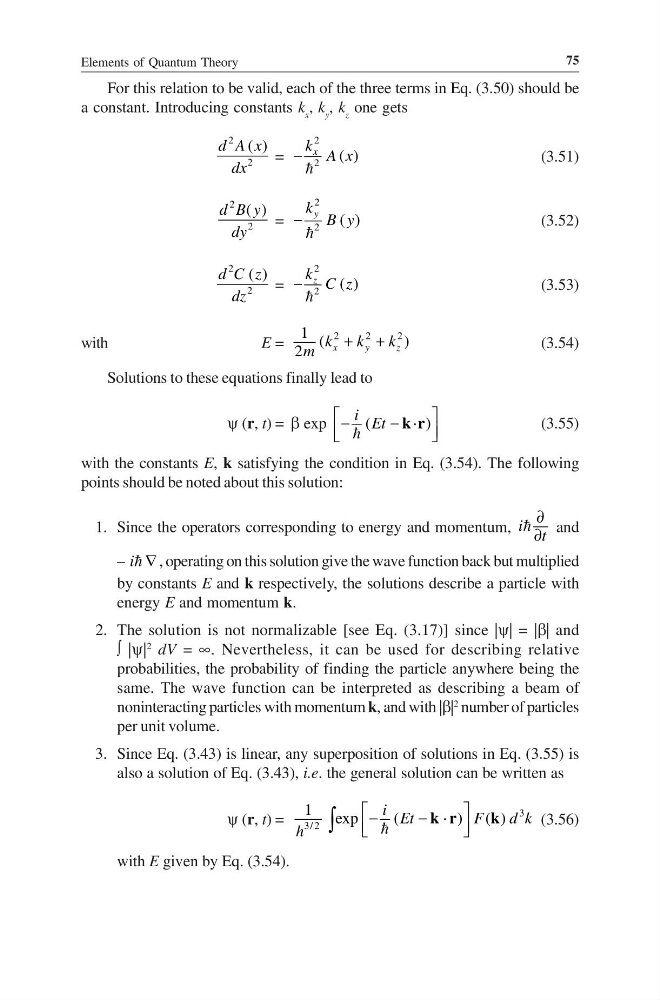
For this relation to be valid, each of the three terms in Eq. (3.50) should be
a constant. Introducing constants k x , k y , k z one gets
2
2
( )
d A x
dx
=
2
2
( )
x
k A x
−
(3.51)
2
2
( )
d B y
dy
=
2
2
( )
y
k B y
−
(3.52)
2
2
( )
d C z
dz
=
2
2
( )
z
k C z
−
(3.53)
with
E =
2
2
2
1 (
)
2
x
y
z
k
k
k
m
+ +
(3.54)
Solutions to these equations finally lead to
ψ (r, t) = β exp
(
)
−
− ⋅
i Et k r
(3.55)
with the constants E, k satisfying the condition in Eq. (3.54). The following
points should be noted about this solution:
1. Since the operators corresponding to energy and momentum, i t
∂
∂
and
– i ∇
, operating on this solution give the wave function back but multiplied
by constants E and k respectively, the solutions describe a particle with
energy E and momentum k.
2. The solution is not normalizable [see Eq. (3.17)] since |ψ| = |β| and
∫ |ψ|
2
dV = ∞. Nevertheless, it can be used for describing relative
probabilities, the probability of finding the particle anywhere being the
same. The wave function can be interpreted as describing a beam of
noninteracting particles with momentum k, and with |β|
2
number of particles
per unit volume.
3. Since Eq. (3.43) is linear, any superposition of solutions in Eq. (3.55) is
also a solution of Eq. (3.43), i.e. the general solution can be written as
ψ (r, t) =
3
3/ 2
1 exp
(
) ( )
−
− ⋅
∫
i Et
F
d k
h
k r
k
(3.56)
with E given by Eq. (3.54).
75
For this relation to be valid, each of the three terms in Eq. (3.50) should be
a constant. Introducing constants k x , k y , k z one gets
2
2
( )
d A x
dx
=
2
2
( )
x
k A x
−
(3.51)
2
2
( )
d B y
dy
=
2
2
( )
y
k B y
−
(3.52)
2
2
( )
d C z
dz
=
2
2
( )
z
k C z
−
(3.53)
with
E =
2
2
2
1 (
)
2
x
y
z
k
k
k
m
+ +
(3.54)
Solutions to these equations finally lead to
ψ (r, t) = β exp
(
)
−
− ⋅
i Et k r
(3.55)
with the constants E, k satisfying the condition in Eq. (3.54). The following
points should be noted about this solution:
1. Since the operators corresponding to energy and momentum, i t
∂
∂
and
– i ∇
, operating on this solution give the wave function back but multiplied
by constants E and k respectively, the solutions describe a particle with
energy E and momentum k.
2. The solution is not normalizable [see Eq. (3.17)] since |ψ| = |β| and
∫ |ψ|
2
dV = ∞. Nevertheless, it can be used for describing relative
probabilities, the probability of finding the particle anywhere being the
same. The wave function can be interpreted as describing a beam of
noninteracting particles with momentum k, and with |β|
2
number of particles
per unit volume.
3. Since Eq. (3.43) is linear, any superposition of solutions in Eq. (3.55) is
also a solution of Eq. (3.43), i.e. the general solution can be written as
ψ (r, t) =
3
3/ 2
1 exp
(
) ( )
−
− ⋅
∫
i Et
F
d k
h
k r
k
(3.56)
with E given by Eq. (3.54).