

Elements of Modern Physics
74
with time (except for the phase factor), this means that the eigenvalues of
B for these states do not change with time, and therefore B is conserved.
The solutions to the Schrödinger equation in some simple situations are now
discussed.
3.5 FREE PARTICLE
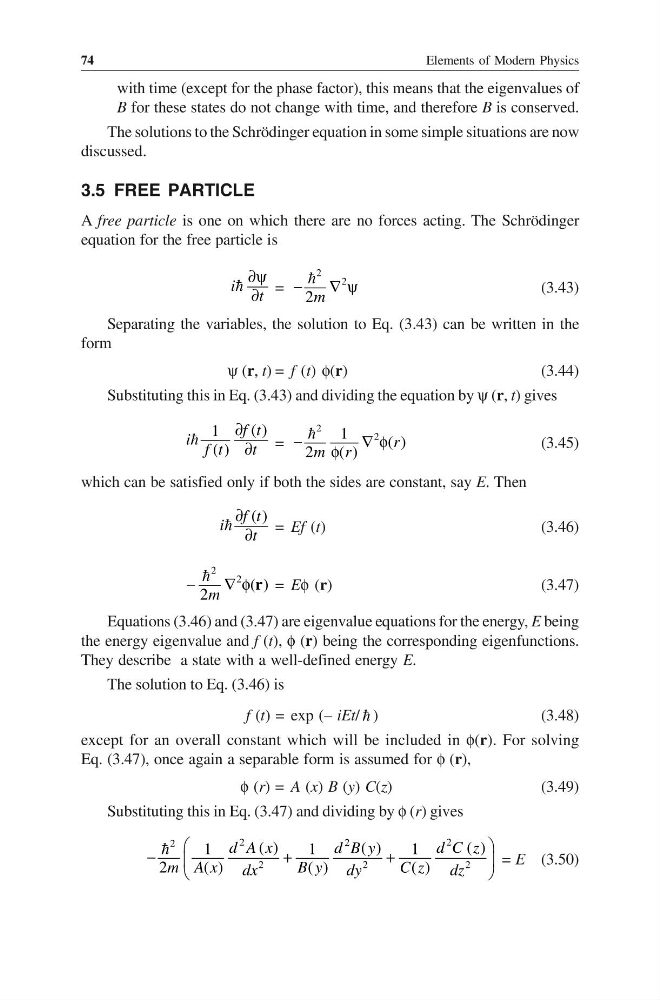
A free particle is one on which there are no forces acting. The Schrödinger
equation for the free particle is
i t
∂ψ
∂
=
2
2
2m
−
∇ ψ
(3.43)
Separating the variables, the solution to Eq. (3.43) can be written in the
form
ψ (r, t) = f (t) φ(r)
(3.44)
Substituting this in Eq. (3.43) and dividing the equation by ψ (r, t) gives
( )
1
( )
f t
i f t
t
∂
∂
=
2
2
1
( )
2
( )
r
m r
−
∇φ
φ
(3.45)
which can be satisfied only if both the sides are constant, say E. Then
( )
f t
i
t
∂
∂
= Ef (t)
(3.46)
2
2 ( )
2
−
∇ φ
m
r = Eφ (r)
(3.47)
Equations (3.46) and (3.47) are eigenvalue equations for the energy, E being
the energy eigenvalue and f (t), φ (r) being the corresponding eigenfunctions.
They describe a state with a well-defined energy E.
The solution to Eq. (3.46) is
f (t) = exp (– iEt/ )
(3.48)
except for an overall constant which will be included in φ(r). For solving
Eq. (3.47), once again a separable form is assumed for φ (r),
φ (r) = A (x) B (y) C(z)
(3.49)
Substituting this in Eq. (3.47) and dividing by φ (r) gives
2
2
2
2
2
2
2
( )
( )
( )
1
1
1
2
( )
( )
( )
d A x
d C z
d B y
m A x
B y
C z
dx
dy
dz
−
+
+
= E (3.50)
74
with time (except for the phase factor), this means that the eigenvalues of
B for these states do not change with time, and therefore B is conserved.
The solutions to the Schrödinger equation in some simple situations are now
discussed.
3.5 FREE PARTICLE
A free particle is one on which there are no forces acting. The Schrödinger
equation for the free particle is
i t
∂ψ
∂
=
2
2
2m
−
∇ ψ
(3.43)
Separating the variables, the solution to Eq. (3.43) can be written in the
form
ψ (r, t) = f (t) φ(r)
(3.44)
Substituting this in Eq. (3.43) and dividing the equation by ψ (r, t) gives
( )
1
( )
f t
i f t
t
∂
∂
=
2
2
1
( )
2
( )
r
m r
−
∇φ
φ
(3.45)
which can be satisfied only if both the sides are constant, say E. Then
( )
f t
i
t
∂
∂
= Ef (t)
(3.46)
2
2 ( )
2
−
∇ φ
m
r = Eφ (r)
(3.47)
Equations (3.46) and (3.47) are eigenvalue equations for the energy, E being
the energy eigenvalue and f (t), φ (r) being the corresponding eigenfunctions.
They describe a state with a well-defined energy E.
The solution to Eq. (3.46) is
f (t) = exp (– iEt/ )
(3.48)
except for an overall constant which will be included in φ(r). For solving
Eq. (3.47), once again a separable form is assumed for φ (r),
φ (r) = A (x) B (y) C(z)
(3.49)
Substituting this in Eq. (3.47) and dividing by φ (r) gives
2
2
2
2
2
2
2
( )
( )
( )
1
1
1
2
( )
( )
( )
d A x
d C z
d B y
m A x
B y
C z
dx
dy
dz
−
+
+
= E (3.50)