

Elements of Modern Physics
76
3.6 WAVE PACKET AND THE UNCERTAINTY PRINCIPLE
A wave packet is superposition, as in Eq. (3.56), of plane-wave solutions with
nearly the same momenta, so as to give a wave function which is localized in
space. Such a wave function may be written in the form
ψ (r, t) =
2
3
0
3/ 2
1
(
)exp
( /2
)
−
−
− ⋅
∫
i
f
k t m
dk
h
k k
k r
(3.57)
where f (k – k 0 ) is significantly nonzero only in a small region about k ≈ k 0 .
There are some general properties of the wave packet which are demonstrated
here by taking the Gaussian form for f (k – k 0 ). For
f (k – k 0 ) =
2
0
3/ 4
3/ 2
2 2
(
)
1
exp
( )
2
−
−
π
b
b
k k
(3.58)
the wave packet ψ (r, t) is obtained from Eq. (3.57) by changing the variable of
integration to q = k – k 0 , and integrating
ψ (r, t) = exp
2
0
0 .
( , )
2
−
−
k
i
t k r u t
m
r
(3.59)
u (r, t) =
2
2
3/ 2
2
0
3/ 4
2
3/ 2
exp
/ (1
/ )
2
(1
/ )
−
−
+
π
+
b
b
t
i tb m
m
it b m
k
r
(3.60)
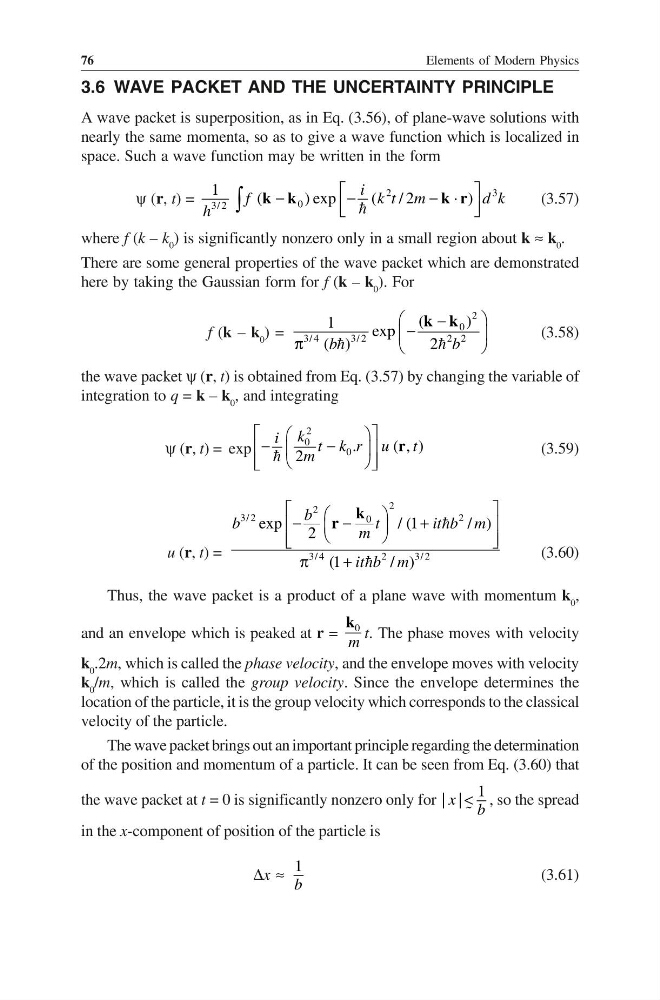
Thus, the wave packet is a product of a plane wave with momentum k 0 ,
and an envelope which is peaked at r =
0
m
k t. The phase moves with velocity
k 0 .2m, which is called the phase velocity, and the envelope moves with velocity
k 0 /m, which is called the group velocity. Since the envelope determines the
location of the particle, it is the group velocity which corresponds to the classical
velocity of the particle.
The wave packet brings out an important principle regarding the determination
of the position and momentum of a particle. It can be seen from Eq. (3.60) that
the wave packet at t = 0 is significantly nonzero only for
1
| |
x b
<
, so the spread
in the x-component of position of the particle is
∆x ≈
1
b
(3.61)
76
3.6 WAVE PACKET AND THE UNCERTAINTY PRINCIPLE
A wave packet is superposition, as in Eq. (3.56), of plane-wave solutions with
nearly the same momenta, so as to give a wave function which is localized in
space. Such a wave function may be written in the form
ψ (r, t) =
2
3
0
3/ 2
1
(
)exp
( /2
)
−
−
− ⋅
∫
i
f
k t m
dk
h
k k
k r
(3.57)
where f (k – k 0 ) is significantly nonzero only in a small region about k ≈ k 0 .
There are some general properties of the wave packet which are demonstrated
here by taking the Gaussian form for f (k – k 0 ). For
f (k – k 0 ) =
2
0
3/ 4
3/ 2
2 2
(
)
1
exp
( )
2
−
−
π
b
b
k k
(3.58)
the wave packet ψ (r, t) is obtained from Eq. (3.57) by changing the variable of
integration to q = k – k 0 , and integrating
ψ (r, t) = exp
2
0
0 .
( , )
2
−
−
k
i
t k r u t
m
r
(3.59)
u (r, t) =
2
2
3/ 2
2
0
3/ 4
2
3/ 2
exp
/ (1
/ )
2
(1
/ )
−
−
+
π
+
b
b
t
i tb m
m
it b m
k
r
(3.60)
Thus, the wave packet is a product of a plane wave with momentum k 0 ,
and an envelope which is peaked at r =
0
m
k t. The phase moves with velocity
k 0 .2m, which is called the phase velocity, and the envelope moves with velocity
k 0 /m, which is called the group velocity. Since the envelope determines the
location of the particle, it is the group velocity which corresponds to the classical
velocity of the particle.
The wave packet brings out an important principle regarding the determination
of the position and momentum of a particle. It can be seen from Eq. (3.60) that
the wave packet at t = 0 is significantly nonzero only for
1
| |
x b
<
, so the spread
in the x-component of position of the particle is
∆x ≈
1
b
(3.61)