

Elements of Modern Physics
68
be predicted precisely, in a single observation. Only a probabilistic prediction
can be made that if the experiment is repeated a large number of times, the
frequency of a particle being found in different regions is proportional to the
square of the wave function associated with each particle. The inability, in general,
to predict the results of individual events is inherent in quantum mechanics and
is called the principle of indeterminacy.
The main problem in quantum mechanics is the determination of the wave
function. For obtaining the rules which govern the determination of the wave
function, we again invoke our experience with wave functions which describe
radiation and therefore, photons. It was shown in Chapter 1 that the scalar and
vector fields of electromagnetic radiation in a region where there are no sources,
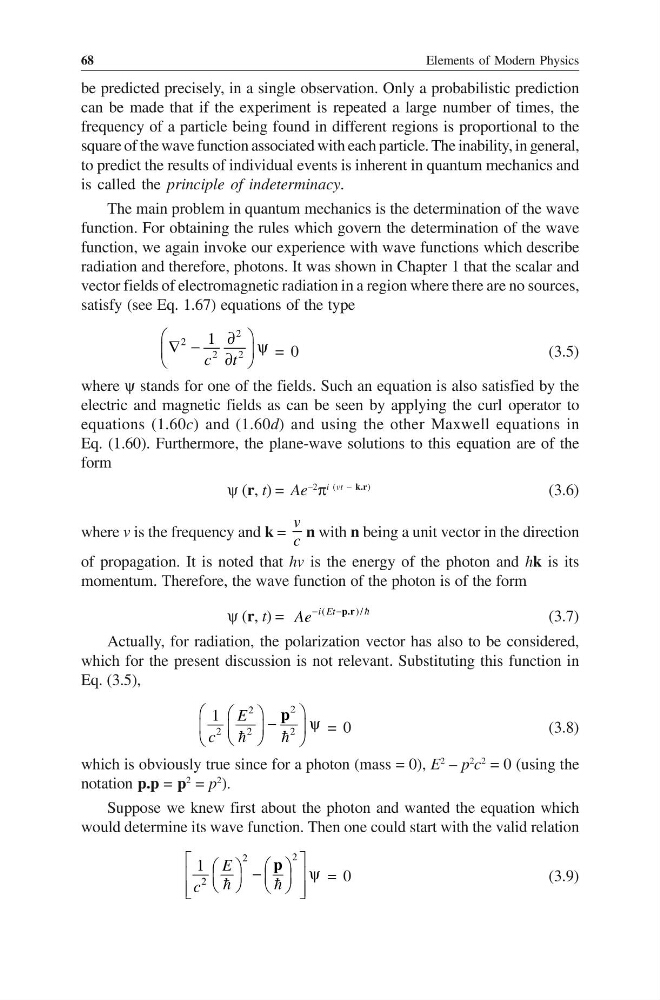
satisfy (see Eq. 1.67) equations of the type
2
2
2
2
1
c t
∂
∇ −
ψ
∂
= 0
(3.5)
where ψ stands for one of the fields. Such an equation is also satisfied by the
electric and magnetic fields as can be seen by applying the curl operator to
equations (1.60c) and (1.60d) and using the other Maxwell equations in
Eq. (1.60). Furthermore, the plane-wave solutions to this equation are of the
form
ψ (r, t) = Ae
–2
π
i (vt – k.r)
(3.6)
where v is the frequency and k =
v
c
n with n being a unit vector in the direction
of propagation. It is noted that hv is the energy of the photon and hk is its
momentum. Therefore, the wave function of the photon is of the form
ψ (r, t) =
(
) /
−
−
i Et
Ae
p.r
(3.7)
Actually, for radiation, the polarization vector has also to be considered,
which for the present discussion is not relevant. Substituting this function in
Eq. (3.5),
2
2
2
2
2
1
−
ψ
E
c
p
= 0
(3.8)
which is obviously true since for a photon (mass = 0), E
2
– p
2
c
2
= 0 (using the
notation p.p = p
2
= p
2
).
Suppose we knew first about the photon and wanted the equation which
would determine its wave function. Then one could start with the valid relation
2
2
2
1
−
ψ
E
c
p
= 0
(3.9)
68
be predicted precisely, in a single observation. Only a probabilistic prediction
can be made that if the experiment is repeated a large number of times, the
frequency of a particle being found in different regions is proportional to the
square of the wave function associated with each particle. The inability, in general,
to predict the results of individual events is inherent in quantum mechanics and
is called the principle of indeterminacy.
The main problem in quantum mechanics is the determination of the wave
function. For obtaining the rules which govern the determination of the wave
function, we again invoke our experience with wave functions which describe
radiation and therefore, photons. It was shown in Chapter 1 that the scalar and
vector fields of electromagnetic radiation in a region where there are no sources,
satisfy (see Eq. 1.67) equations of the type
2
2
2
2
1
c t
∂
∇ −
ψ
∂
= 0
(3.5)
where ψ stands for one of the fields. Such an equation is also satisfied by the
electric and magnetic fields as can be seen by applying the curl operator to
equations (1.60c) and (1.60d) and using the other Maxwell equations in
Eq. (1.60). Furthermore, the plane-wave solutions to this equation are of the
form
ψ (r, t) = Ae
–2
π
i (vt – k.r)
(3.6)
where v is the frequency and k =
v
c
n with n being a unit vector in the direction
of propagation. It is noted that hv is the energy of the photon and hk is its
momentum. Therefore, the wave function of the photon is of the form
ψ (r, t) =
(
) /
−
−
i Et
Ae
p.r
(3.7)
Actually, for radiation, the polarization vector has also to be considered,
which for the present discussion is not relevant. Substituting this function in
Eq. (3.5),
2
2
2
2
2
1
−
ψ
E
c
p
= 0
(3.8)
which is obviously true since for a photon (mass = 0), E
2
– p
2
c
2
= 0 (using the
notation p.p = p
2
= p
2
).
Suppose we knew first about the photon and wanted the equation which
would determine its wave function. Then one could start with the valid relation
2
2
2
1
−
ψ
E
c
p
= 0
(3.9)