

Elements of Quantum Theory
67
coherent waves coming from S 1 and S 2 , and the intensity at a point on the
screen is given by the modulus squared of the resultant amplitude:
I = |ψ (S 1 ) + ψ (S 2 )| 2
(3.1)
=
1
2
2 ( – / )
2 (
/ ) 2
|
|
π
λ
π
− λ
+
i vt l
i vt l
Ae
Ae
(3.2)
where v is the frequency, λ is the wavelength, and l 1 and l 2 are the distances of
the point on the screen from the two slits. Therefore, the intensity of the
interference pattern at any point is given by
I =
2
2
4 | | cos
ax
A
d
π
λ
(3.3)
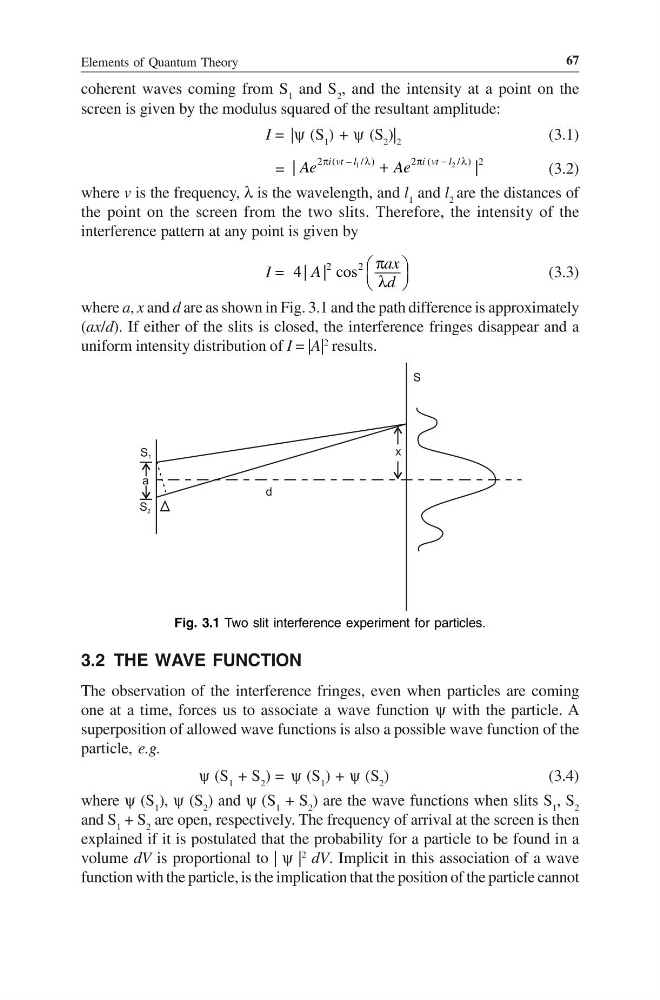
where a, x and d are as shown in Fig. 3.1 and the path difference is approximately
(ax/d). If either of the slits is closed, the interference fringes disappear and a
uniform intensity distribution of I = |A|
2
results.
S 1
S 2
a
d
x
S
Fig. 3.1 Two slit interference experiment for particles.
3.2 THE WAVE FUNCTION
The observation of the interference fringes, even when particles are coming
one at a time, forces us to associate a wave function ψ with the particle. A
superposition of allowed wave functions is also a possible wave function of the
particle, e.g.
ψ (S 1 + S 2 ) = ψ (S 1 ) + ψ (S 2 )
(3.4)
where ψ (S 1 ), ψ (S 2 ) and ψ (S 1 + S 2 ) are the wave functions when slits S 1 , S 2
and S 1 + S 2 are open, respectively. The frequency of arrival at the screen is then
explained if it is postulated that the probability for a particle to be found in a
volume dV is proportional to | ψ |
2
dV. Implicit in this association of a wave
function with the particle, is the implication that the position of the particle cannot
67
coherent waves coming from S 1 and S 2 , and the intensity at a point on the
screen is given by the modulus squared of the resultant amplitude:
I = |ψ (S 1 ) + ψ (S 2 )| 2
(3.1)
=
1
2
2 ( – / )
2 (
/ ) 2
|
|
π
λ
π
− λ
+
i vt l
i vt l
Ae
Ae
(3.2)
where v is the frequency, λ is the wavelength, and l 1 and l 2 are the distances of
the point on the screen from the two slits. Therefore, the intensity of the
interference pattern at any point is given by
I =
2
2
4 | | cos
ax
A
d
π
λ
(3.3)
where a, x and d are as shown in Fig. 3.1 and the path difference is approximately
(ax/d). If either of the slits is closed, the interference fringes disappear and a
uniform intensity distribution of I = |A|
2
results.
S 1
S 2
a
d
x
S
Fig. 3.1 Two slit interference experiment for particles.
3.2 THE WAVE FUNCTION
The observation of the interference fringes, even when particles are coming
one at a time, forces us to associate a wave function ψ with the particle. A
superposition of allowed wave functions is also a possible wave function of the
particle, e.g.
ψ (S 1 + S 2 ) = ψ (S 1 ) + ψ (S 2 )
(3.4)
where ψ (S 1 ), ψ (S 2 ) and ψ (S 1 + S 2 ) are the wave functions when slits S 1 , S 2
and S 1 + S 2 are open, respectively. The frequency of arrival at the screen is then
explained if it is postulated that the probability for a particle to be found in a
volume dV is proportional to | ψ |
2
dV. Implicit in this association of a wave
function with the particle, is the implication that the position of the particle cannot