

Elements of Quantum Theory
69
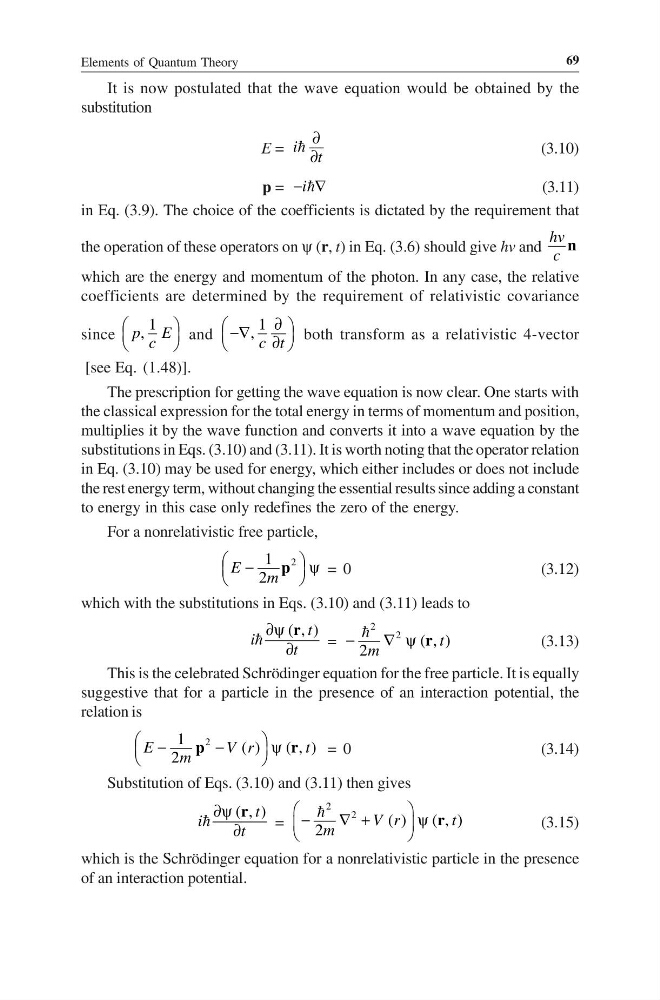
It is now postulated that the wave equation would be obtained by the
substitution
E = i t
∂
∂
(3.10)
p = i
− ∇
(3.11)
in Eq. (3.9). The choice of the coefficients is dictated by the requirement that
the operation of these operators on ψ (r, t) in Eq. (3.6) should give hv and
hv
c
n
which are the energy and momentum of the photon. In any case, the relative
coefficients are determined by the requirement of relativistic covariance
since
1
,
p E
c
and
1
, c t
∂
−∇
∂
both transform as a relativistic 4-vector
[see Eq. (1.48)].
The prescription for getting the wave equation is now clear. One starts with
the classical expression for the total energy in terms of momentum and position,
multiplies it by the wave function and converts it into a wave equation by the
substitutions in Eqs. (3.10) and (3.11). It is worth noting that the operator relation
in Eq. (3.10) may be used for energy, which either includes or does not include
the rest energy term, without changing the essential results since adding a constant
to energy in this case only redefines the zero of the energy.
For a nonrelativistic free particle,
2
1
2
−
ψ
E
m
p
= 0
(3.12)
which with the substitutions in Eqs. (3.10) and (3.11) leads to
( , )
∂ψ
∂
t
i
t
r
=
2
2
( , )
2
−
∇ ψ
t
m
r
(3.13)
This is the celebrated Schrödinger equation for the free particle. It is equally
suggestive that for a particle in the presence of an interaction potential, the
relation is
2
1
( )
( , )
2
−
−
ψ
E
V r
t
m
p
r
= 0
(3.14)
Substitution of Eqs. (3.10) and (3.11) then gives
( , )
∂ψ
∂
t
i
t
r
=
2
2
( )
( , )
2
−
∇ +
ψ
V r
t
m
r
(3.15)
which is the Schrödinger equation for a nonrelativistic particle in the presence
of an interaction potential.
69
It is now postulated that the wave equation would be obtained by the
substitution
E = i t
∂
∂
(3.10)
p = i
− ∇
(3.11)
in Eq. (3.9). The choice of the coefficients is dictated by the requirement that
the operation of these operators on ψ (r, t) in Eq. (3.6) should give hv and
hv
c
n
which are the energy and momentum of the photon. In any case, the relative
coefficients are determined by the requirement of relativistic covariance
since
1
,
p E
c
and
1
, c t
∂
−∇
∂
both transform as a relativistic 4-vector
[see Eq. (1.48)].
The prescription for getting the wave equation is now clear. One starts with
the classical expression for the total energy in terms of momentum and position,
multiplies it by the wave function and converts it into a wave equation by the
substitutions in Eqs. (3.10) and (3.11). It is worth noting that the operator relation
in Eq. (3.10) may be used for energy, which either includes or does not include
the rest energy term, without changing the essential results since adding a constant
to energy in this case only redefines the zero of the energy.
For a nonrelativistic free particle,
2
1
2
−
ψ
E
m
p
= 0
(3.12)
which with the substitutions in Eqs. (3.10) and (3.11) leads to
( , )
∂ψ
∂
t
i
t
r
=
2
2
( , )
2
−
∇ ψ
t
m
r
(3.13)
This is the celebrated Schrödinger equation for the free particle. It is equally
suggestive that for a particle in the presence of an interaction potential, the
relation is
2
1
( )
( , )
2
−
−
ψ
E
V r
t
m
p
r
= 0
(3.14)
Substitution of Eqs. (3.10) and (3.11) then gives
( , )
∂ψ
∂
t
i
t
r
=
2
2
( )
( , )
2
−
∇ +
ψ
V r
t
m
r
(3.15)
which is the Schrödinger equation for a nonrelativistic particle in the presence
of an interaction potential.