

Elements of Modern Physics
58
2
0
0
1
(1 cos )
2
λ λ
λ − λ =
−
θ +
⋅ −
+ ∆
f
i
i
h
p p
p
EM
mc
hmc
(2.77)
where ∆E has been neglected compared to mc
2
. For x-ray energies of a few
tens of keV and binding energies of the order of a few eV, the second term on
the right hand side is smaller than the first term. Because of the variation of p i ,
this term gives rise to a spread in the frequency of the scattered beam
[see Fig. 2.3 (a)].
Examples 5
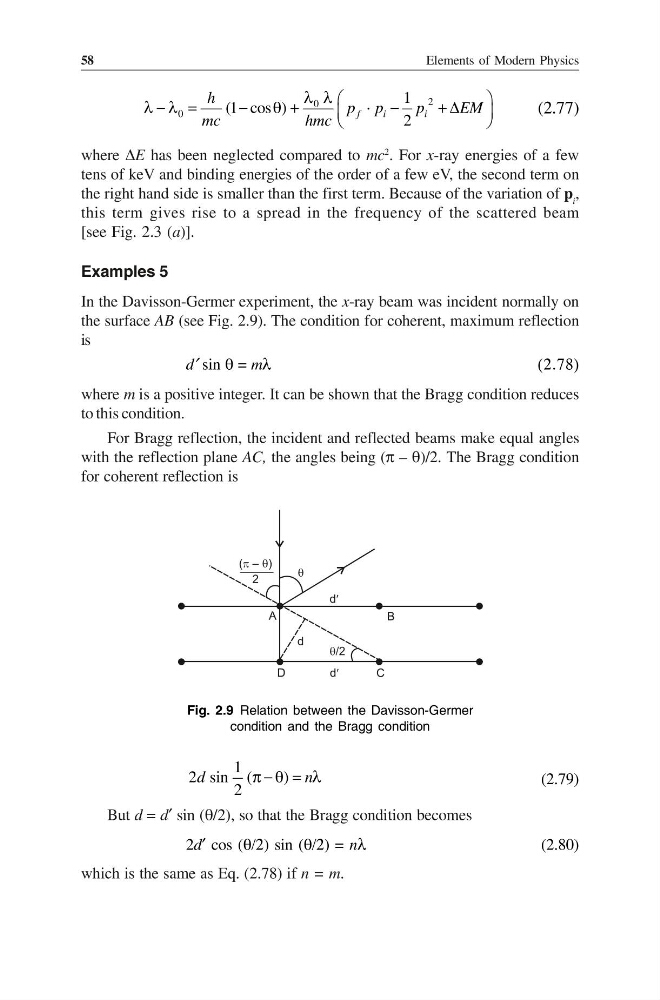
In the Davisson-Germer experiment, the x-ray beam was incident normally on
the surface AB (see Fig. 2.9). The condition for coherent, maximum reflection
is
d′ sin θ = mλ
(2.78)
where m is a positive integer. It can be shown that the Bragg condition reduces
to this condition.
For Bragg reflection, the incident and reflected beams make equal angles
with the reflection plane AC, the angles being (π – θ)/2. The Bragg condition
for coherent reflection is
( – )
p q
2
q
d¢
A
B
d
D
C
d¢
q/2
Fig. 2.9 Relation between the Davisson-Germer
condition and the Bragg condition
1
2 sin (
)
2
d
n
π − θ = λ
(2.79)
But d = d′ sin (θ/2), so that the Bragg condition becomes
2d′ cos (θ/2) sin (θ/2) = nλ
(2.80)
which is the same as Eq. (2.78) if n = m.
58
2
0
0
1
(1 cos )
2
λ λ
λ − λ =
−
θ +
⋅ −
+ ∆
f
i
i
h
p p
p
EM
mc
hmc
(2.77)
where ∆E has been neglected compared to mc
2
. For x-ray energies of a few
tens of keV and binding energies of the order of a few eV, the second term on
the right hand side is smaller than the first term. Because of the variation of p i ,
this term gives rise to a spread in the frequency of the scattered beam
[see Fig. 2.3 (a)].
Examples 5
In the Davisson-Germer experiment, the x-ray beam was incident normally on
the surface AB (see Fig. 2.9). The condition for coherent, maximum reflection
is
d′ sin θ = mλ
(2.78)
where m is a positive integer. It can be shown that the Bragg condition reduces
to this condition.
For Bragg reflection, the incident and reflected beams make equal angles
with the reflection plane AC, the angles being (π – θ)/2. The Bragg condition
for coherent reflection is
( – )
p q
2
q
d¢
A
B
d
D
C
d¢
q/2
Fig. 2.9 Relation between the Davisson-Germer
condition and the Bragg condition
1
2 sin (
)
2
d
n
π − θ = λ
(2.79)
But d = d′ sin (θ/2), so that the Bragg condition becomes
2d′ cos (θ/2) sin (θ/2) = nλ
(2.80)
which is the same as Eq. (2.78) if n = m.