

Introduction to Quantum Ideas
57
Example 2
The position of the maximum in Eq. (2.17) is determined numerically by iteration.
Equating the derivative of u(λ) to zero, one gets the condition
x = 5 (1 – e
–x
)
(2.71)
where x = hc/λkT. Inspection suggests that the solution to this is close to x ≈ 5.
First iteration gives
x ≈ 5 (1 – e
–5
)
= 4.9663
(2.72)
while the second iteration gives
x ≈ 5(1–e
–4.9663
)
= 4.96516
(2.73)
which agrees with Eq. (2.18).
Example 3
An experiment on the photoelectric effect of a metal gives stopping potentials
of 4.62 V for λ = 1850 Å, and 0.18 V for λ = 5460 Å. These results can be used
to calculate the Planck’s constant and the work function of the metal. From
Einstein’s relation in Eq. (2.23),
0
hc e eV
= φ +
λ
(2.74)
which on using the experimental values, leads to two linear equations in h and φ.
Solving them, we get h = 6.64 × 10
–34
J s and φ = 2.1eV.
Example 4
The wavelength of x-rays scattered by bound electrons (Sec. 2.3) has a spread,
mainly due to the fact that the bound electron has a momentum distribution. For
estimating the correction due to the non-zero initial momentum, it is noted that
the binding energy of the electrons is usually quite small, about 10 eV, compared
to the x-ray energies of about 10 keV.
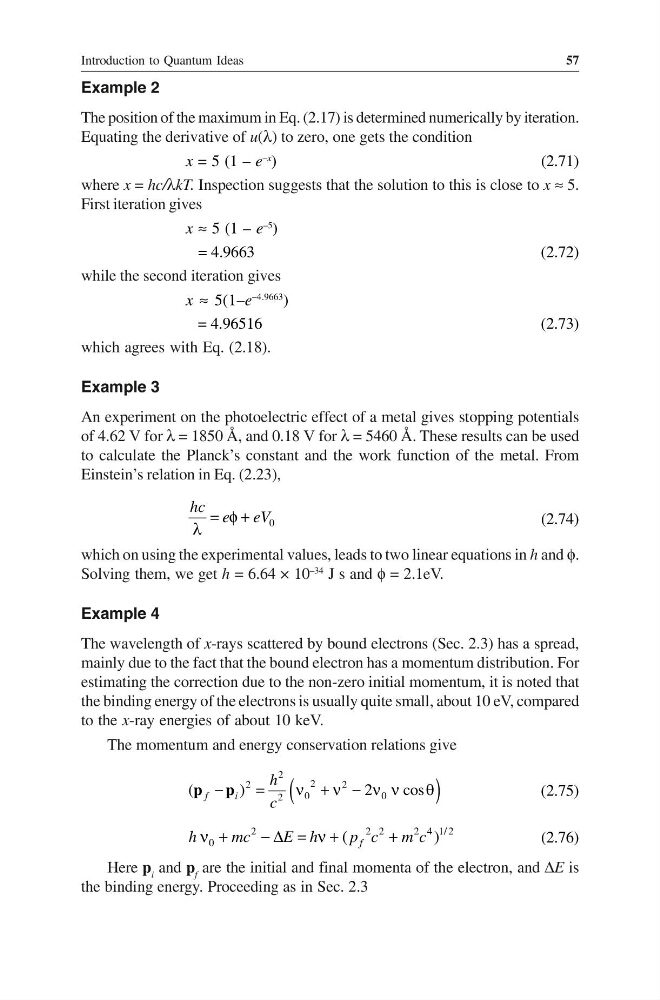
The momentum and energy conservation relations give
(
)
2
2
2
2
0
0
2
(
)
2
cos
−
=
ν +ν − ν ν
θ
f
i
h
c
p p
(2.75)
2
2 2
2 4 1 / 2
0
(
)
f
h
mc
E h
p c m c
ν +
− ∆ = ν +
+
(2.76)
Here p i and p f are the initial and final momenta of the electron, and ∆E is
the binding energy. Proceeding as in Sec. 2.3
57
Example 2
The position of the maximum in Eq. (2.17) is determined numerically by iteration.
Equating the derivative of u(λ) to zero, one gets the condition
x = 5 (1 – e
–x
)
(2.71)
where x = hc/λkT. Inspection suggests that the solution to this is close to x ≈ 5.
First iteration gives
x ≈ 5 (1 – e
–5
)
= 4.9663
(2.72)
while the second iteration gives
x ≈ 5(1–e
–4.9663
)
= 4.96516
(2.73)
which agrees with Eq. (2.18).
Example 3
An experiment on the photoelectric effect of a metal gives stopping potentials
of 4.62 V for λ = 1850 Å, and 0.18 V for λ = 5460 Å. These results can be used
to calculate the Planck’s constant and the work function of the metal. From
Einstein’s relation in Eq. (2.23),
0
hc e eV
= φ +
λ
(2.74)
which on using the experimental values, leads to two linear equations in h and φ.
Solving them, we get h = 6.64 × 10
–34
J s and φ = 2.1eV.
Example 4
The wavelength of x-rays scattered by bound electrons (Sec. 2.3) has a spread,
mainly due to the fact that the bound electron has a momentum distribution. For
estimating the correction due to the non-zero initial momentum, it is noted that
the binding energy of the electrons is usually quite small, about 10 eV, compared
to the x-ray energies of about 10 keV.
The momentum and energy conservation relations give
(
)
2
2
2
2
0
0
2
(
)
2
cos
−
=
ν +ν − ν ν
θ
f
i
h
c
p p
(2.75)
2
2 2
2 4 1 / 2
0
(
)
f
h
mc
E h
p c m c
ν +
− ∆ = ν +
+
(2.76)
Here p i and p f are the initial and final momenta of the electron, and ∆E is
the binding energy. Proceeding as in Sec. 2.3