

Introduction to Quantum Ideas
59
Example 6
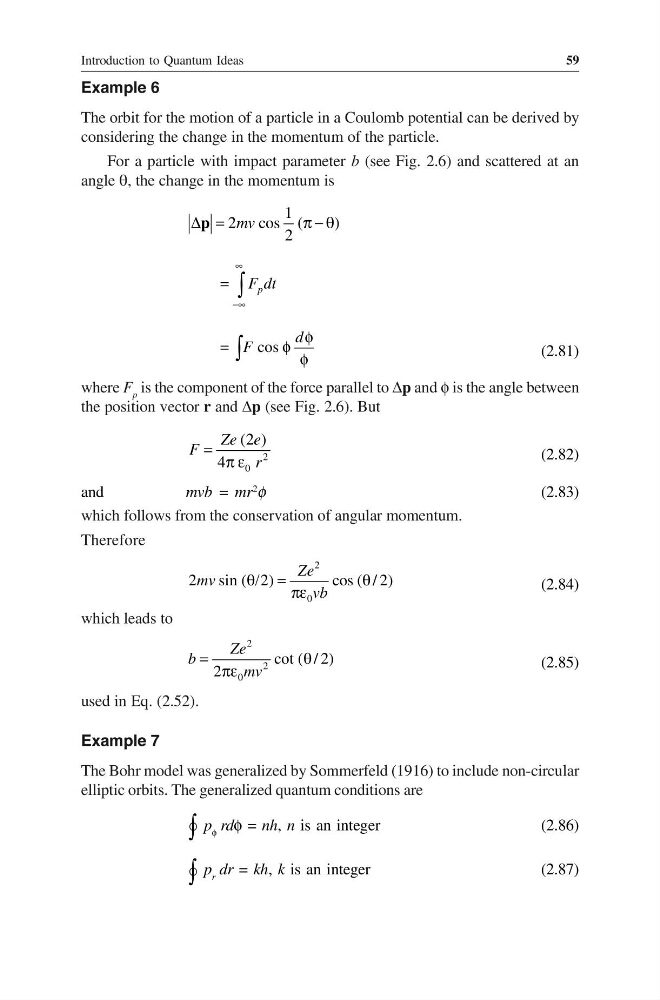
The orbit for the motion of a particle in a Coulomb potential can be derived by
considering the change in the momentum of the particle.
For a particle with impact parameter b (see Fig. 2.6) and scattered at an
angle θ, the change in the momentum is
1
2 cos (
)
2
∆ =
π−θ
mv
p
p
F dt
∞
−∞
= ∫
cos
d
F
φ
=
φ φ
∫
(2.81)
where F p is the component of the force parallel to ∆p and φ is the angle between
the position vector r and ∆p (see Fig. 2.6). But
2
0
(2 )
4
Ze e
F
r
= π ε
(2.82)
and
mvb = mr
2
φ
(2.83)
which follows from the conservation of angular momentum.
Therefore
2
0
2 sin ( 2)
cos ( / 2)
Ze
mv
vb
θ/ =
θ
πε
(2.84)
which leads to
2
2
0
cot ( / 2)
2
Ze
b
mv
=
θ
πε
(2.85)
used in Eq. (2.52).
Example 7
The Bohr model was generalized by Sommerfeld (1916) to include non-circular
elliptic orbits. The generalized quantum conditions are
z p φ rdφ = nh, n is an integer
(2.86)
z
p r dr = kh, k is an integer
(2.87)
59
Example 6
The orbit for the motion of a particle in a Coulomb potential can be derived by
considering the change in the momentum of the particle.
For a particle with impact parameter b (see Fig. 2.6) and scattered at an
angle θ, the change in the momentum is
1
2 cos (
)
2
∆ =
π−θ
mv
p
p
F dt
∞
−∞
= ∫
cos
d
F
φ
=
φ φ
∫
(2.81)
where F p is the component of the force parallel to ∆p and φ is the angle between
the position vector r and ∆p (see Fig. 2.6). But
2
0
(2 )
4
Ze e
F
r
= π ε
(2.82)
and
mvb = mr
2
φ
(2.83)
which follows from the conservation of angular momentum.
Therefore
2
0
2 sin ( 2)
cos ( / 2)
Ze
mv
vb
θ/ =
θ
πε
(2.84)
which leads to
2
2
0
cot ( / 2)
2
Ze
b
mv
=
θ
πε
(2.85)
used in Eq. (2.52).
Example 7
The Bohr model was generalized by Sommerfeld (1916) to include non-circular
elliptic orbits. The generalized quantum conditions are
z p φ rdφ = nh, n is an integer
(2.86)
z
p r dr = kh, k is an integer
(2.87)