

Introduction to Quantum Ideas
37
black-body radiation has found a more satisfactory description in terms of later
developments of quantum statistical mechanics. However, its historical
importance lies in the fact that it was for the first time here that the idea of
quantized energy was introduced and used for the description of physical
observations.
2.2 PHOTOELECTRIC EFFECT
The quantum hypothesis of Planck postulates that the energies of the atomic
oscillator are quantized and that they can change only by an integral multiple
or hv. This does not necessarily imply that the energy of the radiation in the
cavity is quantized. It suggests, however, that since the changes in the radiation
energy are due to absorption or emission of radiation by the atomic oscillators,
the energy of the radiation itself is quantized into multiples of hν. It is obvious
from the previous discussion that this quantized energy would also lead to Planck’s
law for the black-body radiation. This possibility received strong support from
Einstein’s explanation of photoelectric effect.
Hertz (1887) found that when a beam of ultraviolet radiation, for example,
from a mercury lamp, impinges on the surface of an alkali metal such as Cs, Rb,
K or Na, (which have a small work function), electrons are emitted. The number
of electrons emitted per second, and their energies can be studied by subjecting
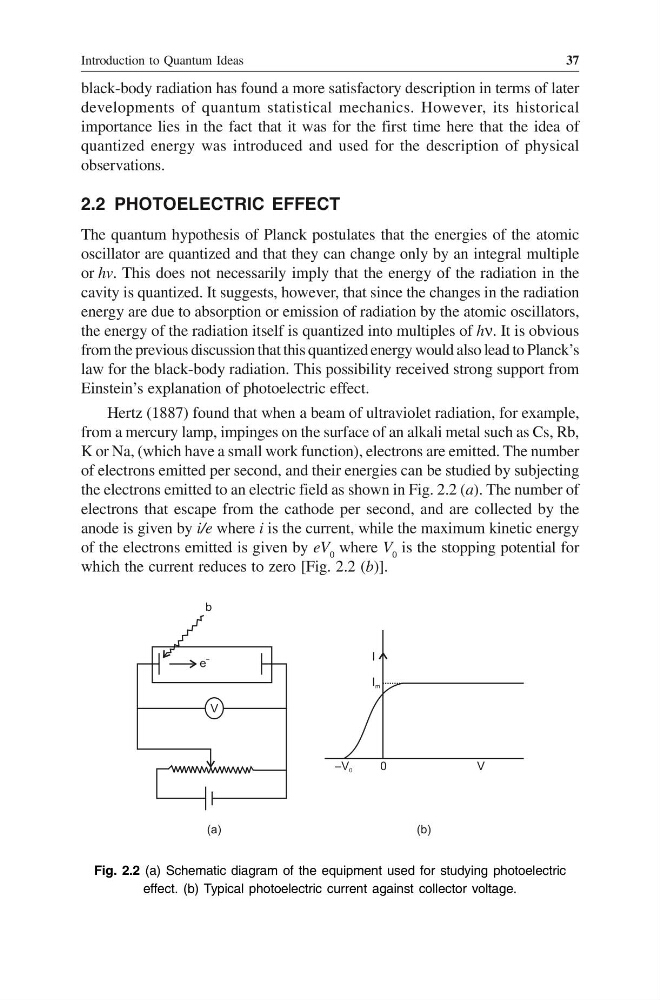
the electrons emitted to an electric field as shown in Fig. 2.2 (a). The number of
electrons that escape from the cathode per second, and are collected by the
anode is given by i/e where i is the current, while the maximum kinetic energy
of the electrons emitted is given by eV 0 where V 0 is the stopping potential for
which the current reduces to zero [Fig. 2.2 (b)].
Fig. 2.2 (a) Schematic diagram of the equipment used for studying photoelectric
effect. (b) Typical photoelectric current against collector voltage.
37
black-body radiation has found a more satisfactory description in terms of later
developments of quantum statistical mechanics. However, its historical
importance lies in the fact that it was for the first time here that the idea of
quantized energy was introduced and used for the description of physical
observations.
2.2 PHOTOELECTRIC EFFECT
The quantum hypothesis of Planck postulates that the energies of the atomic
oscillator are quantized and that they can change only by an integral multiple
or hv. This does not necessarily imply that the energy of the radiation in the
cavity is quantized. It suggests, however, that since the changes in the radiation
energy are due to absorption or emission of radiation by the atomic oscillators,
the energy of the radiation itself is quantized into multiples of hν. It is obvious
from the previous discussion that this quantized energy would also lead to Planck’s
law for the black-body radiation. This possibility received strong support from
Einstein’s explanation of photoelectric effect.
Hertz (1887) found that when a beam of ultraviolet radiation, for example,
from a mercury lamp, impinges on the surface of an alkali metal such as Cs, Rb,
K or Na, (which have a small work function), electrons are emitted. The number
of electrons emitted per second, and their energies can be studied by subjecting
the electrons emitted to an electric field as shown in Fig. 2.2 (a). The number of
electrons that escape from the cathode per second, and are collected by the
anode is given by i/e where i is the current, while the maximum kinetic energy
of the electrons emitted is given by eV 0 where V 0 is the stopping potential for
which the current reduces to zero [Fig. 2.2 (b)].
Fig. 2.2 (a) Schematic diagram of the equipment used for studying photoelectric
effect. (b) Typical photoelectric current against collector voltage.