

Elements of Modern Physics
38
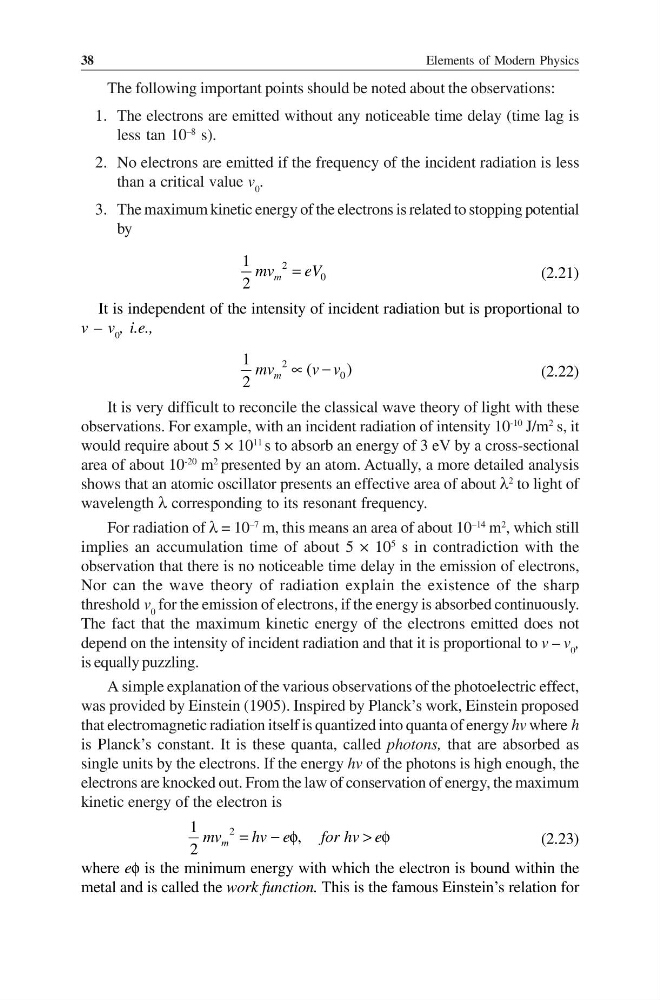
The following important points should be noted about the observations:
1. The electrons are emitted without any noticeable time delay (time lag is
less tan 10
–8
s).
2. No electrons are emitted if the frequency of the incident radiation is less
than a critical value v 0 .
3. The maximum kinetic energy of the electrons is related to stopping potential
by
2
0
1
2
m
mv
eV
=
(2.21)
It is independent of the intensity of incident radiation but is proportional to
v – v 0 , i.e.,
2
0
1
(
)
2
m
mv
v v
∝ −
(2.22)
It is very difficult to reconcile the classical wave theory of light with these
observations. For example, with an incident radiation of intensity 10
-10
J/m
2
s, it
would require about 5 × 10
11
s to absorb an energy of 3 eV by a cross-sectional
area of about 10
-20
m
2
presented by an atom. Actually, a more detailed analysis
shows that an atomic oscillator presents an effective area of about λ
2
to light of
wavelength λ corresponding to its resonant frequency.
For radiation of λ = 10
–7
m, this means an area of about 10
–14
m
2
, which still
implies an accumulation time of about 5 × 10
5
s in contradiction with the
observation that there is no noticeable time delay in the emission of electrons,
Nor can the wave theory of radiation explain the existence of the sharp
threshold v 0 for the emission of electrons, if the energy is absorbed continuously.
The fact that the maximum kinetic energy of the electrons emitted does not
depend on the intensity of incident radiation and that it is proportional to v – v 0 ,
is equally puzzling.
A simple explanation of the various observations of the photoelectric effect,
was provided by Einstein (1905). Inspired by Planck’s work, Einstein proposed
that electromagnetic radiation itself is quantized into quanta of energy hv where h
is Planck’s constant. It is these quanta, called photons, that are absorbed as
single units by the electrons. If the energy hv of the photons is high enough, the
electrons are knocked out. From the law of conservation of energy, the maximum
kinetic energy of the electron is
2
1
,
2
m
mv
hv e
for hv e
= − φ
> φ
(2.23)
where eφ is the minimum energy with which the electron is bound within the
metal and is called the work function. This is the famous Einstein’s relation for
38
The following important points should be noted about the observations:
1. The electrons are emitted without any noticeable time delay (time lag is
less tan 10
–8
s).
2. No electrons are emitted if the frequency of the incident radiation is less
than a critical value v 0 .
3. The maximum kinetic energy of the electrons is related to stopping potential
by
2
0
1
2
m
mv
eV
=
(2.21)
It is independent of the intensity of incident radiation but is proportional to
v – v 0 , i.e.,
2
0
1
(
)
2
m
mv
v v
∝ −
(2.22)
It is very difficult to reconcile the classical wave theory of light with these
observations. For example, with an incident radiation of intensity 10
-10
J/m
2
s, it
would require about 5 × 10
11
s to absorb an energy of 3 eV by a cross-sectional
area of about 10
-20
m
2
presented by an atom. Actually, a more detailed analysis
shows that an atomic oscillator presents an effective area of about λ
2
to light of
wavelength λ corresponding to its resonant frequency.
For radiation of λ = 10
–7
m, this means an area of about 10
–14
m
2
, which still
implies an accumulation time of about 5 × 10
5
s in contradiction with the
observation that there is no noticeable time delay in the emission of electrons,
Nor can the wave theory of radiation explain the existence of the sharp
threshold v 0 for the emission of electrons, if the energy is absorbed continuously.
The fact that the maximum kinetic energy of the electrons emitted does not
depend on the intensity of incident radiation and that it is proportional to v – v 0 ,
is equally puzzling.
A simple explanation of the various observations of the photoelectric effect,
was provided by Einstein (1905). Inspired by Planck’s work, Einstein proposed
that electromagnetic radiation itself is quantized into quanta of energy hv where h
is Planck’s constant. It is these quanta, called photons, that are absorbed as
single units by the electrons. If the energy hv of the photons is high enough, the
electrons are knocked out. From the law of conservation of energy, the maximum
kinetic energy of the electron is
2
1
,
2
m
mv
hv e
for hv e
= − φ
> φ
(2.23)
where eφ is the minimum energy with which the electron is bound within the
metal and is called the work function. This is the famous Einstein’s relation for