

Elements of Modern Physics
36
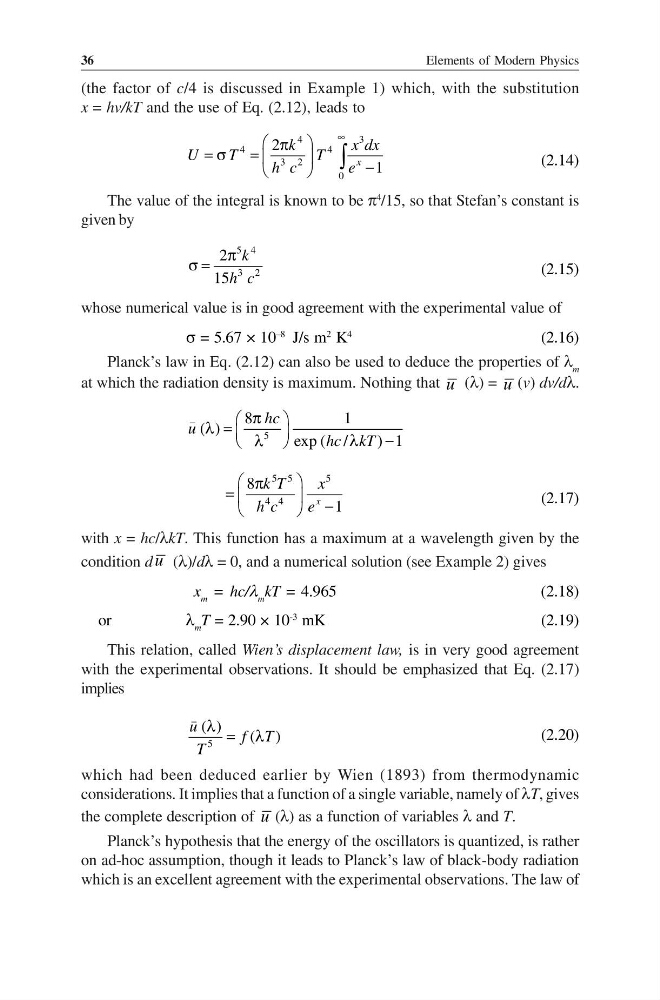
(the factor of c/4 is discussed in Example 1) which, with the substitution
x = hv/kT and the use of Eq. (2.12), leads to
4
3
4
4
3 2
0
2
1
x
k
xd x
U
T
T
h c
e
∞
π
= σ
=
−
∫
(2.14)
The value of the integral is known to be π
4
/15, so that Stefan’s constant is
given by
5 4
3 2
2
15
k
h c
π
σ =
(2.15)
whose numerical value is in good agreement with the experimental value of
σ = 5.67 × 10
–8
J/s m
2
K
4
(2.16)
Planck’s law in Eq. (2.12) can also be used to deduce the properties of λ m
at which the radiation density is maximum. Nothing that u (λ) = u (v) dv/dλ.
5
8
1
( )
exp ( /
) 1
hc
u
hc kT
−
π
λ =
λ
−
λ
5 5
5
4 4
8
1
x
k T
x
h c
e
π
=
−
(2.17)
with x = hc/λkT. This function has a maximum at a wavelength given by the
condition d u (λ)/dλ = 0, and a numerical solution (see Example 2) gives
x m = hc/λ m kT = 4.965
(2.18)
or
λ m T = 2.90 × 10
-3
mK
(2.19)
This relation, called Wien’s displacement law, is in very good agreement
with the experimental observations. It should be emphasized that Eq. (2.17)
implies
5
( )
( )
u
f T
T
−
λ = λ
(2.20)
which had been deduced earlier by Wien (1893) from thermodynamic
considerations. It implies that a function of a single variable, namely of λT, gives
the complete description of u (λ) as a function of variables λ and T.
Planck’s hypothesis that the energy of the oscillators is quantized, is rather
on ad-hoc assumption, though it leads to Planck’s law of black-body radiation
which is an excellent agreement with the experimental observations. The law of
36
(the factor of c/4 is discussed in Example 1) which, with the substitution
x = hv/kT and the use of Eq. (2.12), leads to
4
3
4
4
3 2
0
2
1
x
k
xd x
U
T
T
h c
e
∞
π
= σ
=
−
∫
(2.14)
The value of the integral is known to be π
4
/15, so that Stefan’s constant is
given by
5 4
3 2
2
15
k
h c
π
σ =
(2.15)
whose numerical value is in good agreement with the experimental value of
σ = 5.67 × 10
–8
J/s m
2
K
4
(2.16)
Planck’s law in Eq. (2.12) can also be used to deduce the properties of λ m
at which the radiation density is maximum. Nothing that u (λ) = u (v) dv/dλ.
5
8
1
( )
exp ( /
) 1
hc
u
hc kT
−
π
λ =
λ
−
λ
5 5
5
4 4
8
1
x
k T
x
h c
e
π
=
−
(2.17)
with x = hc/λkT. This function has a maximum at a wavelength given by the
condition d u (λ)/dλ = 0, and a numerical solution (see Example 2) gives
x m = hc/λ m kT = 4.965
(2.18)
or
λ m T = 2.90 × 10
-3
mK
(2.19)
This relation, called Wien’s displacement law, is in very good agreement
with the experimental observations. It should be emphasized that Eq. (2.17)
implies
5
( )
( )
u
f T
T
−
λ = λ
(2.20)
which had been deduced earlier by Wien (1893) from thermodynamic
considerations. It implies that a function of a single variable, namely of λT, gives
the complete description of u (λ) as a function of variables λ and T.
Planck’s hypothesis that the energy of the oscillators is quantized, is rather
on ad-hoc assumption, though it leads to Planck’s law of black-body radiation
which is an excellent agreement with the experimental observations. The law of