

Elements of Modern Physics
412
matter must have been in an ionized state. Since matter in ionized state has
much greater interaction with radiation than does matter in atomic state, the radiation
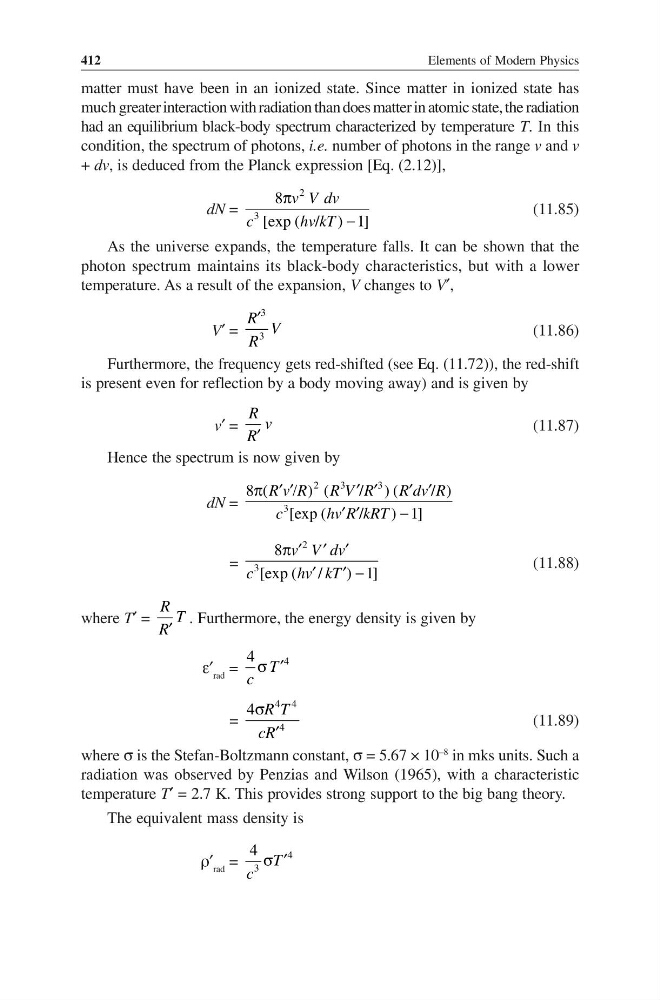
had an equilibrium black-body spectrum characterized by temperature T. In this
condition, the spectrum of photons, i.e. number of photons in the range v and v
+ dv, is deduced from the Planck expression [Eq. (2.12)],
dN =
2
3
8
[exp ( / ) 1]
v V dv
c
hvkT
π
−
(11.85)
As the universe expands, the temperature falls. It can be shown that the
photon spectrum maintains its black-body characteristics, but with a lower
temperature. As a result of the expansion, V changes to V′,
V′ =
3
3
R V
R
′
(11.86)
Furthermore, the frequency gets red-shifted (see Eq. (11.72)), the red-shift
is present even for reflection by a body moving away) and is given by
v′ =
R v
R′
(11.87)
Hence the spectrum is now given by
dN =
2
3
3
3
8 (
) (
/ ) (
/ )
[exp (
/
) 1]
R v R R V R
R dv R
c
hvR kRT
π ′ ′/
′ ′
′ ′
′ ′
−
=
2
3
8
[exp ( /
) 1]
v V dv
c
hv kT
π ′ ′ ′
′
′ −
(11.88)
where T′ =
R T
R′
. Furthermore, the energy density is given by
ε′ rad =
4
4 T
c
σ ′
=
4 4
4
4 R T
cR
σ
′
(11.89)
where σ is the Stefan-Boltzmann constant, σ = 5.67 × 10
–8
in mks units. Such a
radiation was observed by Penzias and Wilson (1965), with a characteristic
temperature T′ = 2.7 K. This provides strong support to the big bang theory.
The equivalent mass density is
ρ′ rad =
4
3
4 T
c
σ ′
412
matter must have been in an ionized state. Since matter in ionized state has
much greater interaction with radiation than does matter in atomic state, the radiation
had an equilibrium black-body spectrum characterized by temperature T. In this
condition, the spectrum of photons, i.e. number of photons in the range v and v
+ dv, is deduced from the Planck expression [Eq. (2.12)],
dN =
2
3
8
[exp ( / ) 1]
v V dv
c
hvkT
π
−
(11.85)
As the universe expands, the temperature falls. It can be shown that the
photon spectrum maintains its black-body characteristics, but with a lower
temperature. As a result of the expansion, V changes to V′,
V′ =
3
3
R V
R
′
(11.86)
Furthermore, the frequency gets red-shifted (see Eq. (11.72)), the red-shift
is present even for reflection by a body moving away) and is given by
v′ =
R v
R′
(11.87)
Hence the spectrum is now given by
dN =
2
3
3
3
8 (
) (
/ ) (
/ )
[exp (
/
) 1]
R v R R V R
R dv R
c
hvR kRT
π ′ ′/
′ ′
′ ′
′ ′
−
=
2
3
8
[exp ( /
) 1]
v V dv
c
hv kT
π ′ ′ ′
′
′ −
(11.88)
where T′ =
R T
R′
. Furthermore, the energy density is given by
ε′ rad =
4
4 T
c
σ ′
=
4 4
4
4 R T
cR
σ
′
(11.89)
where σ is the Stefan-Boltzmann constant, σ = 5.67 × 10
–8
in mks units. Such a
radiation was observed by Penzias and Wilson (1965), with a characteristic
temperature T′ = 2.7 K. This provides strong support to the big bang theory.
The equivalent mass density is
ρ′ rad =
4
3
4 T
c
σ ′