

General Relativity and Cosmology
413
≈ 4.5 × 10
–31
kg/m
3
(11.90)
which is must smaller than the estimated galactic matter density of about
3 × 10
–28
kg/m
3
. The present era is therefore known as the matter-dominated
era. It may be noted that unlike the radiation density which is proportional to 1/
R′
4
, the matter density varies as 1/R′
3
.
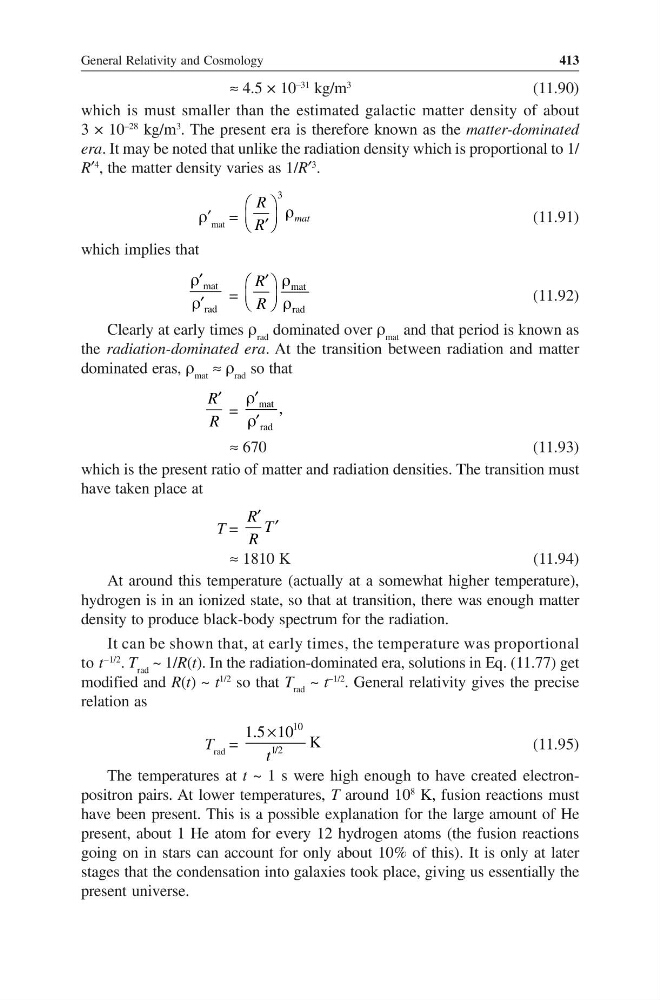
ρ′ mat =
3
mat
R
R
ρ
′
(11.91)
which implies that
mat
rad
ρ′
ρ′
=
mat
rad
R
R
ρ
′
ρ
(11.92)
Clearly at early times ρ rad dominated over ρ mat and that period is known as
the radiation-dominated era. At the transition between radiation and matter
dominated eras, ρ mat ≈ ρ rad so that
R
R
′ =
mat
rad
,
ρ′
ρ′
≈ 670
(11.93)
which is the present ratio of matter and radiation densities. The transition must
have taken place at
T =
R T
R
′ ′
≈ 1810 K
(11.94)
At around this temperature (actually at a somewhat higher temperature),
hydrogen is in an ionized state, so that at transition, there was enough matter
density to produce black-body spectrum for the radiation.
It can be shown that, at early times, the temperature was proportional
to t
–1/2
. T rad ~ 1/R(t). In the radiation-dominated era, solutions in Eq. (11.77) get
modified and R(t) ~ t
1/2
so that T rad ~ t
–1/2
. General relativity gives the precise
relation as
T rad =
10
1/2
1.5 10 K
t
×
(11.95)
The temperatures at t ~ 1 s were high enough to have created electronpositron pairs. At lower temperatures, T around 10
8
K, fusion reactions must
have been present. This is a possible explanation for the large amount of He
present, about 1 He atom for every 12 hydrogen atoms (the fusion reactions
going on in stars can account for only about 10% of this). It is only at later
stages that the condensation into galaxies took place, giving us essentially the
present universe.
413
≈ 4.5 × 10
–31
kg/m
3
(11.90)
which is must smaller than the estimated galactic matter density of about
3 × 10
–28
kg/m
3
. The present era is therefore known as the matter-dominated
era. It may be noted that unlike the radiation density which is proportional to 1/
R′
4
, the matter density varies as 1/R′
3
.
ρ′ mat =
3
mat
R
R
ρ
′
(11.91)
which implies that
mat
rad
ρ′
ρ′
=
mat
rad
R
R
ρ
′
ρ
(11.92)
Clearly at early times ρ rad dominated over ρ mat and that period is known as
the radiation-dominated era. At the transition between radiation and matter
dominated eras, ρ mat ≈ ρ rad so that
R
R
′ =
mat
rad
,
ρ′
ρ′
≈ 670
(11.93)
which is the present ratio of matter and radiation densities. The transition must
have taken place at
T =
R T
R
′ ′
≈ 1810 K
(11.94)
At around this temperature (actually at a somewhat higher temperature),
hydrogen is in an ionized state, so that at transition, there was enough matter
density to produce black-body spectrum for the radiation.
It can be shown that, at early times, the temperature was proportional
to t
–1/2
. T rad ~ 1/R(t). In the radiation-dominated era, solutions in Eq. (11.77) get
modified and R(t) ~ t
1/2
so that T rad ~ t
–1/2
. General relativity gives the precise
relation as
T rad =
10
1/2
1.5 10 K
t
×
(11.95)
The temperatures at t ~ 1 s were high enough to have created electronpositron pairs. At lower temperatures, T around 10
8
K, fusion reactions must
have been present. This is a possible explanation for the large amount of He
present, about 1 He atom for every 12 hydrogen atoms (the fusion reactions
going on in stars can account for only about 10% of this). It is only at later
stages that the condensation into galaxies took place, giving us essentially the
present universe.