

General Relativity and Cosmology
411
0
t 1/2
2t 1/2
k = 1
R m
R(t)
k = – 1
k = 0
t ®
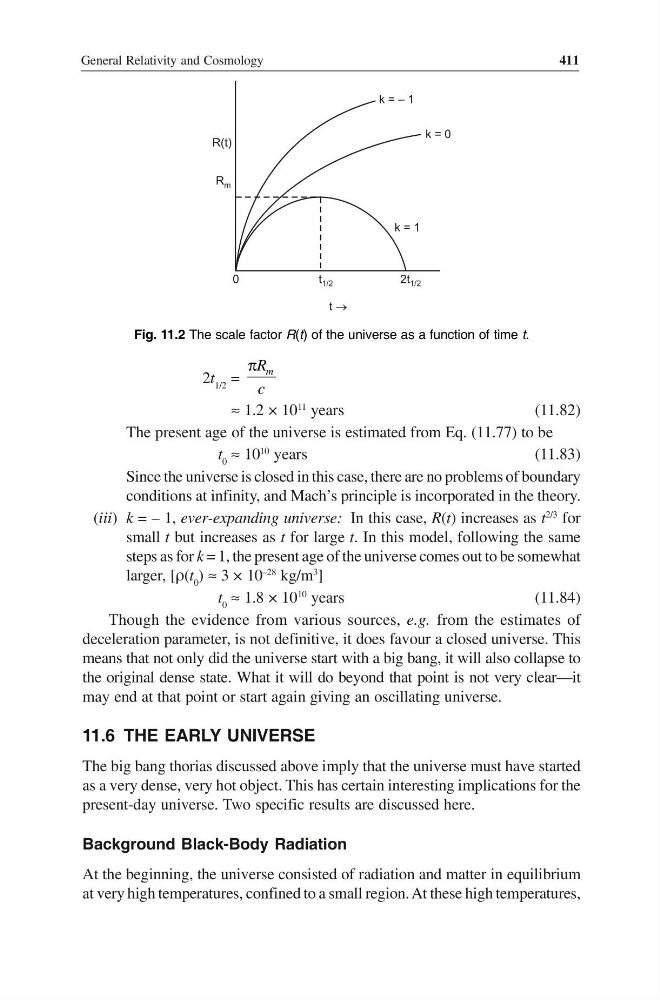
Fig. 11.2 The scale factor R(t) of the universe as a function of time t.
2t 1/2 =
m
R
c
π
≈ 1.2 × 10
11
years
(11.82)
The present age of the universe is estimated from Eq. (11.77) to be
t 0 ≈ 10
10
years
(11.83)
Since the universe is closed in this case, there are no problems of boundary
conditions at infinity, and Mach’s principle is incorporated in the theory.
(iii) k = – 1, ever-expanding universe: In this case, R(t) increases as t
2/3
for
small t but increases as t for large t. In this model, following the same
steps as for k = 1, the present age of the universe comes out to be somewhat
larger, [ρ(t 0 ) ≈ 3 × 10
–28
kg/m
3
]
t 0 ≈ 1.8 × 10
10
years
(11.84)
Though the evidence from various sources, e.g. from the estimates of
deceleration parameter, is not definitive, it does favour a closed universe. This
means that not only did the universe start with a big bang, it will also collapse to
the original dense state. What it will do beyond that point is not very clear—it
may end at that point or start again giving an oscillating universe.
11.6 THE EARLY UNIVERSE
The big bang thorias discussed above imply that the universe must have started
as a very dense, very hot object. This has certain interesting implications for the
present-day universe. Two specific results are discussed here.
Background Black-Body Radiation
At the beginning, the universe consisted of radiation and matter in equilibrium
at very high temperatures, confined to a small region. At these high temperatures,
411
0
t 1/2
2t 1/2
k = 1
R m
R(t)
k = – 1
k = 0
t ®
Fig. 11.2 The scale factor R(t) of the universe as a function of time t.
2t 1/2 =
m
R
c
π
≈ 1.2 × 10
11
years
(11.82)
The present age of the universe is estimated from Eq. (11.77) to be
t 0 ≈ 10
10
years
(11.83)
Since the universe is closed in this case, there are no problems of boundary
conditions at infinity, and Mach’s principle is incorporated in the theory.
(iii) k = – 1, ever-expanding universe: In this case, R(t) increases as t
2/3
for
small t but increases as t for large t. In this model, following the same
steps as for k = 1, the present age of the universe comes out to be somewhat
larger, [ρ(t 0 ) ≈ 3 × 10
–28
kg/m
3
]
t 0 ≈ 1.8 × 10
10
years
(11.84)
Though the evidence from various sources, e.g. from the estimates of
deceleration parameter, is not definitive, it does favour a closed universe. This
means that not only did the universe start with a big bang, it will also collapse to
the original dense state. What it will do beyond that point is not very clear—it
may end at that point or start again giving an oscillating universe.
11.6 THE EARLY UNIVERSE
The big bang thorias discussed above imply that the universe must have started
as a very dense, very hot object. This has certain interesting implications for the
present-day universe. Two specific results are discussed here.
Background Black-Body Radiation
At the beginning, the universe consisted of radiation and matter in equilibrium
at very high temperatures, confined to a small region. At these high temperatures,