

Elements of Modern Physics
410
for k = – 1 or 0, i.e. R (t) ≠ 0. This can be compared with what happens to a body
thrown up from the surface of the earth. If the initial velocity v in is less than the
escape velocity v esc (E tot < 0), the body will reach a maximum height and return
back to the earth, corresponding to the closed universe. If v in > v esc (E tot > 0), the
body will go on forever corresponding to the open universe. When v in = v esc
(E tot = 0), the body just manage to escape from the earth.
In all the three cases of Eq. (11.76), R is positive now, and was large at
earlier times. Hence the universe described by Eq. (11.76) had a big-bang origin.
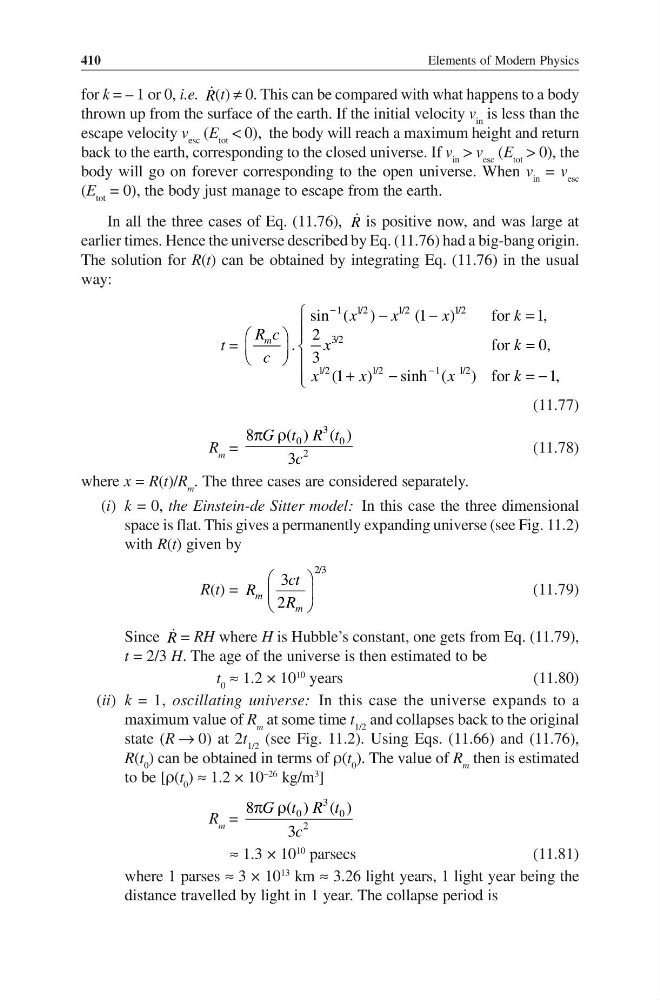
The solution for R(t) can be obtained by integrating Eq. (11.76) in the usual
way:
t =
1 1 /2
1 /2
1 /2
3/2
1/2
1/2
1
1/2
sin ( )
(1 )
for
1,
2
.
f o r= 0 ,
3
(1 )
sinh (
) for
1,
m
x
x
x
k
R c
x
k
c
x
x
x
k
−
−
−
−
=
+
−
=−
(11.77)
R m =
3
0
0
2
8
( ) ( )
3
G t R t
c
π ρ
(11.78)
where x = R(t)/R m . The three cases are considered separately.
(i) k = 0, the Einstein-de Sitter model: In this case the three dimensional
space is flat. This gives a permanently expanding universe (see Fig. 11.2)
with R(t) given by
R(t) =
2/3
3
2
m
m
ct
R
R
(11.79)
Since R = RH where H is Hubble’s constant, one gets from Eq. (11.79),
t = 2/3 H. The age of the universe is then estimated to be
t 0 ≈ 1.2 × 10
10
years
(11.80)
(ii) k = 1, oscillating universe: In this case the universe expands to a
maximum value of R m at some time t 1/2 and collapses back to the original
state (R → 0) at 2t 1/2 (see Fig. 11.2). Using Eqs. (11.66) and (11.76),
R(t 0 ) can be obtained in terms of ρ(t 0 ). The value of R m then is estimated
to be [ρ(t 0 ) ≈ 1.2 × 10
–26
kg/m
3
]
R m =
3
0
0
2
8
( ) ( )
3
G t R t
c
π ρ
≈ 1.3 × 10
10
parsecs
(11.81)
where 1 parses ≈ 3 × 10
13
km ≈ 3.26 light years, 1 light year being the
distance travelled by light in 1 year. The collapse period is
410
for k = – 1 or 0, i.e. R (t) ≠ 0. This can be compared with what happens to a body
thrown up from the surface of the earth. If the initial velocity v in is less than the
escape velocity v esc (E tot < 0), the body will reach a maximum height and return
back to the earth, corresponding to the closed universe. If v in > v esc (E tot > 0), the
body will go on forever corresponding to the open universe. When v in = v esc
(E tot = 0), the body just manage to escape from the earth.
In all the three cases of Eq. (11.76), R is positive now, and was large at
earlier times. Hence the universe described by Eq. (11.76) had a big-bang origin.
The solution for R(t) can be obtained by integrating Eq. (11.76) in the usual
way:
t =
1 1 /2
1 /2
1 /2
3/2
1/2
1/2
1
1/2
sin ( )
(1 )
for
1,
2
.
f o r= 0 ,
3
(1 )
sinh (
) for
1,
m
x
x
x
k
R c
x
k
c
x
x
x
k
−
−
−
−
=
+
−
=−
(11.77)
R m =
3
0
0
2
8
( ) ( )
3
G t R t
c
π ρ
(11.78)
where x = R(t)/R m . The three cases are considered separately.
(i) k = 0, the Einstein-de Sitter model: In this case the three dimensional
space is flat. This gives a permanently expanding universe (see Fig. 11.2)
with R(t) given by
R(t) =
2/3
3
2
m
m
ct
R
R
(11.79)
Since R = RH where H is Hubble’s constant, one gets from Eq. (11.79),
t = 2/3 H. The age of the universe is then estimated to be
t 0 ≈ 1.2 × 10
10
years
(11.80)
(ii) k = 1, oscillating universe: In this case the universe expands to a
maximum value of R m at some time t 1/2 and collapses back to the original
state (R → 0) at 2t 1/2 (see Fig. 11.2). Using Eqs. (11.66) and (11.76),
R(t 0 ) can be obtained in terms of ρ(t 0 ). The value of R m then is estimated
to be [ρ(t 0 ) ≈ 1.2 × 10
–26
kg/m
3
]
R m =
3
0
0
2
8
( ) ( )
3
G t R t
c
π ρ
≈ 1.3 × 10
10
parsecs
(11.81)
where 1 parses ≈ 3 × 10
13
km ≈ 3.26 light years, 1 light year being the
distance travelled by light in 1 year. The collapse period is