

General Relativity and Cosmology
409
=
2
2
0
0
0
0
0
1
(
)
1
(
) ...
2
e
e
t t H
q
H t t
−
+
+
−
+
(11.73)
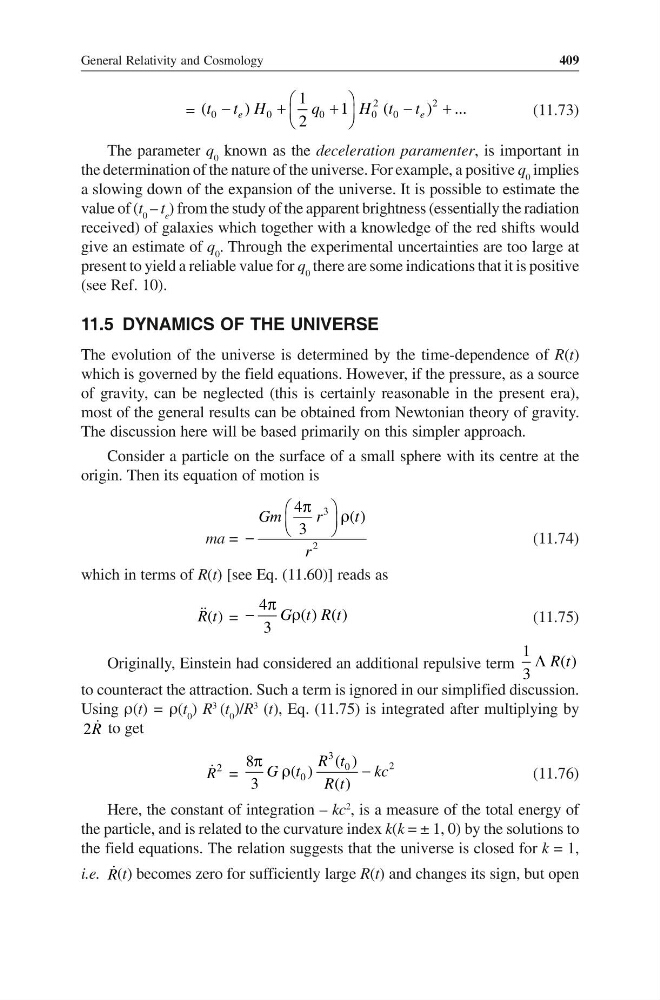
The parameter q 0 known as the deceleration paramenter, is important in
the determination of the nature of the universe. For example, a positive q 0 implies
a slowing down of the expansion of the universe. It is possible to estimate the
value of (t 0 – t e ) from the study of the apparent brightness (essentially the radiation
received) of galaxies which together with a knowledge of the red shifts would
give an estimate of q 0 . Through the experimental uncertainties are too large at
present to yield a reliable value for q 0 there are some indications that it is positive
(see Ref. 10).
11.5 DYNAMICS OF THE UNIVERSE
The evolution of the universe is determined by the time-dependence of R(t)
which is governed by the field equations. However, if the pressure, as a source
of gravity, can be neglected (this is certainly reasonable in the present era),
most of the general results can be obtained from Newtonian theory of gravity.
The discussion here will be based primarily on this simpler approach.
Consider a particle on the surface of a small sphere with its centre at the
origin. Then its equation of motion is
ma =
3
2
4
( )
3
Gm
r
t
r
π
ρ
−
(11.74)
which in terms of R(t) [see Eq. (11.60)] reads as
( )
R t
=
4
( ) ( )
3
G t R t
π
−
ρ
(11.75)
Originally, Einstein had considered an additional repulsive term
1
( )
3
R t
Λ
to counteract the attraction. Such a term is ignored in our simplified discussion.
Using ρ(t) = ρ(t 0 ) R
3
(t 0 )/R
3
(t), Eq. (11.75) is integrated after multiplying by
2R to get
2
R =
3
2
0
0
( )
8
( )
3
()
R t
G t
kc
R t
π ρ
−
(11.76)
Here, the constant of integration – kc
2
, is a measure of the total energy of
the particle, and is related to the curvature index k(k = ± 1, 0) by the solutions to
the field equations. The relation suggests that the universe is closed for k = 1,
i.e. R (t) becomes zero for sufficiently large R(t) and changes its sign, but open
409
=
2
2
0
0
0
0
0
1
(
)
1
(
) ...
2
e
e
t t H
q
H t t
−
+
+
−
+
(11.73)
The parameter q 0 known as the deceleration paramenter, is important in
the determination of the nature of the universe. For example, a positive q 0 implies
a slowing down of the expansion of the universe. It is possible to estimate the
value of (t 0 – t e ) from the study of the apparent brightness (essentially the radiation
received) of galaxies which together with a knowledge of the red shifts would
give an estimate of q 0 . Through the experimental uncertainties are too large at
present to yield a reliable value for q 0 there are some indications that it is positive
(see Ref. 10).
11.5 DYNAMICS OF THE UNIVERSE
The evolution of the universe is determined by the time-dependence of R(t)
which is governed by the field equations. However, if the pressure, as a source
of gravity, can be neglected (this is certainly reasonable in the present era),
most of the general results can be obtained from Newtonian theory of gravity.
The discussion here will be based primarily on this simpler approach.
Consider a particle on the surface of a small sphere with its centre at the
origin. Then its equation of motion is
ma =
3
2
4
( )
3
Gm
r
t
r
π
ρ
−
(11.74)
which in terms of R(t) [see Eq. (11.60)] reads as
( )
R t
=
4
( ) ( )
3
G t R t
π
−
ρ
(11.75)
Originally, Einstein had considered an additional repulsive term
1
( )
3
R t
Λ
to counteract the attraction. Such a term is ignored in our simplified discussion.
Using ρ(t) = ρ(t 0 ) R
3
(t 0 )/R
3
(t), Eq. (11.75) is integrated after multiplying by
2R to get
2
R =
3
2
0
0
( )
8
( )
3
()
R t
G t
kc
R t
π ρ
−
(11.76)
Here, the constant of integration – kc
2
, is a measure of the total energy of
the particle, and is related to the curvature index k(k = ± 1, 0) by the solutions to
the field equations. The relation suggests that the universe is closed for k = 1,
i.e. R (t) becomes zero for sufficiently large R(t) and changes its sign, but open