

Elements of Modern Physics
404
where D = (cB/A)
2
. For 2
GM
c
= 0, x = D
1/2
cos φ. Treating the gravitational term
as a small perturbation, we find to first order in GM/c
2
x =
1/2
2
2
cos
(2 cos )
GMD
D
c
φ +
−
φ
(11.47)
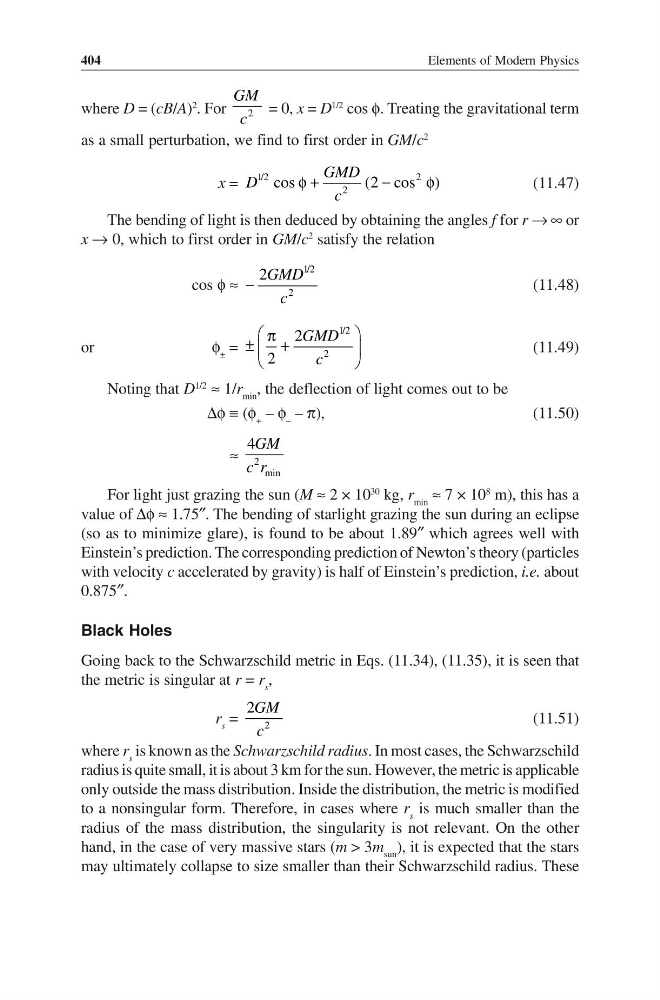
The bending of light is then deduced by obtaining the angles f for r → ∞ or
x → 0, which to first order in GM/c
2
satisfy the relation
cos φ ≈
1/2
2
2GMD
c
−
(11.48)
or
φ ± =
1/2
2
2
2
GMD
c
π
±
+
(11.49)
Noting that D
1/2
≈ 1/r min , the deflection of light comes out to be
∆φ ≡ (φ + – φ – – π),
(11.50)
≈ 2
min
4GM
c r
For light just grazing the sun (M ≈ 2 × 10
30
kg, r min ≈ 7 × 10
8
m), this has a
value of ∆φ ≈ 1.75″. The bending of starlight grazing the sun during an eclipse
(so as to minimize glare), is found to be about 1.89″ which agrees well with
Einstein’s prediction. The corresponding prediction of Newton’s theory (particles
with velocity c accelerated by gravity) is half of Einstein’s prediction, i.e. about
0.875″.
Black Holes
Going back to the Schwarzschild metric in Eqs. (11.34), (11.35), it is seen that
the metric is singular at r = r s ,
r s =
2
2GM
c
(11.51)
where r s is known as the Schwarzschild radius. In most cases, the Schwarzschild
radius is quite small, it is about 3 km for the sun. However, the metric is applicable
only outside the mass distribution. Inside the distribution, the metric is modified
to a nonsingular form. Therefore, in cases where r s is much smaller than the
radius of the mass distribution, the singularity is not relevant. On the other
hand, in the case of very massive stars (m > 3m sun ), it is expected that the stars
may ultimately collapse to size smaller than their Schwarzschild radius. These
404
where D = (cB/A)
2
. For 2
GM
c
= 0, x = D
1/2
cos φ. Treating the gravitational term
as a small perturbation, we find to first order in GM/c
2
x =
1/2
2
2
cos
(2 cos )
GMD
D
c
φ +
−
φ
(11.47)
The bending of light is then deduced by obtaining the angles f for r → ∞ or
x → 0, which to first order in GM/c
2
satisfy the relation
cos φ ≈
1/2
2
2GMD
c
−
(11.48)
or
φ ± =
1/2
2
2
2
GMD
c
π
±
+
(11.49)
Noting that D
1/2
≈ 1/r min , the deflection of light comes out to be
∆φ ≡ (φ + – φ – – π),
(11.50)
≈ 2
min
4GM
c r
For light just grazing the sun (M ≈ 2 × 10
30
kg, r min ≈ 7 × 10
8
m), this has a
value of ∆φ ≈ 1.75″. The bending of starlight grazing the sun during an eclipse
(so as to minimize glare), is found to be about 1.89″ which agrees well with
Einstein’s prediction. The corresponding prediction of Newton’s theory (particles
with velocity c accelerated by gravity) is half of Einstein’s prediction, i.e. about
0.875″.
Black Holes
Going back to the Schwarzschild metric in Eqs. (11.34), (11.35), it is seen that
the metric is singular at r = r s ,
r s =
2
2GM
c
(11.51)
where r s is known as the Schwarzschild radius. In most cases, the Schwarzschild
radius is quite small, it is about 3 km for the sun. However, the metric is applicable
only outside the mass distribution. Inside the distribution, the metric is modified
to a nonsingular form. Therefore, in cases where r s is much smaller than the
radius of the mass distribution, the singularity is not relevant. On the other
hand, in the case of very massive stars (m > 3m sun ), it is expected that the stars
may ultimately collapse to size smaller than their Schwarzschild radius. These