

General Relativity and Cosmology
403
2
2
2
2
2
2
2
1
2
1
1
(
1 )
2
2
dr
GM
A
GM
c B
d
r
r
cr
r
+ −
−
=
−
φ
(11.43)
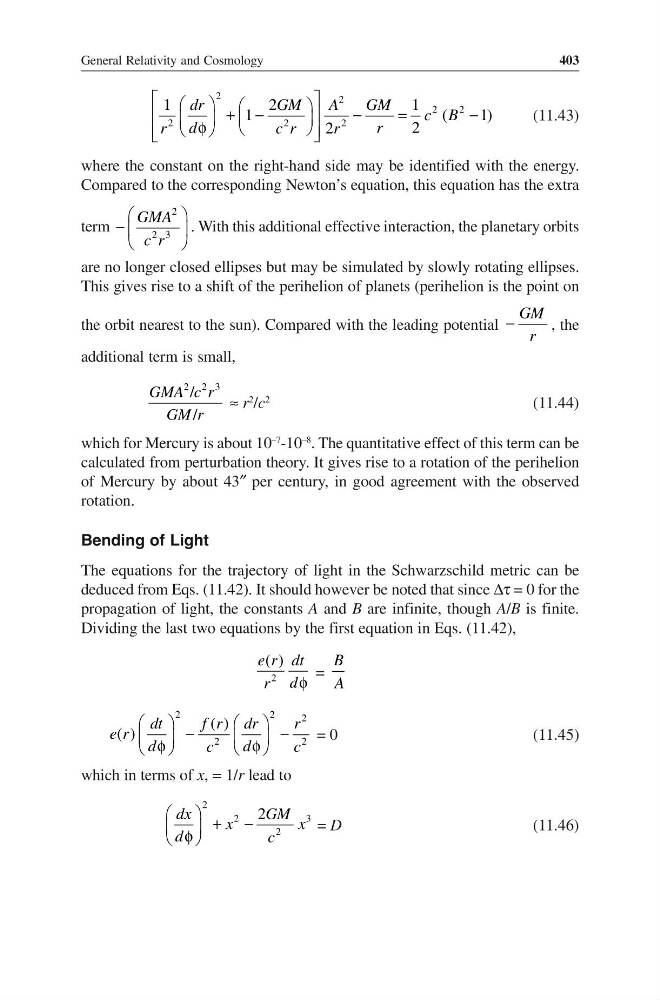
where the constant on the right-hand side may be identified with the energy.
Compared to the corresponding Newton’s equation, this equation has the extra
term
2
2 3
GMA
c r
−
. With this additional effective interaction, the planetary orbits
are no longer closed ellipses but may be simulated by slowly rotating ellipses.
This gives rise to a shift of the perihelion of planets (perihelion is the point on
the orbit nearest to the sun). Compared with the leading potential
GM
r
−
, the
additional term is small,
2 2 3
/
/
GMA c r
GM r
≈ r
2
/c
2
(11.44)
which for Mercury is about 10
–7
-10
–8
. The quantitative effect of this term can be
calculated from perturbation theory. It gives rise to a rotation of the perihelion
of Mercury by about 43″ per century, in good agreement with the observed
rotation.
Bending of Light
The equations for the trajectory of light in the Schwarzschild metric can be
deduced from Eqs. (11.42). It should however be noted that since ∆τ = 0 for the
propagation of light, the constants A and B are infinite, though A/B is finite.
Dividing the last two equations by the first equation in Eqs. (11.42),
2
( )
e r dt
d
r
φ
=
B
A
2
2
2
2
2
( )
( )
dt
f r dr
r
e r d
d
c
c
−
−
φ
φ
= 0
(11.45)
which in terms of x, = 1/r lead to
2
2
3
2
2
dx
GM
x
x
d
c
+ −
φ
= D
(11.46)
403
2
2
2
2
2
2
2
1
2
1
1
(
1 )
2
2
dr
GM
A
GM
c B
d
r
r
cr
r
+ −
−
=
−
φ
(11.43)
where the constant on the right-hand side may be identified with the energy.
Compared to the corresponding Newton’s equation, this equation has the extra
term
2
2 3
GMA
c r
−
. With this additional effective interaction, the planetary orbits
are no longer closed ellipses but may be simulated by slowly rotating ellipses.
This gives rise to a shift of the perihelion of planets (perihelion is the point on
the orbit nearest to the sun). Compared with the leading potential
GM
r
−
, the
additional term is small,
2 2 3
/
/
GMA c r
GM r
≈ r
2
/c
2
(11.44)
which for Mercury is about 10
–7
-10
–8
. The quantitative effect of this term can be
calculated from perturbation theory. It gives rise to a rotation of the perihelion
of Mercury by about 43″ per century, in good agreement with the observed
rotation.
Bending of Light
The equations for the trajectory of light in the Schwarzschild metric can be
deduced from Eqs. (11.42). It should however be noted that since ∆τ = 0 for the
propagation of light, the constants A and B are infinite, though A/B is finite.
Dividing the last two equations by the first equation in Eqs. (11.42),
2
( )
e r dt
d
r
φ
=
B
A
2
2
2
2
2
( )
( )
dt
f r dr
r
e r d
d
c
c
−
−
φ
φ
= 0
(11.45)
which in terms of x, = 1/r lead to
2
2
3
2
2
dx
GM
x
x
d
c
+ −
φ
= D
(11.46)