

Elements of Modern Physics
402
where ∆t is the displacement in the t-coordinate. The corresponding interval
shown by a clock at infinity, is
∆τ = ∆t
(11.37)
Therefore,
∆τ 0 =
1/2
2
2
1
GM
c r
−
∆ τ
(11.38)
which means that a clock in a gravitational field runs at a slower rate. This is
usually stated as implying that atoms (and human beings) in a gravitational
field live longer. Since frequency is inversely proportional to the time interval
this also gives the result that the frequency of radiation coming out of the field
is
v =
1/2
0
2
2
1
GM
v
c r
−
(11.39)
and in the weak field limit, i.e. for small GM/c
2
r,
0
0
v v
v
− ≈ 2
GM
c r
(11.40)
This is essentially the gravitational red shift deduced earlier, in Eq. (11.4),
from the equivalence principle.
Shift of the Perihelion
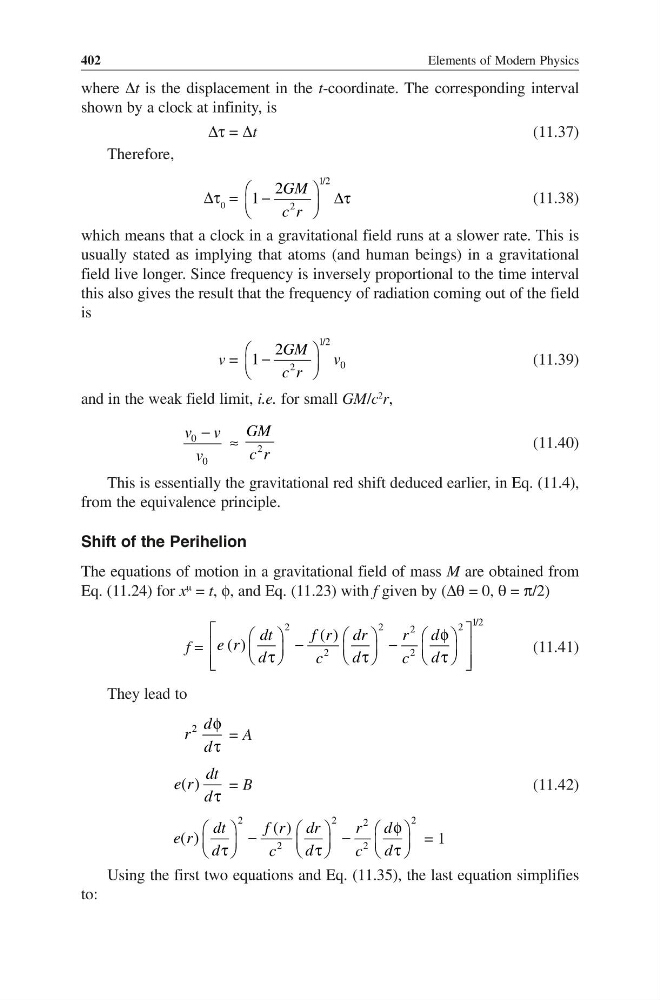
The equations of motion in a gravitational field of mass M are obtained from
Eq. (11.24) for x
µ
= t, φ, and Eq. (11.23) with f given by (∆θ = 0, θ = π/2)
f =
1/2
2
2
2
2
2
2
( )
( )
dt
f r dr
r d
e r d
d
d
c
c
φ
−
−
τ
τ
τ
(11.41)
They lead to
2 d
r d
φ
τ
= A
( )
dt
e r dτ
= B
(11.42)
2
2
2
2
2
2
( )
( )
dt
f r dr
r d
e r d
d
d
c
c
φ
−
−
τ
τ
τ
= 1
Using the first two equations and Eq. (11.35), the last equation simplifies
to:
402
where ∆t is the displacement in the t-coordinate. The corresponding interval
shown by a clock at infinity, is
∆τ = ∆t
(11.37)
Therefore,
∆τ 0 =
1/2
2
2
1
GM
c r
−
∆ τ
(11.38)
which means that a clock in a gravitational field runs at a slower rate. This is
usually stated as implying that atoms (and human beings) in a gravitational
field live longer. Since frequency is inversely proportional to the time interval
this also gives the result that the frequency of radiation coming out of the field
is
v =
1/2
0
2
2
1
GM
v
c r
−
(11.39)
and in the weak field limit, i.e. for small GM/c
2
r,
0
0
v v
v
− ≈ 2
GM
c r
(11.40)
This is essentially the gravitational red shift deduced earlier, in Eq. (11.4),
from the equivalence principle.
Shift of the Perihelion
The equations of motion in a gravitational field of mass M are obtained from
Eq. (11.24) for x
µ
= t, φ, and Eq. (11.23) with f given by (∆θ = 0, θ = π/2)
f =
1/2
2
2
2
2
2
2
( )
( )
dt
f r dr
r d
e r d
d
d
c
c
φ
−
−
τ
τ
τ
(11.41)
They lead to
2 d
r d
φ
τ
= A
( )
dt
e r dτ
= B
(11.42)
2
2
2
2
2
2
( )
( )
dt
f r dr
r d
e r d
d
d
c
c
φ
−
−
τ
τ
τ
= 1
Using the first two equations and Eq. (11.35), the last equation simplifies
to: