

General Relativity and Cosmology
405
stars whose radius is smaller than their Schwarzschild radius, are known as
black holes and the metric singularity gives rise to some unusual behaviour for
them.
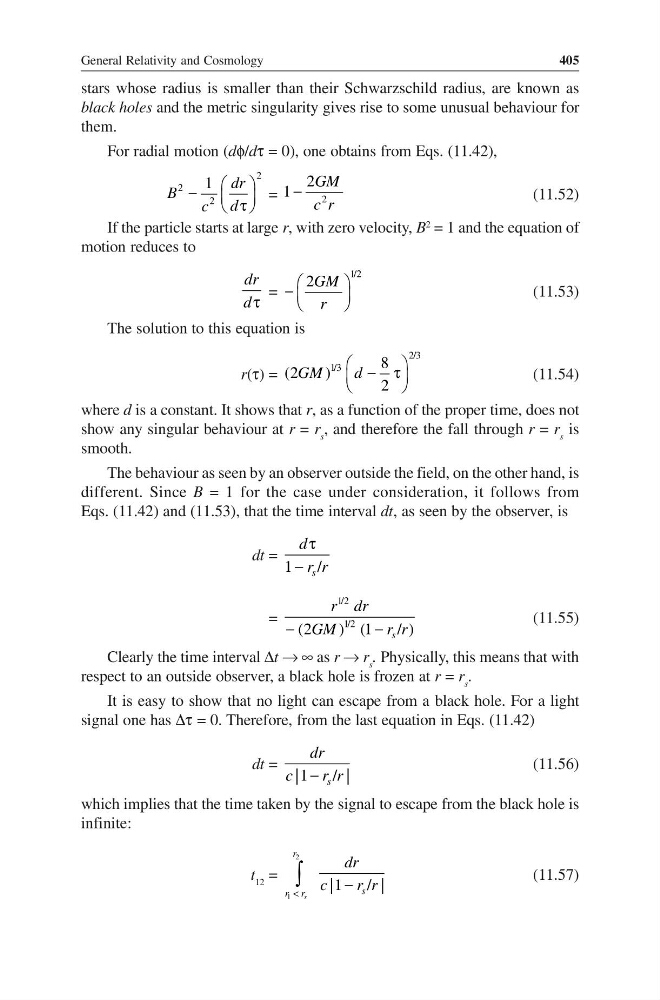
For radial motion (dφ/dτ = 0), one obtains from Eqs. (11.42),
2
2
2
1 dr
B
d
c
−
τ
=
2
2
1
GM
c r
−
(11.52)
If the particle starts at large r, with zero velocity, B
2
= 1 and the equation of
motion reduces to
dr
d τ
=
1/2
2GM
r
−
(11.53)
The solution to this equation is
r(τ) =
2/3
1/3
8
(2
)
2
GM
d
− τ
(11.54)
where d is a constant. It shows that r, as a function of the proper time, does not
show any singular behaviour at r = r s , and therefore the fall through r = r s is
smooth.
The behaviour as seen by an observer outside the field, on the other hand, is
different. Since B = 1 for the case under consideration, it follows from
Eqs. (11.42) and (11.53), that the time interval dt, as seen by the observer, is
dt = 1
/
s
d
r r
τ
−
=
1/2
1/2
(2
) (1
/ )
s
r dr
GM
r r
−
−
(11.55)
Clearly the time interval ∆t → ∞ as r → r s . Physically, this means that with
respect to an outside observer, a black hole is frozen at r = r s .
It is easy to show that no light can escape from a black hole. For a light
signal one has ∆τ = 0. Therefore, from the last equation in Eqs. (11.42)
dt = |1
/ |
s
dr
c
r r
−
(11.56)
which implies that the time taken by the signal to escape from the black hole is
infinite:
t 12 =
2
1
|1
/ |
s
r
s
r r
dr
c
r r
<
−
∫
(11.57)
405
stars whose radius is smaller than their Schwarzschild radius, are known as
black holes and the metric singularity gives rise to some unusual behaviour for
them.
For radial motion (dφ/dτ = 0), one obtains from Eqs. (11.42),
2
2
2
1 dr
B
d
c
−
τ
=
2
2
1
GM
c r
−
(11.52)
If the particle starts at large r, with zero velocity, B
2
= 1 and the equation of
motion reduces to
dr
d τ
=
1/2
2GM
r
−
(11.53)
The solution to this equation is
r(τ) =
2/3
1/3
8
(2
)
2
GM
d
− τ
(11.54)
where d is a constant. It shows that r, as a function of the proper time, does not
show any singular behaviour at r = r s , and therefore the fall through r = r s is
smooth.
The behaviour as seen by an observer outside the field, on the other hand, is
different. Since B = 1 for the case under consideration, it follows from
Eqs. (11.42) and (11.53), that the time interval dt, as seen by the observer, is
dt = 1
/
s
d
r r
τ
−
=
1/2
1/2
(2
) (1
/ )
s
r dr
GM
r r
−
−
(11.55)
Clearly the time interval ∆t → ∞ as r → r s . Physically, this means that with
respect to an outside observer, a black hole is frozen at r = r s .
It is easy to show that no light can escape from a black hole. For a light
signal one has ∆τ = 0. Therefore, from the last equation in Eqs. (11.42)
dt = |1
/ |
s
dr
c
r r
−
(11.56)
which implies that the time taken by the signal to escape from the black hole is
infinite:
t 12 =
2
1
|1
/ |
s
r
s
r r
dr
c
r r
<
−
∫
(11.57)