

Elements of Modern Physics
400
a from P, along the geodesics. If the circumference of the circle is of length l,
the curvature is given by
K =
3
0
3
2
lim
a
a l
a
→
π −
π
(11.28)
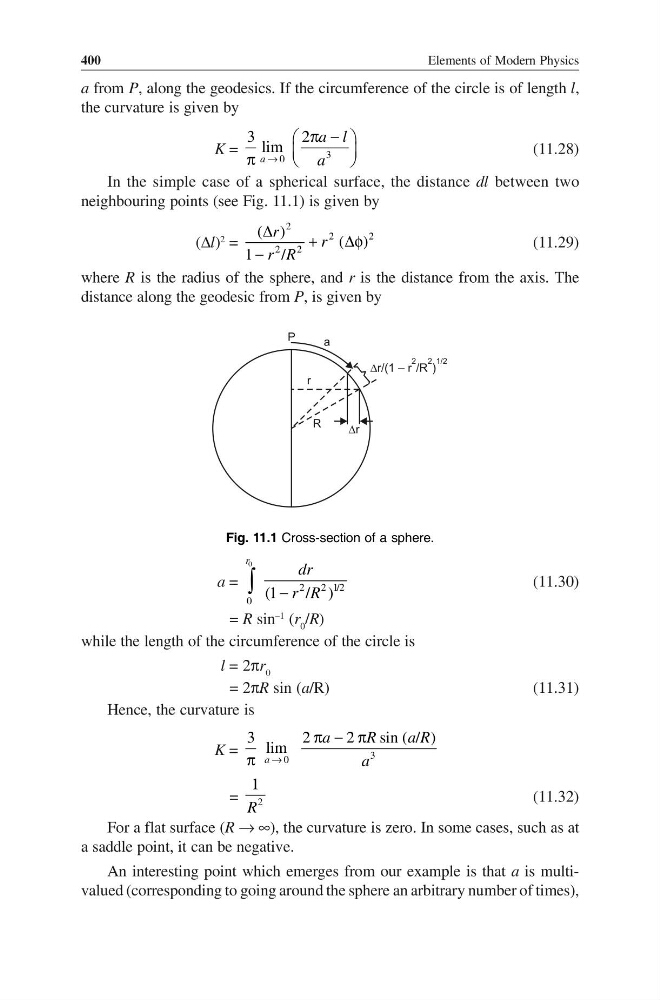
In the simple case of a spherical surface, the distance dl between two
neighbouring points (see Fig. 11.1) is given by
(∆l)
2
=
2
2
2
2
2
( )
( )
1
/
r
r
r R
∆
+
∆φ
−
(11.29)
where R is the radius of the sphere, and r is the distance from the axis. The
distance along the geodesic from P, is given by
R
Dr
Dr/(1 – r /R )
2 2 1/2
a
P
r
Fig. 11.1 Cross-section of a sphere.
a =
0
2
2 1 /2
0
(1
/ )
r
dr
r R
−
∫
(11.30)
= R sin
–1
(r 0 /R)
while the length of the circumference of the circle is
l = 2πr 0
= 2πR sin (a/R)
(11.31)
Hence, the curvature is
K =
3
0
3
2
2
sin( / )
lim
a
a
R
aR
a
→
π − π
π
= 2
1
R
(11.32)
For a flat surface (R → ∞), the curvature is zero. In some cases, such as at
a saddle point, it can be negative.
An interesting point which emerges from our example is that a is multivalued (corresponding to going around the sphere an arbitrary number of times),
400
a from P, along the geodesics. If the circumference of the circle is of length l,
the curvature is given by
K =
3
0
3
2
lim
a
a l
a
→
π −
π
(11.28)
In the simple case of a spherical surface, the distance dl between two
neighbouring points (see Fig. 11.1) is given by
(∆l)
2
=
2
2
2
2
2
( )
( )
1
/
r
r
r R
∆
+
∆φ
−
(11.29)
where R is the radius of the sphere, and r is the distance from the axis. The
distance along the geodesic from P, is given by
R
Dr
Dr/(1 – r /R )
2 2 1/2
a
P
r
Fig. 11.1 Cross-section of a sphere.
a =
0
2
2 1 /2
0
(1
/ )
r
dr
r R
−
∫
(11.30)
= R sin
–1
(r 0 /R)
while the length of the circumference of the circle is
l = 2πr 0
= 2πR sin (a/R)
(11.31)
Hence, the curvature is
K =
3
0
3
2
2
sin( / )
lim
a
a
R
aR
a
→
π − π
π
= 2
1
R
(11.32)
For a flat surface (R → ∞), the curvature is zero. In some cases, such as at
a saddle point, it can be negative.
An interesting point which emerges from our example is that a is multivalued (corresponding to going around the sphere an arbitrary number of times),