

General Relativity and Cosmology
395
shift of ∆λ/λ 0 ≈ – gh/c
2
≈ – (2.57 ± 0.26) × 10
–15
compared with the predicted
value of – 2.46 × 10
–15
.
The theory of general relativity is based on the principle of equivalence and
includes the gravitational effects in terms of the geometry of the space. The
theory makes no distinction between gravitational and inertial effects, both being
related to the energy and momentum distribution of matter and hence
incorporates Mach’s principle to some extent (there are some difficulties is the
interpretation of boundary conditions in the case of an infinite universe).
11.2 CURVED SPACE-TIME
In the theory of general relativity, the inertial and gravitational effects are
described by the geometry of the space. These effects modify the space properties,
e.g. the surface may become curved, which affect the dynamics of objects.
Some of the ideas involved can be illustrated by the following simple example.
Metric Tensor of the Space
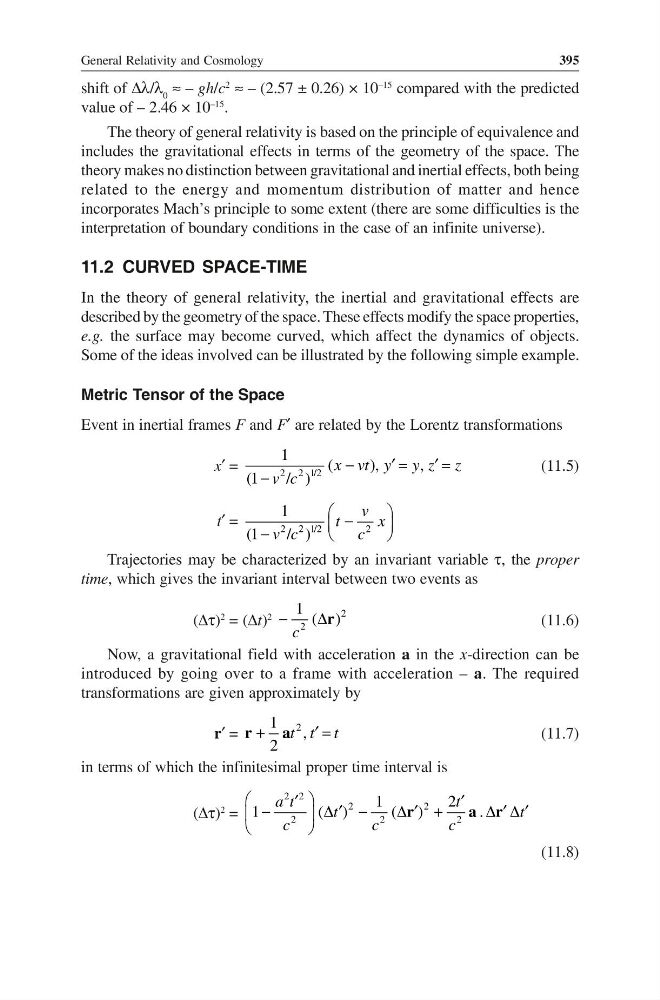
Event in inertial frames F and F′ are related by the Lorentz transformations
x′ =
2 2 1 /2
1
(
),
,
(1
/ )
x vt y y z z
v c
−
′=
′=
−
(11.5)
t′ =
2
1 / 2
2
1
(1
/ )
v
t
x
v c
c
2
−
−
Trajectories may be characterized by an invariant variable τ, the proper
time, which gives the invariant interval between two events as
(∆τ)
2
= (∆t)
2
2
2
1 ( )
c
−
∆r
(11.6)
Now, a gravitational field with acceleration a in the x-direction can be
introduced by going over to a frame with acceleration – a. The required
transformations are given approximately by
r′ =
2
1
,
2
t t t
+
′=
r
a
(11.7)
in terms of which the infinitesimal proper time interval is
(∆τ)
2
=
2 2
2
2
2
2
2
1
2
1
( )
( )
.
a t
t
t
t
c
c
c
′
′
−
∆′ −
∆ ′ +
∆ ′∆′
r
a r
(11.8)
395
shift of ∆λ/λ 0 ≈ – gh/c
2
≈ – (2.57 ± 0.26) × 10
–15
compared with the predicted
value of – 2.46 × 10
–15
.
The theory of general relativity is based on the principle of equivalence and
includes the gravitational effects in terms of the geometry of the space. The
theory makes no distinction between gravitational and inertial effects, both being
related to the energy and momentum distribution of matter and hence
incorporates Mach’s principle to some extent (there are some difficulties is the
interpretation of boundary conditions in the case of an infinite universe).
11.2 CURVED SPACE-TIME
In the theory of general relativity, the inertial and gravitational effects are
described by the geometry of the space. These effects modify the space properties,
e.g. the surface may become curved, which affect the dynamics of objects.
Some of the ideas involved can be illustrated by the following simple example.
Metric Tensor of the Space
Event in inertial frames F and F′ are related by the Lorentz transformations
x′ =
2 2 1 /2
1
(
),
,
(1
/ )
x vt y y z z
v c
−
′=
′=
−
(11.5)
t′ =
2
1 / 2
2
1
(1
/ )
v
t
x
v c
c
2
−
−
Trajectories may be characterized by an invariant variable τ, the proper
time, which gives the invariant interval between two events as
(∆τ)
2
= (∆t)
2
2
2
1 ( )
c
−
∆r
(11.6)
Now, a gravitational field with acceleration a in the x-direction can be
introduced by going over to a frame with acceleration – a. The required
transformations are given approximately by
r′ =
2
1
,
2
t t t
+
′=
r
a
(11.7)
in terms of which the infinitesimal proper time interval is
(∆τ)
2
=
2 2
2
2
2
2
2
1
2
1
( )
( )
.
a t
t
t
t
c
c
c
′
′
−
∆′ −
∆ ′ +
∆ ′∆′
r
a r
(11.8)