

Elements of Modern Physics
394
The physical laws are locally the same in an inertial frame with gravitational
acceleration g and a noninertial frame with acceleration – g but no gravity.
It is important to note that the equivalence is local since the gravitational
field tends to zero at large distances whereas the inertial forces in general do
not vanish at infinity.
The principle of equivalence gives special importance to freely-falling
frames. In these frames, the local effect of gravity is cancelled by the inertial
forces so that they form local inertial frames and the considerations of special
relativity suffice to describe the physical observations in them. They allow us
to deduce two interesting results without going into additional details of the
general theory.
1. Bending of light in a gravitational field: Consider a beam of light in a
gravitational field. Observed from a freely-falling frame which is locally
inertial, the beam travels in a straight line. However, the frame with the
gravitational field moves with acceleration – g with respect to the freelyfalling frame so that in this frame the beam appears to bend in the direction
of g. This is a remarkable result since just the finiteness of the velocity
of light implies that light interacts with gravitational fields. The bending
of light in a gravitational field is observed in the deflection of light from
the stars, moving past the sun, seen during total solar eclipses. However,
since g is not constant along the path of the beam, quantitative calculations
are rather complicated. It may be noted that the predictions of general
theory agree with the observations within experimental accuracy.
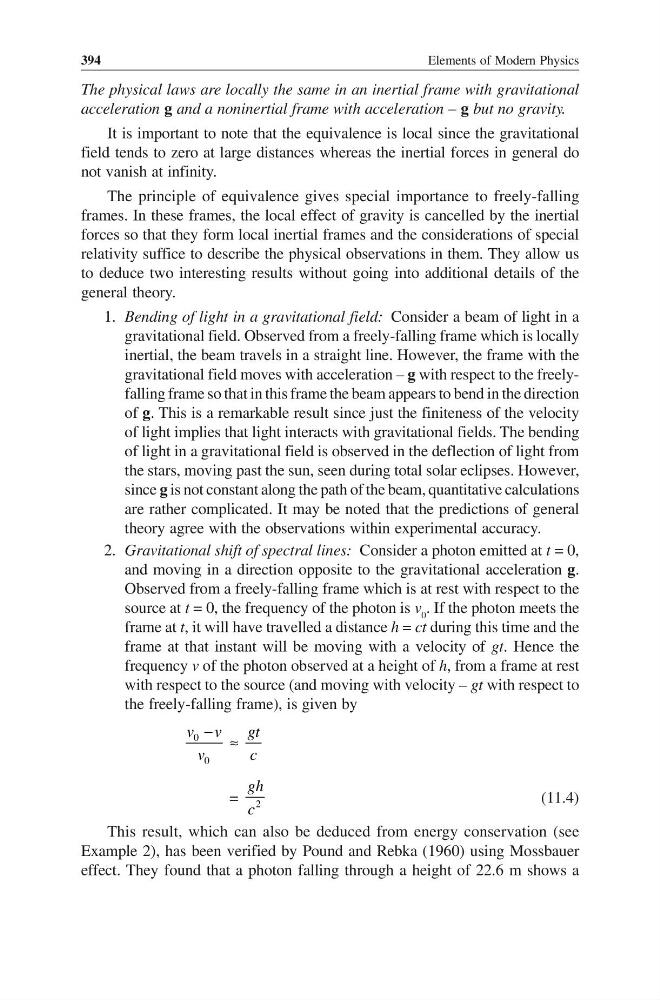
2. Gravitational shift of spectral lines: Consider a photon emitted at t = 0,
and moving in a direction opposite to the gravitational acceleration g.
Observed from a freely-falling frame which is at rest with respect to the
source at t = 0, the frequency of the photon is v 0 . If the photon meets the
frame at t, it will have travelled a distance h = ct during this time and the
frame at that instant will be moving with a velocity of gt. Hence the
frequency v of the photon observed at a height of h, from a frame at rest
with respect to the source (and moving with velocity – gt with respect to
the freely-falling frame), is given by
0
0
v v
v
− ≈
gt
c
= 2
gh
c
(11.4)
This result, which can also be deduced from energy conservation (see
Example 2), has been verified by Pound and Rebka (1960) using Mossbauer
effect. They found that a photon falling through a height of 22.6 m shows a
394
The physical laws are locally the same in an inertial frame with gravitational
acceleration g and a noninertial frame with acceleration – g but no gravity.
It is important to note that the equivalence is local since the gravitational
field tends to zero at large distances whereas the inertial forces in general do
not vanish at infinity.
The principle of equivalence gives special importance to freely-falling
frames. In these frames, the local effect of gravity is cancelled by the inertial
forces so that they form local inertial frames and the considerations of special
relativity suffice to describe the physical observations in them. They allow us
to deduce two interesting results without going into additional details of the
general theory.
1. Bending of light in a gravitational field: Consider a beam of light in a
gravitational field. Observed from a freely-falling frame which is locally
inertial, the beam travels in a straight line. However, the frame with the
gravitational field moves with acceleration – g with respect to the freelyfalling frame so that in this frame the beam appears to bend in the direction
of g. This is a remarkable result since just the finiteness of the velocity
of light implies that light interacts with gravitational fields. The bending
of light in a gravitational field is observed in the deflection of light from
the stars, moving past the sun, seen during total solar eclipses. However,
since g is not constant along the path of the beam, quantitative calculations
are rather complicated. It may be noted that the predictions of general
theory agree with the observations within experimental accuracy.
2. Gravitational shift of spectral lines: Consider a photon emitted at t = 0,
and moving in a direction opposite to the gravitational acceleration g.
Observed from a freely-falling frame which is at rest with respect to the
source at t = 0, the frequency of the photon is v 0 . If the photon meets the
frame at t, it will have travelled a distance h = ct during this time and the
frame at that instant will be moving with a velocity of gt. Hence the
frequency v of the photon observed at a height of h, from a frame at rest
with respect to the source (and moving with velocity – gt with respect to
the freely-falling frame), is given by
0
0
v v
v
− ≈
gt
c
= 2
gh
c
(11.4)
This result, which can also be deduced from energy conservation (see
Example 2), has been verified by Pound and Rebka (1960) using Mossbauer
effect. They found that a photon falling through a height of 22.6 m shows a