

Elements of Modern Physics
396
Thus, a gravitational (or inertial effect is described by a more complicated
measure or metric of ∆τ in terms of ∆t′, ∆x′, ∆y′, ∆z′.
The expression of the measure, for a frame in arbitrary motion, can be
stated in a compact form by writing
(∆τ)
2
= g µv ∆x
µ
∆x
v
(11.9)
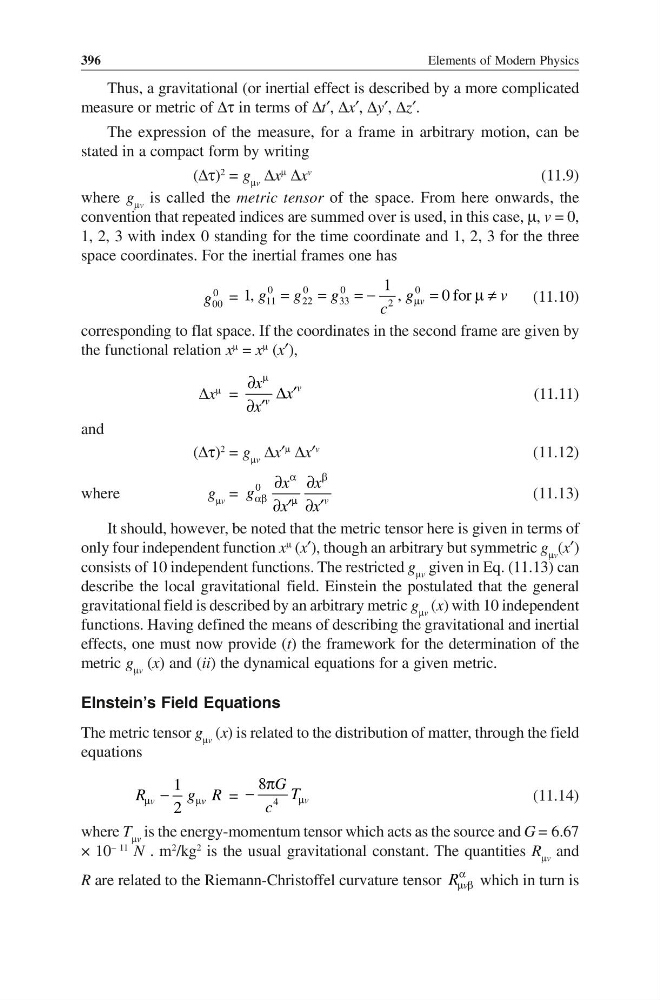
where g µv is called the metric tensor of the space. From here onwards, the
convention that repeated indices are summed over is used, in this case, µ, v = 0,
1, 2, 3 with index 0 standing for the time coordinate and 1, 2, 3 for the three
space coordinates. For the inertial frames one has
0
00
g =
0
0
0
0
11
22
33
2
1
1,
,
0 for
v
g
g
g
g
v
c
µ
=
=
=−
=
µ≠
(11.10)
corresponding to flat space. If the coordinates in the second frame are given by
the functional relation x
µ
= x
µ
(x′),
∆x
µ
=
v
v
x x
x
µ
∂ ∆ ′
∂ ′
(11.11)
and
(∆τ)
2
= g µv ∆x′
µ
∆x′
v
(11.12)
where
g µv =
0
v
x
x
g
x
x
α
β
αβ
µ
∂
∂
∂ ′ ∂ ′
(11.13)
It should, however, be noted that the metric tensor here is given in terms of
only four independent function x
µ
(x′), though an arbitrary but symmetric g µv (x′)
consists of 10 independent functions. The restricted g µv given in Eq. (11.13) can
describe the local gravitational field. Einstein the postulated that the general
gravitational field is described by an arbitrary metric g µv (x) with 10 independent
functions. Having defined the means of describing the gravitational and inertial
effects, one must now provide (t) the framework for the determination of the
metric g µv (x) and (ii) the dynamical equations for a given metric.
Elnstein’s Field Equations
The metric tensor g µv (x) is related to the distribution of matter, through the field
equations
1
2
v
v
R
g R
µ
µ
−
=
4
8
v
G T
c
µ
π
−
(11.14)
where T µv is the energy-momentum tensor which acts as the source and G = 6.67
× 10
– 11
N . m
2
/kg
2
is the usual gravitational constant. The quantities R µv and
R are related to the Riemann-Christoffel curvature tensor v
R
α
µ β which in turn is
396
Thus, a gravitational (or inertial effect is described by a more complicated
measure or metric of ∆τ in terms of ∆t′, ∆x′, ∆y′, ∆z′.
The expression of the measure, for a frame in arbitrary motion, can be
stated in a compact form by writing
(∆τ)
2
= g µv ∆x
µ
∆x
v
(11.9)
where g µv is called the metric tensor of the space. From here onwards, the
convention that repeated indices are summed over is used, in this case, µ, v = 0,
1, 2, 3 with index 0 standing for the time coordinate and 1, 2, 3 for the three
space coordinates. For the inertial frames one has
0
00
g =
0
0
0
0
11
22
33
2
1
1,
,
0 for
v
g
g
g
g
v
c
µ
=
=
=−
=
µ≠
(11.10)
corresponding to flat space. If the coordinates in the second frame are given by
the functional relation x
µ
= x
µ
(x′),
∆x
µ
=
v
v
x x
x
µ
∂ ∆ ′
∂ ′
(11.11)
and
(∆τ)
2
= g µv ∆x′
µ
∆x′
v
(11.12)
where
g µv =
0
v
x
x
g
x
x
α
β
αβ
µ
∂
∂
∂ ′ ∂ ′
(11.13)
It should, however, be noted that the metric tensor here is given in terms of
only four independent function x
µ
(x′), though an arbitrary but symmetric g µv (x′)
consists of 10 independent functions. The restricted g µv given in Eq. (11.13) can
describe the local gravitational field. Einstein the postulated that the general
gravitational field is described by an arbitrary metric g µv (x) with 10 independent
functions. Having defined the means of describing the gravitational and inertial
effects, one must now provide (t) the framework for the determination of the
metric g µv (x) and (ii) the dynamical equations for a given metric.
Elnstein’s Field Equations
The metric tensor g µv (x) is related to the distribution of matter, through the field
equations
1
2
v
v
R
g R
µ
µ
−
=
4
8
v
G T
c
µ
π
−
(11.14)
where T µv is the energy-momentum tensor which acts as the source and G = 6.67
× 10
– 11
N . m
2
/kg
2
is the usual gravitational constant. The quantities R µv and
R are related to the Riemann-Christoffel curvature tensor v
R
α
µ β which in turn is