

Elementary Particles
381
Cosmic Rays
Before the development of powerful accelerators, the cosmis rays were the
only source of particles with sufficient energy to produce mesons and strange
baryons. Many particles such as the positrons, the µ-mesons, the π-mesons,
and several strange particles were first observed in the cosmic rays.
Primary cosmic rays are a flux of energetic charged particles, mainly protons
(about 89% protons, 9% helium nuclei, 1% remaining heavier elements and
about 1% electrons) that are incident on the earth. The energy of these particles
varies from about 10
3
MeV to 10
–14
MeV(average energy is about 10
4
MeV).
When these energetic particles encounter the earth’s atmosphere, they undergo
inelastic collisions, producing what are called secondary cosmic rays which
consist of mesons, protons, neutrons, strange particles etc. These secondary
cosmic rays will themselves undergo additional elastic collisions, producing
nucleonic cascades. Ultimately they reach the ground with a composition of
about 80% µ-mesons, the remaining being protons, neutrons and some strange
particles.
The origin of the rays is thought to be supernova explosions, with additional
contributions from the sun (low energy cosmic rays), the centra of the galaxy,
etc. Some high energy particles may be from outside our galaxy.
While the cosmic rays have proved to be important for the discovery of
many particles, they have the disadvantage that neither their energy, nor their
intensity, can be monitored to our convenience.
Van de Graaff Generator
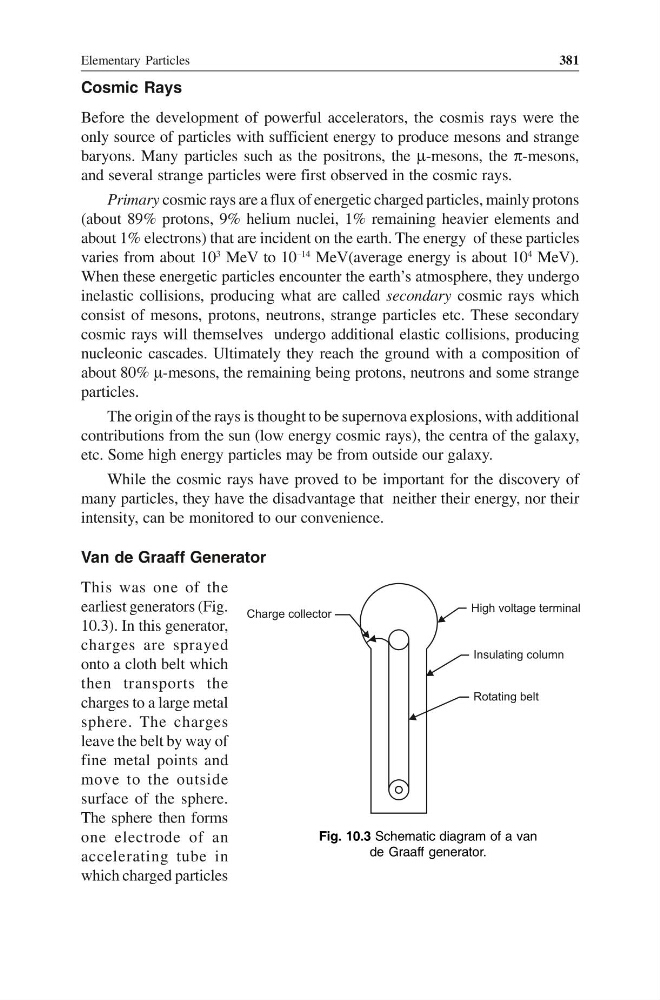
This was one of the
earliest generators (Fig.
10.3). In this generator,
charges are sprayed
onto a cloth belt which
then transports the
charges to a large metal
sphere. The charges
leave the belt by way of
fine metal points and
move to the outside
surface of the sphere.
The sphere then forms
one electrode of an
accelerating tube in
which charged particles
Charge collector
High voltage terminal
Insulating column
Rotating belt
Fig. 10.3 Schematic diagram of a van
de Graaff generator.
381
Cosmic Rays
Before the development of powerful accelerators, the cosmis rays were the
only source of particles with sufficient energy to produce mesons and strange
baryons. Many particles such as the positrons, the µ-mesons, the π-mesons,
and several strange particles were first observed in the cosmic rays.
Primary cosmic rays are a flux of energetic charged particles, mainly protons
(about 89% protons, 9% helium nuclei, 1% remaining heavier elements and
about 1% electrons) that are incident on the earth. The energy of these particles
varies from about 10
3
MeV to 10
–14
MeV(average energy is about 10
4
MeV).
When these energetic particles encounter the earth’s atmosphere, they undergo
inelastic collisions, producing what are called secondary cosmic rays which
consist of mesons, protons, neutrons, strange particles etc. These secondary
cosmic rays will themselves undergo additional elastic collisions, producing
nucleonic cascades. Ultimately they reach the ground with a composition of
about 80% µ-mesons, the remaining being protons, neutrons and some strange
particles.
The origin of the rays is thought to be supernova explosions, with additional
contributions from the sun (low energy cosmic rays), the centra of the galaxy,
etc. Some high energy particles may be from outside our galaxy.
While the cosmic rays have proved to be important for the discovery of
many particles, they have the disadvantage that neither their energy, nor their
intensity, can be monitored to our convenience.
Van de Graaff Generator
This was one of the
earliest generators (Fig.
10.3). In this generator,
charges are sprayed
onto a cloth belt which
then transports the
charges to a large metal
sphere. The charges
leave the belt by way of
fine metal points and
move to the outside
surface of the sphere.
The sphere then forms
one electrode of an
accelerating tube in
which charged particles
Charge collector
High voltage terminal
Insulating column
Rotating belt
Fig. 10.3 Schematic diagram of a van
de Graaff generator.