

Elements of Modern Physics
382
(such as the protons) can be accelerated. This accelerator can be used for
accelerating protons to energies of about 15 MeV and is very useful in lowenergy nuclear physics. The limitations of linear accelerators are in general due
to the length, instability and loss of voltage.
The Cyclotron
The cyclotron is based on the principle that charged particles (nonrelativistic)
in a constant magnetic field B perform circular motion whose frequency is
independent of the magnitude of the velocity. The frequency is obtained by the
force-acceleration relation
ev B = mv
2
/r
(10.41)
or
ω =
eB
m
(10.42)
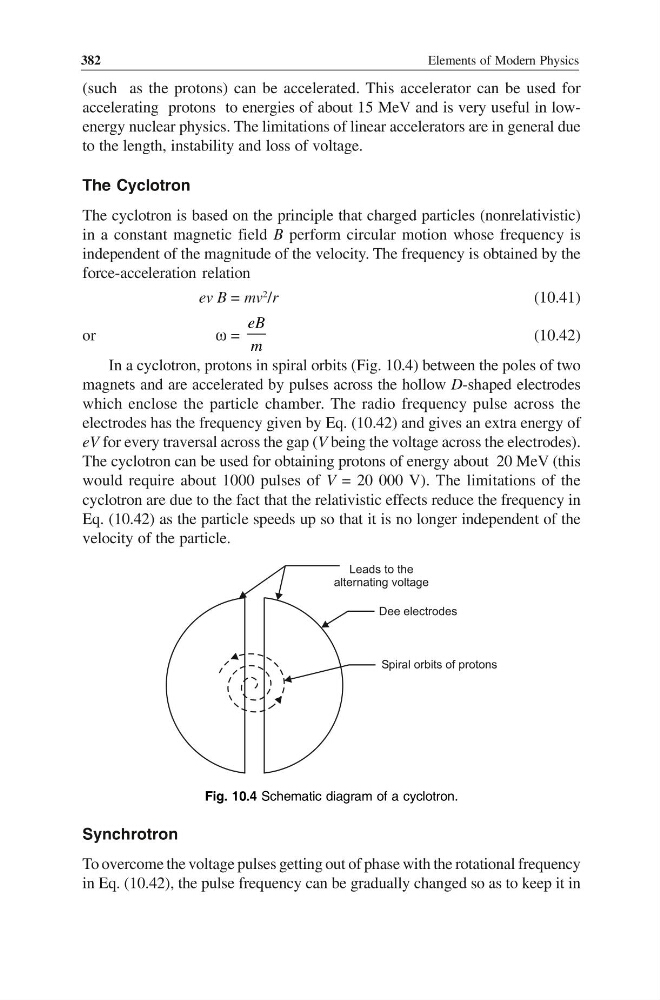
In a cyclotron, protons in spiral orbits (Fig. 10.4) between the poles of two
magnets and are accelerated by pulses across the hollow D-shaped electrodes
which enclose the particle chamber. The radio frequency pulse across the
electrodes has the frequency given by Eq. (10.42) and gives an extra energy of
eV for every traversal across the gap (V being the voltage across the electrodes).
The cyclotron can be used for obtaining protons of energy about 20 MeV (this
would require about 1000 pulses of V = 20 000 V). The limitations of the
cyclotron are due to the fact that the relativistic effects reduce the frequency in
Eq. (10.42) as the particle speeds up so that it is no longer independent of the
velocity of the particle.
Leads to the
alternating voltage
Dee electrodes
Spiral orbits of protons
Fig. 10.4 Schematic diagram of a cyclotron.
Synchrotron
To overcome the voltage pulses getting out of phase with the rotational frequency
in Eq. (10.42), the pulse frequency can be gradually changed so as to keep it in
382
(such as the protons) can be accelerated. This accelerator can be used for
accelerating protons to energies of about 15 MeV and is very useful in lowenergy nuclear physics. The limitations of linear accelerators are in general due
to the length, instability and loss of voltage.
The Cyclotron
The cyclotron is based on the principle that charged particles (nonrelativistic)
in a constant magnetic field B perform circular motion whose frequency is
independent of the magnitude of the velocity. The frequency is obtained by the
force-acceleration relation
ev B = mv
2
/r
(10.41)
or
ω =
eB
m
(10.42)
In a cyclotron, protons in spiral orbits (Fig. 10.4) between the poles of two
magnets and are accelerated by pulses across the hollow D-shaped electrodes
which enclose the particle chamber. The radio frequency pulse across the
electrodes has the frequency given by Eq. (10.42) and gives an extra energy of
eV for every traversal across the gap (V being the voltage across the electrodes).
The cyclotron can be used for obtaining protons of energy about 20 MeV (this
would require about 1000 pulses of V = 20 000 V). The limitations of the
cyclotron are due to the fact that the relativistic effects reduce the frequency in
Eq. (10.42) as the particle speeds up so that it is no longer independent of the
velocity of the particle.
Leads to the
alternating voltage
Dee electrodes
Spiral orbits of protons
Fig. 10.4 Schematic diagram of a cyclotron.
Synchrotron
To overcome the voltage pulses getting out of phase with the rotational frequency
in Eq. (10.42), the pulse frequency can be gradually changed so as to keep it in