

Elements of Modern Physics
380
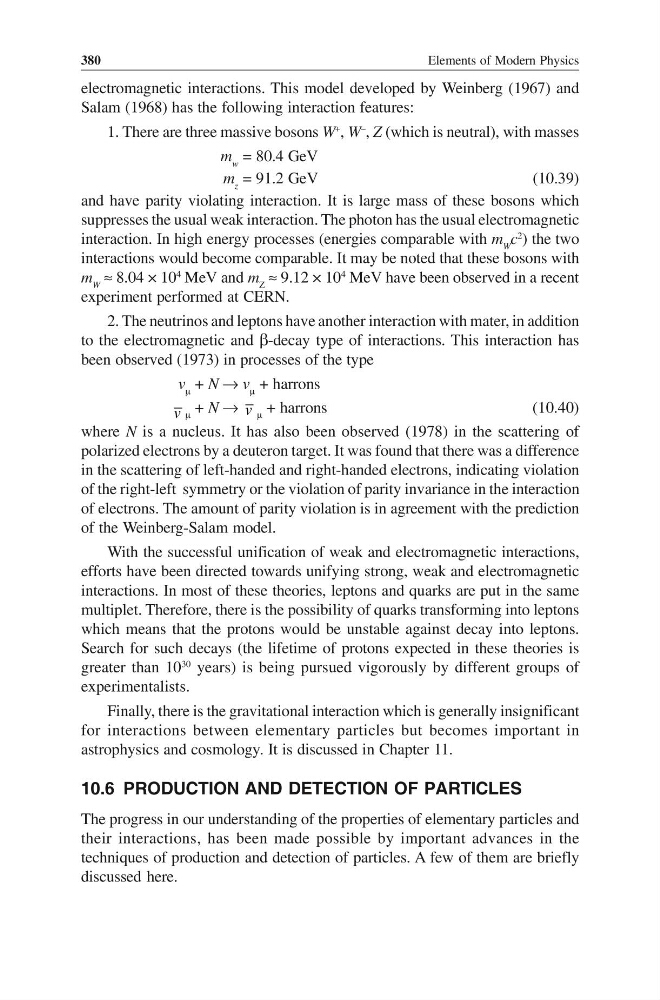
electromagnetic interactions. This model developed by Weinberg (1967) and
Salam (1968) has the following interaction features:
1. There are three massive bosons W
+
, W
–
, Z (which is neutral), with masses
m w = 80.4 GeV
m z = 91.2 GeV
(10.39)
and have parity violating interaction. It is large mass of these bosons which
suppresses the usual weak interaction. The photon has the usual electromagnetic
interaction. In high energy processes (energies comparable with m W c
2
) the two
interactions would become comparable. It may be noted that these bosons with
m W ≈ 8.04 × 10
4
MeV and m Z ≈ 9.12 × 10
4
MeV have been observed in a recent
experiment performed at CERN.
2. The neutrinos and leptons have another interaction with mater, in addition
to the electromagnetic and β-decay type of interactions. This interaction has
been observed (1973) in processes of the type
v µ + N → v µ + harrons
v µ + N → v µ + harrons
(10.40)
where N is a nucleus. It has also been observed (1978) in the scattering of
polarized electrons by a deuteron target. It was found that there was a difference
in the scattering of left-handed and right-handed electrons, indicating violation
of the right-left symmetry or the violation of parity invariance in the interaction
of electrons. The amount of parity violation is in agreement with the prediction
of the Weinberg-Salam model.
With the successful unification of weak and electromagnetic interactions,
efforts have been directed towards unifying strong, weak and electromagnetic
interactions. In most of these theories, leptons and quarks are put in the same
multiplet. Therefore, there is the possibility of quarks transforming into leptons
which means that the protons would be unstable against decay into leptons.
Search for such decays (the lifetime of protons expected in these theories is
greater than 10
30
years) is being pursued vigorously by different groups of
experimentalists.
Finally, there is the gravitational interaction which is generally insignificant
for interactions between elementary particles but becomes important in
astrophysics and cosmology. It is discussed in Chapter 11.
10.6 PRODUCTION AND DETECTION OF PARTICLES
The progress in our understanding of the properties of elementary particles and
their interactions, has been made possible by important advances in the
techniques of production and detection of particles. A few of them are briefly
discussed here.
380
electromagnetic interactions. This model developed by Weinberg (1967) and
Salam (1968) has the following interaction features:
1. There are three massive bosons W
+
, W
–
, Z (which is neutral), with masses
m w = 80.4 GeV
m z = 91.2 GeV
(10.39)
and have parity violating interaction. It is large mass of these bosons which
suppresses the usual weak interaction. The photon has the usual electromagnetic
interaction. In high energy processes (energies comparable with m W c
2
) the two
interactions would become comparable. It may be noted that these bosons with
m W ≈ 8.04 × 10
4
MeV and m Z ≈ 9.12 × 10
4
MeV have been observed in a recent
experiment performed at CERN.
2. The neutrinos and leptons have another interaction with mater, in addition
to the electromagnetic and β-decay type of interactions. This interaction has
been observed (1973) in processes of the type
v µ + N → v µ + harrons
v µ + N → v µ + harrons
(10.40)
where N is a nucleus. It has also been observed (1978) in the scattering of
polarized electrons by a deuteron target. It was found that there was a difference
in the scattering of left-handed and right-handed electrons, indicating violation
of the right-left symmetry or the violation of parity invariance in the interaction
of electrons. The amount of parity violation is in agreement with the prediction
of the Weinberg-Salam model.
With the successful unification of weak and electromagnetic interactions,
efforts have been directed towards unifying strong, weak and electromagnetic
interactions. In most of these theories, leptons and quarks are put in the same
multiplet. Therefore, there is the possibility of quarks transforming into leptons
which means that the protons would be unstable against decay into leptons.
Search for such decays (the lifetime of protons expected in these theories is
greater than 10
30
years) is being pursued vigorously by different groups of
experimentalists.
Finally, there is the gravitational interaction which is generally insignificant
for interactions between elementary particles but becomes important in
astrophysics and cosmology. It is discussed in Chapter 11.
10.6 PRODUCTION AND DETECTION OF PARTICLES
The progress in our understanding of the properties of elementary particles and
their interactions, has been made possible by important advances in the
techniques of production and detection of particles. A few of them are briefly
discussed here.