

Elements of Modern Physics
368
The properties of the interactions and the classification of particles are
now considered.
10.2 STRONG INTERACTION
Quarks interact with each other strongly by exchanging gluons which are
supposed to be eight in number. The strength of this interaction called the strong
interaction is given by
α s ≈ 0.4 – 0.2
(10.4)
which may be compared with the corresponding strength of electromagnetic
interaction given by the fine structure constant α ≈ 1/137. As a result of this
interaction (one also postulates an additional confining potential), bound states
are obtained, which are the observed strongly interacting particles. They are
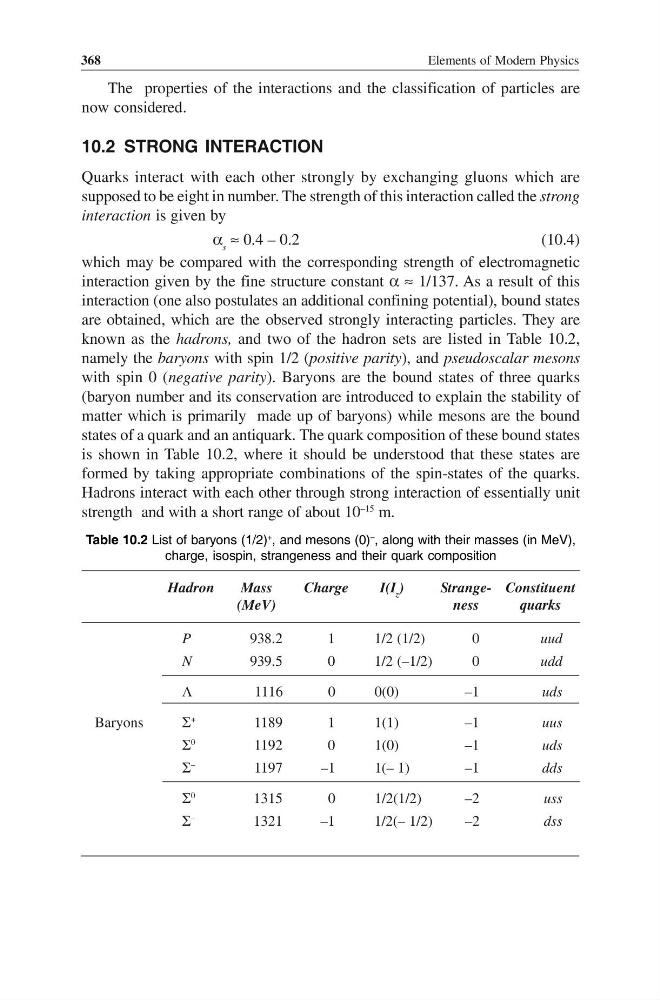
known as the hadrons, and two of the hadron sets are listed in Table 10.2,
namely the baryons with spin 1/2 (positive parity), and pseudoscalar mesons
with spin 0 (negative parity). Baryons are the bound states of three quarks
(baryon number and its conservation are introduced to explain the stability of
matter which is primarily made up of baryons) while mesons are the bound
states of a quark and an antiquark. The quark composition of these bound states
is shown in Table 10.2, where it should be understood that these states are
formed by taking appropriate combinations of the spin-states of the quarks.
Hadrons interact with each other through strong interaction of essentially unit
strength and with a short range of about 10
–15
m.
Table 10.2 List of baryons (1/2)
+
, and mesons (0)
–
, along with their masses (in MeV),
charge, isospin, strangeness and their quark composition
Hadron
Mass
Charge
I(I z )
Strange- Constituent
(MeV)
ness
quarks
P
938.2
1
1/2 (1/2)
0
uud
N
939.5
0
1/2 (–1/2)
0
udd
Λ
1116
0
0(0)
–1
uds
Baryons
Σ
+
1189
1
1(1)
–1
uus
Σ
0
1192
0
1(0)
–1
uds
Σ
–
1197
–1
1(– 1)
–1
dds
Σ
0
1315
0
1/2(1/2)
–2
uss
Σ
–
1321
–1
1/2(– 1/2)
–2
dss
368
The properties of the interactions and the classification of particles are
now considered.
10.2 STRONG INTERACTION
Quarks interact with each other strongly by exchanging gluons which are
supposed to be eight in number. The strength of this interaction called the strong
interaction is given by
α s ≈ 0.4 – 0.2
(10.4)
which may be compared with the corresponding strength of electromagnetic
interaction given by the fine structure constant α ≈ 1/137. As a result of this
interaction (one also postulates an additional confining potential), bound states
are obtained, which are the observed strongly interacting particles. They are
known as the hadrons, and two of the hadron sets are listed in Table 10.2,
namely the baryons with spin 1/2 (positive parity), and pseudoscalar mesons
with spin 0 (negative parity). Baryons are the bound states of three quarks
(baryon number and its conservation are introduced to explain the stability of
matter which is primarily made up of baryons) while mesons are the bound
states of a quark and an antiquark. The quark composition of these bound states
is shown in Table 10.2, where it should be understood that these states are
formed by taking appropriate combinations of the spin-states of the quarks.
Hadrons interact with each other through strong interaction of essentially unit
strength and with a short range of about 10
–15
m.
Table 10.2 List of baryons (1/2)
+
, and mesons (0)
–
, along with their masses (in MeV),
charge, isospin, strangeness and their quark composition
Hadron
Mass
Charge
I(I z )
Strange- Constituent
(MeV)
ness
quarks
P
938.2
1
1/2 (1/2)
0
uud
N
939.5
0
1/2 (–1/2)
0
udd
Λ
1116
0
0(0)
–1
uds
Baryons
Σ
+
1189
1
1(1)
–1
uus
Σ
0
1192
0
1(0)
–1
uds
Σ
–
1197
–1
1(– 1)
–1
dds
Σ
0
1315
0
1/2(1/2)
–2
uss
Σ
–
1321
–1
1/2(– 1/2)
–2
dss