

Elementary Particles
367
same mass as the leptons but with other properties such as the charge, being
opposite to those of the leptons (antiparticles for fermions are the holes in the
negative-energy sea of Dirac discussed in Sec. 4.8).
Similar to the lepton doublets, there are doublets of quarks which have not
so far been observed, but which have proved extremely useful in describing the
properties of their composites, such as the proton, the neutron, etc. They are
,
,
u
c
t
s
d
b
(10.3)
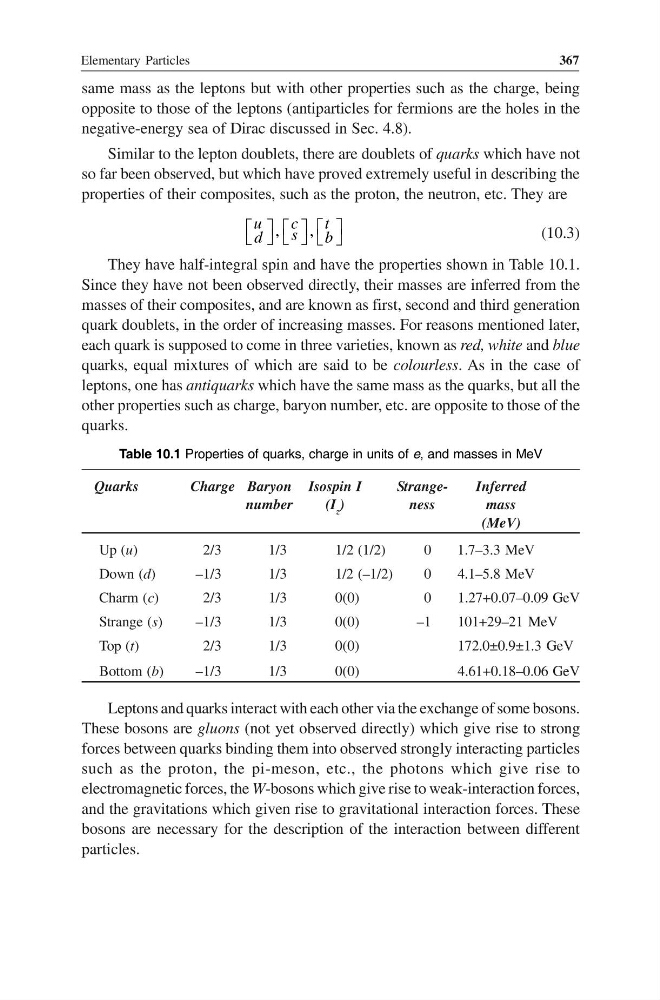
They have half-integral spin and have the properties shown in Table 10.1.
Since they have not been observed directly, their masses are inferred from the
masses of their composites, and are known as first, second and third generation
quark doublets, in the order of increasing masses. For reasons mentioned later,
each quark is supposed to come in three varieties, known as red, white and blue
quarks, equal mixtures of which are said to be colourless. As in the case of
leptons, one has antiquarks which have the same mass as the quarks, but all the
other properties such as charge, baryon number, etc. are opposite to those of the
quarks.
Table 10.1 Properties of quarks, charge in units of e, and masses in MeV
Quarks
Charge Baryon Isospin I
StrangeInferred
number
(I z )
ness
mass
(MeV)
Up (u)
2/3
1/3
1/2 (1/2)
0
1.7–3.3 MeV
Down (d)
–1/3
1/3
1/2 (–1/2)
0
4.1–5.8 MeV
Charm (c)
2/3
1/3
0(0)
0
1.27+0.07–0.09 GeV
Strange (s)
–1/3
1/3
0(0)
–1
101+29–21 MeV
Top (t)
2/3
1/3
0(0)
172.0±0.9±1.3 GeV
Bottom (b)
–1/3
1/3
0(0)
4.61+0.18–0.06 GeV
Leptons and quarks interact with each other via the exchange of some bosons.
These bosons are gluons (not yet observed directly) which give rise to strong
forces between quarks binding them into observed strongly interacting particles
such as the proton, the pi-meson, etc., the photons which give rise to
electromagnetic forces, the W-bosons which give rise to weak-interaction forces,
and the gravitations which given rise to gravitational interaction forces. These
bosons are necessary for the description of the interaction between different
particles.
367
same mass as the leptons but with other properties such as the charge, being
opposite to those of the leptons (antiparticles for fermions are the holes in the
negative-energy sea of Dirac discussed in Sec. 4.8).
Similar to the lepton doublets, there are doublets of quarks which have not
so far been observed, but which have proved extremely useful in describing the
properties of their composites, such as the proton, the neutron, etc. They are
,
,
u
c
t
s
d
b
(10.3)
They have half-integral spin and have the properties shown in Table 10.1.
Since they have not been observed directly, their masses are inferred from the
masses of their composites, and are known as first, second and third generation
quark doublets, in the order of increasing masses. For reasons mentioned later,
each quark is supposed to come in three varieties, known as red, white and blue
quarks, equal mixtures of which are said to be colourless. As in the case of
leptons, one has antiquarks which have the same mass as the quarks, but all the
other properties such as charge, baryon number, etc. are opposite to those of the
quarks.
Table 10.1 Properties of quarks, charge in units of e, and masses in MeV
Quarks
Charge Baryon Isospin I
StrangeInferred
number
(I z )
ness
mass
(MeV)
Up (u)
2/3
1/3
1/2 (1/2)
0
1.7–3.3 MeV
Down (d)
–1/3
1/3
1/2 (–1/2)
0
4.1–5.8 MeV
Charm (c)
2/3
1/3
0(0)
0
1.27+0.07–0.09 GeV
Strange (s)
–1/3
1/3
0(0)
–1
101+29–21 MeV
Top (t)
2/3
1/3
0(0)
172.0±0.9±1.3 GeV
Bottom (b)
–1/3
1/3
0(0)
4.61+0.18–0.06 GeV
Leptons and quarks interact with each other via the exchange of some bosons.
These bosons are gluons (not yet observed directly) which give rise to strong
forces between quarks binding them into observed strongly interacting particles
such as the proton, the pi-meson, etc., the photons which give rise to
electromagnetic forces, the W-bosons which give rise to weak-interaction forces,
and the gravitations which given rise to gravitational interaction forces. These
bosons are necessary for the description of the interaction between different
particles.