

Elements of Modern Physics
366
While considering the microscopic structure of matter, it is pertinent to ask
whether the different forms of matter have a common basis. Is it possible to
understand the various properties in terms of a few elementary particles with
prescribed rules for their interactions? If these constituent particles and their
interactions are analysed, then in principle, one can construct all the forms of
matter and explain their properties.
In this chapter, the present status of out understanding of the elementary
particles, their various interactions and the unification of these interactions that
is emerging are briefly discussed.
10.1 ELEMENTARY PARTICLES
What are the elementary particles? This is not always an easy question to answer.
The answer will in general depend upon the existing knowledge and the
calculational tools provided by the underlying theory, which allow us to explain
the properties of the composite objects. Therefore, it might happen that entities
that are regarded as elementary particles at some time can later be described as
composite particles as out knowledge and calculational techniques improve.
For example, atoms which were regarded as the building blocks in the nineteenth
century are now regarded as composites of electrons and a nucleus, and the
nucleus itself is regarded a composite of protons and neutrons (the nucleons).
The generally accepted ideas of elementary particles are presented here and
their implications discussed. The interesting feature of these ideas is that many
particles that are thought to be elementary, have not yet been observed, and
indeed may not be observable in principle.
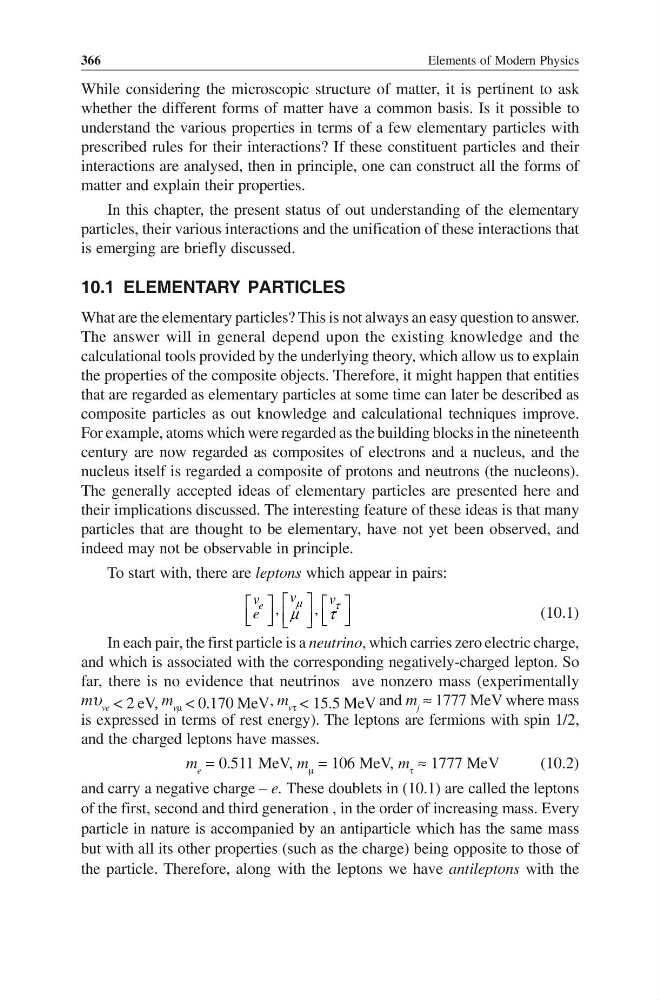
To start with, there are leptons which appear in pairs:
,
,
e
v
v
v
e
m
t
m
t
È ˘
È ˘
È ˘
Í ˙
Í ˙
Í ˙
Î ˚
Î ˚
Î ˚
(10.1)
In each pair, the first particle is a neutrino, which carries zero electric charge,
and which is associated with the corresponding negatively-charged lepton. So
far, there is no evidence that neutrinos ave nonzero mass (experimentally
mυ ve < 2 eV, m vµ < 0.170 MeV , m vτ < 15.5 MeV and m j ≈ 1777 MeV where mass
is expressed in terms of rest energy). The leptons are fermions with spin 1/2,
and the charged leptons have masses.
m e = 0.511 MeV, m µ = 106 MeV, m τ ≈ 1777 MeV
(10.2)
and carry a negative charge – e. These doublets in (10.1) are called the leptons
of the first, second and third generation , in the order of increasing mass. Every
particle in nature is accompanied by an antiparticle which has the same mass
but with all its other properties (such as the charge) being opposite to those of
the particle. Therefore, along with the leptons we have antileptons with the
366
While considering the microscopic structure of matter, it is pertinent to ask
whether the different forms of matter have a common basis. Is it possible to
understand the various properties in terms of a few elementary particles with
prescribed rules for their interactions? If these constituent particles and their
interactions are analysed, then in principle, one can construct all the forms of
matter and explain their properties.
In this chapter, the present status of out understanding of the elementary
particles, their various interactions and the unification of these interactions that
is emerging are briefly discussed.
10.1 ELEMENTARY PARTICLES
What are the elementary particles? This is not always an easy question to answer.
The answer will in general depend upon the existing knowledge and the
calculational tools provided by the underlying theory, which allow us to explain
the properties of the composite objects. Therefore, it might happen that entities
that are regarded as elementary particles at some time can later be described as
composite particles as out knowledge and calculational techniques improve.
For example, atoms which were regarded as the building blocks in the nineteenth
century are now regarded as composites of electrons and a nucleus, and the
nucleus itself is regarded a composite of protons and neutrons (the nucleons).
The generally accepted ideas of elementary particles are presented here and
their implications discussed. The interesting feature of these ideas is that many
particles that are thought to be elementary, have not yet been observed, and
indeed may not be observable in principle.
To start with, there are leptons which appear in pairs:
,
,
e
v
v
v
e
m
t
m
t
È ˘
È ˘
È ˘
Í ˙
Í ˙
Í ˙
Î ˚
Î ˚
Î ˚
(10.1)
In each pair, the first particle is a neutrino, which carries zero electric charge,
and which is associated with the corresponding negatively-charged lepton. So
far, there is no evidence that neutrinos ave nonzero mass (experimentally
mυ ve < 2 eV, m vµ < 0.170 MeV , m vτ < 15.5 MeV and m j ≈ 1777 MeV where mass
is expressed in terms of rest energy). The leptons are fermions with spin 1/2,
and the charged leptons have masses.
m e = 0.511 MeV, m µ = 106 MeV, m τ ≈ 1777 MeV
(10.2)
and carry a negative charge – e. These doublets in (10.1) are called the leptons
of the first, second and third generation , in the order of increasing mass. Every
particle in nature is accompanied by an antiparticle which has the same mass
but with all its other properties (such as the charge) being opposite to those of
the particle. Therefore, along with the leptons we have antileptons with the