

Elementary Particles
369
Hadron
Mass
Charge
I(I z )
Strange- Constituent
(MeV)
ness
quarks
π
+
139.6
1
1(1)
0
u d
π
θ
135.1
0
1(0)
0
u, u d d
π
–
139.6
–1
1(–1)
0
d u
Mesons
K
+
494
1
1/2(1/2)
1
us
K
0
498
0
1/2(–1/2)
1
d s
0
K
498
0
1/2(1/2)
–1
s d
K
–
494
–1
1/2(–1/2)
–1
s u
η
549
0
0
0 u u , dd , ss
Isospin Symmetry
The most striking feature to be noted in the properties of the hadrons is that
they come in multiplets with components of very nearly the same mass, e.g.
938.2 MeV for the proton and 939.5 MeV for the neutron. Such a property has
been noted for bound states in central potentials, where the states with different m
values but the same l value, have the same energy. It is therefore suggested that
we postulate and abstract space in which there is an abstract spin called isospin
I, and the different components of a multiplet are states with the same I but
different I z . For example, P and N have I = 1/2 and I z = 1/2, – 1/2 respectively.
The equality of the masses of the different components, would then follow
from the invariance of the interaction under rotations in the abstract isospin
space.
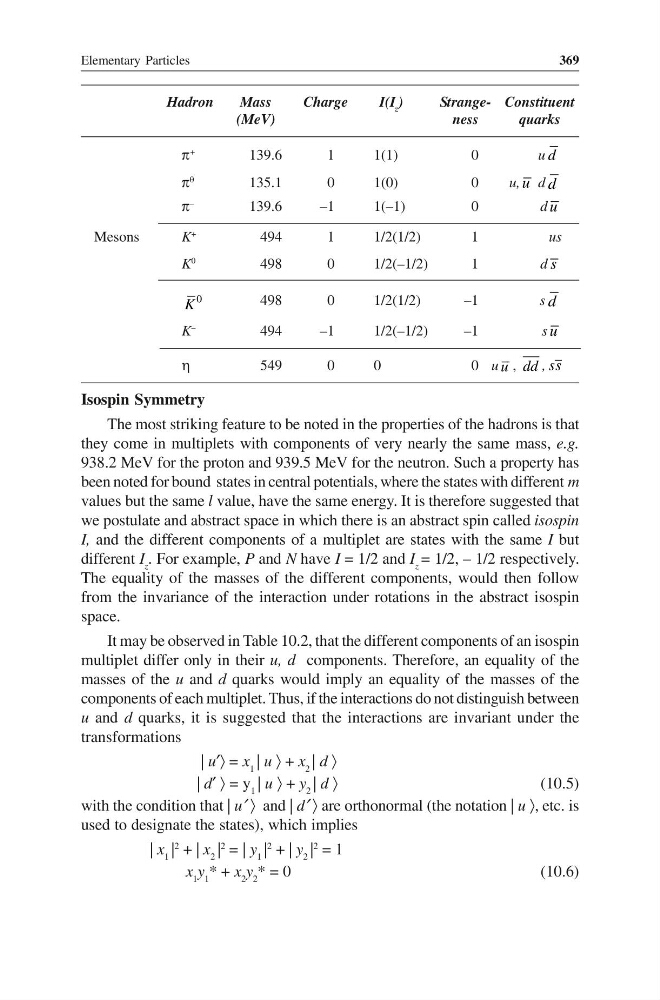
It may be observed in Table 10.2, that the different components of an isospin
multiplet differ only in their u, d components. Therefore, an equality of the
masses of the u and d quarks would imply an equality of the masses of the
components of each multiplet. Thus, if the interactions do not distinguish between
u and d quarks, it is suggested that the interactions are invariant under the
transformations
| u′〉 = x 1 | u 〉 + x 2 | d 〉
| d′ 〉 = y 1 | u 〉 + y 2 | d 〉
(10.5)
with the condition that | u′ 〉 and | d′ 〉 are orthonormal (the notation | u 〉, etc. is
used to designate the states), which implies
| x 1 |
2
+ | x 2 |
2
= | y 1 |
2
+ | y 2 |
2
= 1
x 1 y 1 * + x 2 y 2 * = 0
(10.6)
369
Hadron
Mass
Charge
I(I z )
Strange- Constituent
(MeV)
ness
quarks
π
+
139.6
1
1(1)
0
u d
π
θ
135.1
0
1(0)
0
u, u d d
π
–
139.6
–1
1(–1)
0
d u
Mesons
K
+
494
1
1/2(1/2)
1
us
K
0
498
0
1/2(–1/2)
1
d s
0
K
498
0
1/2(1/2)
–1
s d
K
–
494
–1
1/2(–1/2)
–1
s u
η
549
0
0
0 u u , dd , ss
Isospin Symmetry
The most striking feature to be noted in the properties of the hadrons is that
they come in multiplets with components of very nearly the same mass, e.g.
938.2 MeV for the proton and 939.5 MeV for the neutron. Such a property has
been noted for bound states in central potentials, where the states with different m
values but the same l value, have the same energy. It is therefore suggested that
we postulate and abstract space in which there is an abstract spin called isospin
I, and the different components of a multiplet are states with the same I but
different I z . For example, P and N have I = 1/2 and I z = 1/2, – 1/2 respectively.
The equality of the masses of the different components, would then follow
from the invariance of the interaction under rotations in the abstract isospin
space.
It may be observed in Table 10.2, that the different components of an isospin
multiplet differ only in their u, d components. Therefore, an equality of the
masses of the u and d quarks would imply an equality of the masses of the
components of each multiplet. Thus, if the interactions do not distinguish between
u and d quarks, it is suggested that the interactions are invariant under the
transformations
| u′〉 = x 1 | u 〉 + x 2 | d 〉
| d′ 〉 = y 1 | u 〉 + y 2 | d 〉
(10.5)
with the condition that | u′ 〉 and | d′ 〉 are orthonormal (the notation | u 〉, etc. is
used to designate the states), which implies
| x 1 |
2
+ | x 2 |
2
= | y 1 |
2
+ | y 2 |
2
= 1
x 1 y 1 * + x 2 y 2 * = 0
(10.6)