

Elements of Modern Physics
362
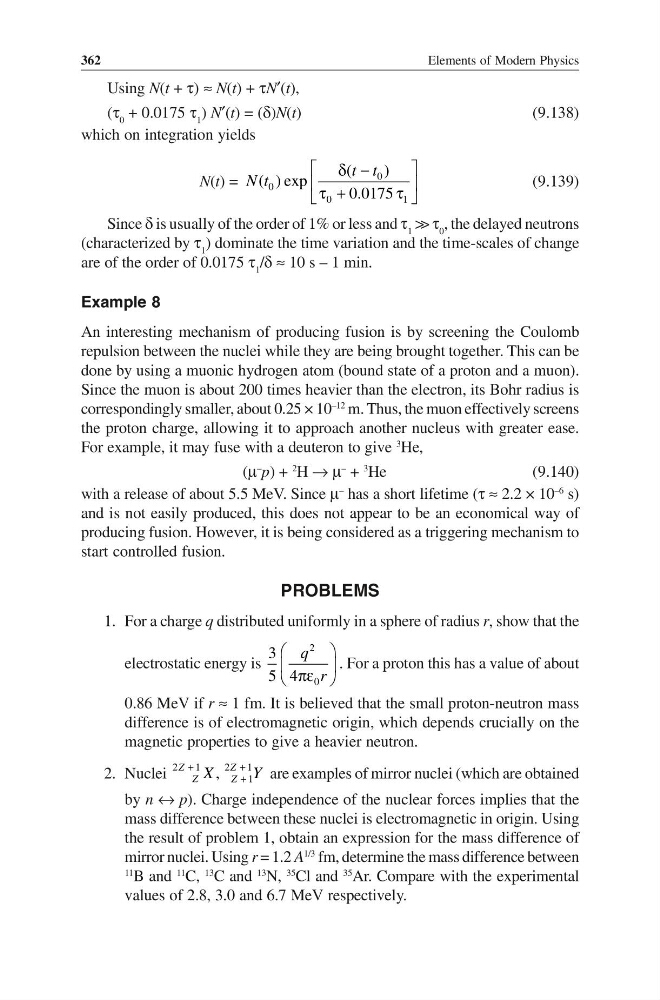
Using N(t + τ) ≈ N(t) + τN′(t),
(τ 0 + 0.0175 τ 1 ) N′(t) = (δ)N(t)
(9.138)
which on integration yields
N(t) =
0
0
0
1
(
)
( ) exp
0.0175
t t
N t
δ −
τ +
τ
(9.139)
Since δ is usually of the order of 1% or less and τ 1 >> τ 0 , the delayed neutrons
(characterized by τ 1 ) dominate the time variation and the time-scales of change
are of the order of 0.0175 τ 1 /δ ≈ 10 s – 1 min.
Example 8
An interesting mechanism of producing fusion is by screening the Coulomb
repulsion between the nuclei while they are being brought together. This can be
done by using a muonic hydrogen atom (bound state of a proton and a muon).
Since the muon is about 200 times heavier than the electron, its Bohr radius is
correspondingly smaller, about 0.25 × 10
–12
m. Thus, the muon effectively screens
the proton charge, allowing it to approach another nucleus with greater ease.
For example, it may fuse with a deuteron to give
3
He,
(µ
–
p) +
2
H → µ
–
+
3
He
(9.140)
with a release of about 5.5 MeV. Since µ
–
has a short lifetime (τ ≈ 2.2 × 10
–6
s)
and is not easily produced, this does not appear to be an economical way of
producing fusion. However, it is being considered as a triggering mechanism to
start controlled fusion.
PROBLEMS
1. For a charge q distributed uniformly in a sphere of radius r, show that the
electrostatic energy is
2
0
3
5 4
q
r
πε
. For a proton this has a value of about
0.86 MeV if r ≈ 1 fm. It is believed that the small proton-neutron mass
difference is of electromagnetic origin, which depends crucially on the
magnetic properties to give a heavier neutron.
2. Nuclei
2
1
2
1
1
,
Z
Z
Z
Z
X
Y
+
+
+
are examples of mirror nuclei (which are obtained
by n ↔ p). Charge independence of the nuclear forces implies that the
mass difference between these nuclei is electromagnetic in origin. Using
the result of problem 1, obtain an expression for the mass difference of
mirror nuclei. Using r = 1.2 A
1/3
fm, determine the mass difference between
11
B and
11
C,
13
C and
13
N,
35
Cl and
35
Ar. Compare with the experimental
values of 2.8, 3.0 and 6.7 MeV respectively.
362
Using N(t + τ) ≈ N(t) + τN′(t),
(τ 0 + 0.0175 τ 1 ) N′(t) = (δ)N(t)
(9.138)
which on integration yields
N(t) =
0
0
0
1
(
)
( ) exp
0.0175
t t
N t
δ −
τ +
τ
(9.139)
Since δ is usually of the order of 1% or less and τ 1 >> τ 0 , the delayed neutrons
(characterized by τ 1 ) dominate the time variation and the time-scales of change
are of the order of 0.0175 τ 1 /δ ≈ 10 s – 1 min.
Example 8
An interesting mechanism of producing fusion is by screening the Coulomb
repulsion between the nuclei while they are being brought together. This can be
done by using a muonic hydrogen atom (bound state of a proton and a muon).
Since the muon is about 200 times heavier than the electron, its Bohr radius is
correspondingly smaller, about 0.25 × 10
–12
m. Thus, the muon effectively screens
the proton charge, allowing it to approach another nucleus with greater ease.
For example, it may fuse with a deuteron to give
3
He,
(µ
–
p) +
2
H → µ
–
+
3
He
(9.140)
with a release of about 5.5 MeV. Since µ
–
has a short lifetime (τ ≈ 2.2 × 10
–6
s)
and is not easily produced, this does not appear to be an economical way of
producing fusion. However, it is being considered as a triggering mechanism to
start controlled fusion.
PROBLEMS
1. For a charge q distributed uniformly in a sphere of radius r, show that the
electrostatic energy is
2
0
3
5 4
q
r
πε
. For a proton this has a value of about
0.86 MeV if r ≈ 1 fm. It is believed that the small proton-neutron mass
difference is of electromagnetic origin, which depends crucially on the
magnetic properties to give a heavier neutron.
2. Nuclei
2
1
2
1
1
,
Z
Z
Z
Z
X
Y
+
+
+
are examples of mirror nuclei (which are obtained
by n ↔ p). Charge independence of the nuclear forces implies that the
mass difference between these nuclei is electromagnetic in origin. Using
the result of problem 1, obtain an expression for the mass difference of
mirror nuclei. Using r = 1.2 A
1/3
fm, determine the mass difference between
11
B and
11
C,
13
C and
13
N,
35
Cl and
35
Ar. Compare with the experimental
values of 2.8, 3.0 and 6.7 MeV respectively.