

The Nucleus
363
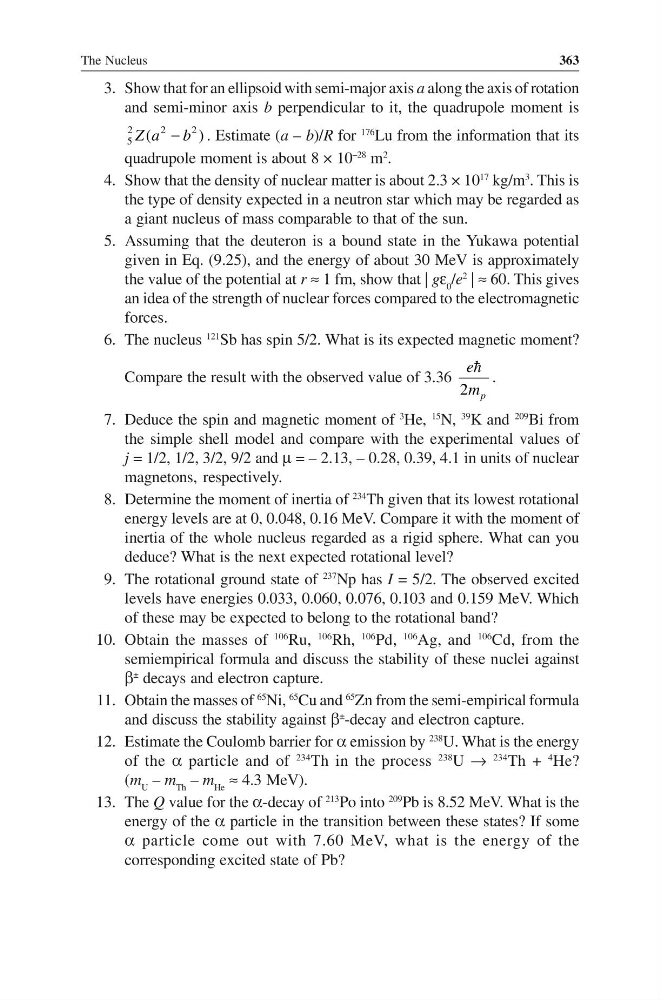
3. Show that for an ellipsoid with semi-major axis a along the axis of rotation
and semi-minor axis b perpendicular to it, the quadrupole moment is
2
2
2
5 (
)
Z a b
−
. Estimate (a – b)/R for
176
Lu from the information that its
quadrupole moment is about 8 × 10
–28
m
2
.
4. Show that the density of nuclear matter is about 2.3 × 10
17
kg/m
3
. This is
the type of density expected in a neutron star which may be regarded as
a giant nucleus of mass comparable to that of the sun.
5. Assuming that the deuteron is a bound state in the Yukawa potential
given in Eq. (9.25), and the energy of about 30 MeV is approximately
the value of the potential at r ≈ 1 fm, show that | gε 0 /e
2
| ≈ 60. This gives
an idea of the strength of nuclear forces compared to the electromagnetic
forces.
6. The nucleus
121
Sb has spin 5/2. What is its expected magnetic moment?
Compare the result with the observed value of 3.36 2 p
e
m
.
7. Deduce the spin and magnetic moment of
3
He,
15
N,
39
K and
209
Bi from
the simple shell model and compare with the experimental values of
j = 1/2, 1/2, 3/2, 9/2 and µ = – 2.13, – 0.28, 0.39, 4.1 in units of nuclear
magnetons, respectively.
8. Determine the moment of inertia of
234
Th given that its lowest rotational
energy levels are at 0, 0.048, 0.16 MeV. Compare it with the moment of
inertia of the whole nucleus regarded as a rigid sphere. What can you
deduce? What is the next expected rotational level?
9. The rotational ground state of
237
Np has I = 5/2. The observed excited
levels have energies 0.033, 0.060, 0.076, 0.103 and 0.159 MeV. Which
of these may be expected to belong to the rotational band?
10. Obtain the masses of
106
Ru,
106
Rh,
106
Pd,
106
Ag, and
106
Cd, from the
semiempirical formula and discuss the stability of these nuclei against
β
±
decays and electron capture.
11. Obtain the masses of
65
Ni,
65
Cu and
65
Zn from the semi-empirical formula
and discuss the stability against β
±
-decay and electron capture.
12. Estimate the Coulomb barrier for α emission by
238
U. What is the energy
of the α particle and of
234
Th in the process
238
U →
234
Th +
4
He?
(m U – m Th – m He ≈ 4.3 MeV).
13. The Q value for the α-decay of
213
Po into
209
Pb is 8.52 MeV. What is the
energy of the α particle in the transition between these states? If some
α particle come out with 7.60 MeV, what is the energy of the
corresponding excited state of Pb?
363
3. Show that for an ellipsoid with semi-major axis a along the axis of rotation
and semi-minor axis b perpendicular to it, the quadrupole moment is
2
2
2
5 (
)
Z a b
−
. Estimate (a – b)/R for
176
Lu from the information that its
quadrupole moment is about 8 × 10
–28
m
2
.
4. Show that the density of nuclear matter is about 2.3 × 10
17
kg/m
3
. This is
the type of density expected in a neutron star which may be regarded as
a giant nucleus of mass comparable to that of the sun.
5. Assuming that the deuteron is a bound state in the Yukawa potential
given in Eq. (9.25), and the energy of about 30 MeV is approximately
the value of the potential at r ≈ 1 fm, show that | gε 0 /e
2
| ≈ 60. This gives
an idea of the strength of nuclear forces compared to the electromagnetic
forces.
6. The nucleus
121
Sb has spin 5/2. What is its expected magnetic moment?
Compare the result with the observed value of 3.36 2 p
e
m
.
7. Deduce the spin and magnetic moment of
3
He,
15
N,
39
K and
209
Bi from
the simple shell model and compare with the experimental values of
j = 1/2, 1/2, 3/2, 9/2 and µ = – 2.13, – 0.28, 0.39, 4.1 in units of nuclear
magnetons, respectively.
8. Determine the moment of inertia of
234
Th given that its lowest rotational
energy levels are at 0, 0.048, 0.16 MeV. Compare it with the moment of
inertia of the whole nucleus regarded as a rigid sphere. What can you
deduce? What is the next expected rotational level?
9. The rotational ground state of
237
Np has I = 5/2. The observed excited
levels have energies 0.033, 0.060, 0.076, 0.103 and 0.159 MeV. Which
of these may be expected to belong to the rotational band?
10. Obtain the masses of
106
Ru,
106
Rh,
106
Pd,
106
Ag, and
106
Cd, from the
semiempirical formula and discuss the stability of these nuclei against
β
±
decays and electron capture.
11. Obtain the masses of
65
Ni,
65
Cu and
65
Zn from the semi-empirical formula
and discuss the stability against β
±
-decay and electron capture.
12. Estimate the Coulomb barrier for α emission by
238
U. What is the energy
of the α particle and of
234
Th in the process
238
U →
234
Th +
4
He?
(m U – m Th – m He ≈ 4.3 MeV).
13. The Q value for the α-decay of
213
Po into
209
Pb is 8.52 MeV. What is the
energy of the α particle in the transition between these states? If some
α particle come out with 7.60 MeV, what is the energy of the
corresponding excited state of Pb?