

The Nucleus
361
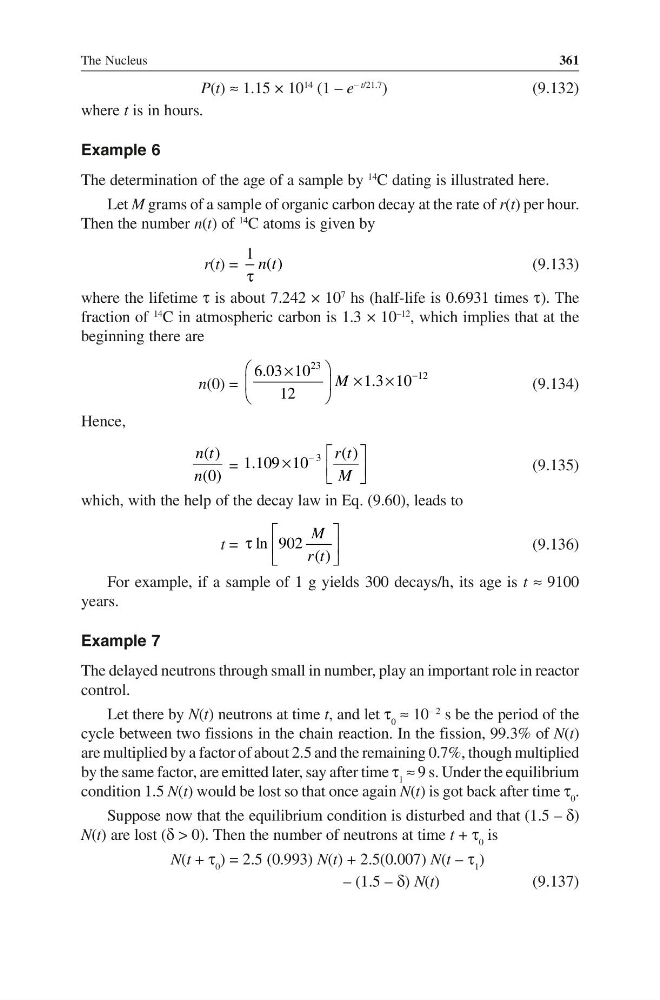
P(t) ≈ 1.15 × 10
14
(1 – e
– t/21.7
)
(9.132)
where t is in hours.
Example 6
The determination of the age of a sample by
14
C dating is illustrated here.
Let M grams of a sample of organic carbon decay at the rate of r(t) per hour.
Then the number n(t) of
14
C atoms is given by
r(t) =
1 ( )
n t
τ
(9.133)
where the lifetime τ is about 7.242 × 10
7
hs (half-life is 0.6931 times τ). The
fraction of
14
C in atmospheric carbon is 1.3 × 10
–12
, which implies that at the
beginning there are
n(0) =
23
12
6.03 10
1.3 10
12
M
−
×
× ×
(9.134)
Hence,
( )
(0)
n t
n
=
3
( )
1.109 10
r t
M
−
×
(9.135)
which, with the help of the decay law in Eq. (9.60), leads to
t = ln 902 ( )
M
r t
τ
(9.136)
For example, if a sample of 1 g yields 300 decays/h, its age is t ≈ 9100
years.
Example 7
The delayed neutrons through small in number, play an important role in reactor
control.
Let there by N(t) neutrons at time t, and let τ 0 ≈ 10
– 2
s be the period of the
cycle between two fissions in the chain reaction. In the fission, 99.3% of N(t)
are multiplied by a factor of about 2.5 and the remaining 0.7%, though multiplied
by the same factor, are emitted later, say after time τ 1 ≈ 9 s. Under the equilibrium
condition 1.5 N(t) would be lost so that once again N(t) is got back after time τ 0 .
Suppose now that the equilibrium condition is disturbed and that (1.5 – δ)
N(t) are lost (δ > 0). Then the number of neutrons at time t + τ 0 is
N(t + τ 0 ) = 2.5 (0.993) N(t) + 2.5(0.007) N(t – τ 1 )
– (1.5 – δ) N(t)
(9.137)
361
P(t) ≈ 1.15 × 10
14
(1 – e
– t/21.7
)
(9.132)
where t is in hours.
Example 6
The determination of the age of a sample by
14
C dating is illustrated here.
Let M grams of a sample of organic carbon decay at the rate of r(t) per hour.
Then the number n(t) of
14
C atoms is given by
r(t) =
1 ( )
n t
τ
(9.133)
where the lifetime τ is about 7.242 × 10
7
hs (half-life is 0.6931 times τ). The
fraction of
14
C in atmospheric carbon is 1.3 × 10
–12
, which implies that at the
beginning there are
n(0) =
23
12
6.03 10
1.3 10
12
M
−
×
× ×
(9.134)
Hence,
( )
(0)
n t
n
=
3
( )
1.109 10
r t
M
−
×
(9.135)
which, with the help of the decay law in Eq. (9.60), leads to
t = ln 902 ( )
M
r t
τ
(9.136)
For example, if a sample of 1 g yields 300 decays/h, its age is t ≈ 9100
years.
Example 7
The delayed neutrons through small in number, play an important role in reactor
control.
Let there by N(t) neutrons at time t, and let τ 0 ≈ 10
– 2
s be the period of the
cycle between two fissions in the chain reaction. In the fission, 99.3% of N(t)
are multiplied by a factor of about 2.5 and the remaining 0.7%, though multiplied
by the same factor, are emitted later, say after time τ 1 ≈ 9 s. Under the equilibrium
condition 1.5 N(t) would be lost so that once again N(t) is got back after time τ 0 .
Suppose now that the equilibrium condition is disturbed and that (1.5 – δ)
N(t) are lost (δ > 0). Then the number of neutrons at time t + τ 0 is
N(t + τ 0 ) = 2.5 (0.993) N(t) + 2.5(0.007) N(t – τ 1 )
– (1.5 – δ) N(t)
(9.137)