

The Nucleus
341
E α ≈
208
6.203
6.086 MeV
212
≈
(9.73)
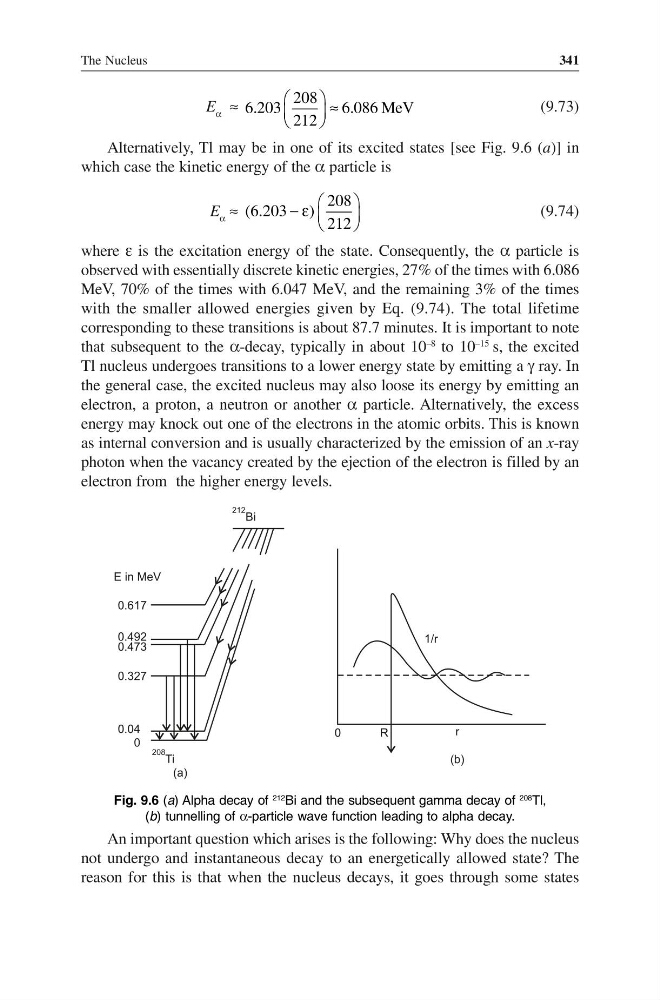
Alternatively, Tl may be in one of its excited states [see Fig. 9.6 (a)] in
which case the kinetic energy of the α particle is
E α ≈
208
(6.203 ) 212
− ε
(9.74)
where ε is the excitation energy of the state. Consequently, the α particle is
observed with essentially discrete kinetic energies, 27% of the times with 6.086
MeV, 70% of the times with 6.047 MeV, and the remaining 3% of the times
with the smaller allowed energies given by Eq. (9.74). The total lifetime
corresponding to these transitions is about 87.7 minutes. It is important to note
that subsequent to the α-decay, typically in about 10
–8
to 10
–15
s, the excited
Tl nucleus undergoes transitions to a lower energy state by emitting a γ ray. In
the general case, the excited nucleus may also loose its energy by emitting an
electron, a proton, a neutron or another α particle. Alternatively, the excess
energy may knock out one of the electrons in the atomic orbits. This is known
as internal conversion and is usually characterized by the emission of an x-ray
photon when the vacancy created by the ejection of the electron is filled by an
electron from the higher energy levels.
212 Bi
E in MeV
0.617
0.492
0.473
0.327
0.04
0
208 Ti
(a)
1/r
0
R
r
(b)
Fig. 9.6 (a) Alpha decay of
212
Bi and the subsequent gamma decay of
208
Tl,
(b) tunnelling of α-particle wave function leading to alpha decay.
An important question which arises is the following: Why does the nucleus
not undergo and instantaneous decay to an energetically allowed state? The
reason for this is that when the nucleus decays, it goes through some states
341
E α ≈
208
6.203
6.086 MeV
212
≈
(9.73)
Alternatively, Tl may be in one of its excited states [see Fig. 9.6 (a)] in
which case the kinetic energy of the α particle is
E α ≈
208
(6.203 ) 212
− ε
(9.74)
where ε is the excitation energy of the state. Consequently, the α particle is
observed with essentially discrete kinetic energies, 27% of the times with 6.086
MeV, 70% of the times with 6.047 MeV, and the remaining 3% of the times
with the smaller allowed energies given by Eq. (9.74). The total lifetime
corresponding to these transitions is about 87.7 minutes. It is important to note
that subsequent to the α-decay, typically in about 10
–8
to 10
–15
s, the excited
Tl nucleus undergoes transitions to a lower energy state by emitting a γ ray. In
the general case, the excited nucleus may also loose its energy by emitting an
electron, a proton, a neutron or another α particle. Alternatively, the excess
energy may knock out one of the electrons in the atomic orbits. This is known
as internal conversion and is usually characterized by the emission of an x-ray
photon when the vacancy created by the ejection of the electron is filled by an
electron from the higher energy levels.
212 Bi
E in MeV
0.617
0.492
0.473
0.327
0.04
0
208 Ti
(a)
1/r
0
R
r
(b)
Fig. 9.6 (a) Alpha decay of
212
Bi and the subsequent gamma decay of
208
Tl,
(b) tunnelling of α-particle wave function leading to alpha decay.
An important question which arises is the following: Why does the nucleus
not undergo and instantaneous decay to an energetically allowed state? The
reason for this is that when the nucleus decays, it goes through some states