

Elements of Modern Physics
342
which have higher energy and the decay products must overcome the potential
barrier. For example, when Tl and He are just touching each other before
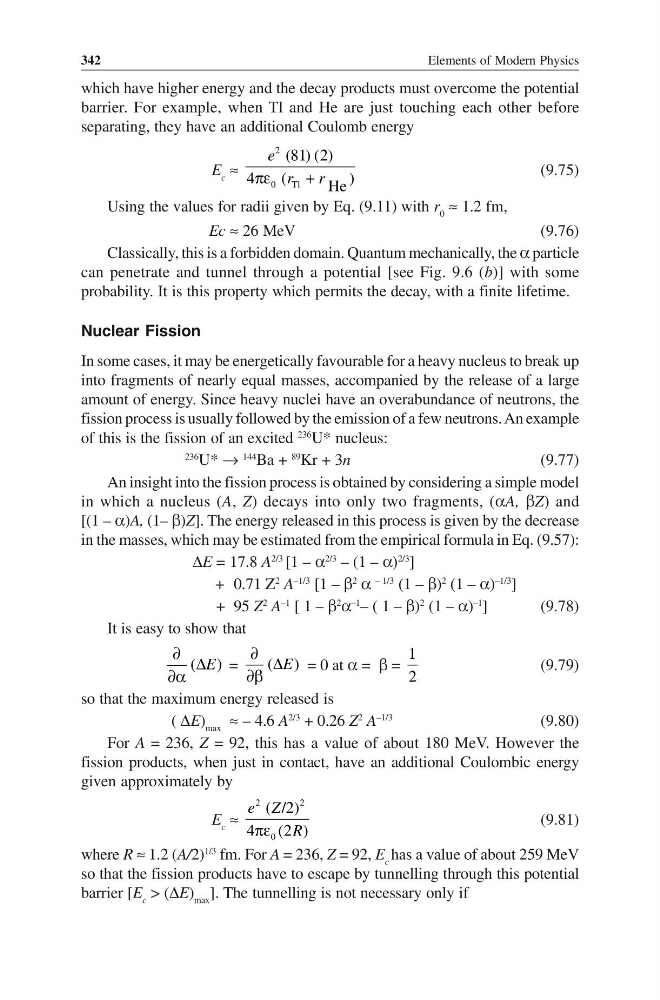
separating, they have an additional Coulomb energy
E c ≈
2
0
Tl
(81) (2)
4
(
)
He
e
r
r
πε
+
(9.75)
Using the values for radii given by Eq. (9.11) with r 0 ≈ 1.2 fm,
Ec ≈ 26 MeV
(9.76)
Classically, this is a forbidden domain. Quantum mechanically, the α particle
can penetrate and tunnel through a potential [see Fig. 9.6 (b)] with some
probability. It is this property which permits the decay, with a finite lifetime.
Nuclear Fission
In some cases, it may be energetically favourable for a heavy nucleus to break up
into fragments of nearly equal masses, accompanied by the release of a large
amount of energy. Since heavy nuclei have an overabundance of neutrons, the
fission process is usually followed by the emission of a few neutrons. An example
of this is the fission of an excited
236
U* nucleus:
236
U* →
144
Ba +
89
Kr + 3n
(9.77)
An insight into the fission process is obtained by considering a simple model
in which a nucleus (A, Z) decays into only two fragments, (αA, βZ) and
[(1 – α)A, (1– β)Z]. The energy released in this process is given by the decrease
in the masses, which may be estimated from the empirical formula in Eq. (9.57):
∆E = 17.8 A
2/3
[1 – α
2/3
– (1 – α)
2/3
]
+ 0.71 Z
2
A
–1/3
[1 – β
2
α
– 1/3
(1 – β)
2
(1 – α)
–1/3
]
+ 95 Z
2
A
–1
[ 1 – β
2
α
–1
– ( 1 – β)
2
(1 – α)
–1
]
(9.78)
It is easy to show that
( )
E
∂ ∆
∂α
=
( )
E
∂ ∆
∂β
= 0 at α = β =
1
2
(9.79)
so that the maximum energy released is
( ∆E) max ≈ – 4.6 A
2/3
+ 0.26 Z
2
A
–1/3
(9.80)
For A = 236, Z = 92, this has a value of about 180 MeV. However the
fission products, when just in contact, have an additional Coulombic energy
given approximately by
E c ≈
2
2
0
( /2)
4 (2 )
e Z
R
πε
(9.81)
where R ≈ 1.2 (A/2)
1/3
fm. For A = 236, Z = 92, E c has a value of about 259 MeV
so that the fission products have to escape by tunnelling through this potential
barrier [E c > (∆E) max ]. The tunnelling is not necessary only if
342
which have higher energy and the decay products must overcome the potential
barrier. For example, when Tl and He are just touching each other before
separating, they have an additional Coulomb energy
E c ≈
2
0
Tl
(81) (2)
4
(
)
He
e
r
r
πε
+
(9.75)
Using the values for radii given by Eq. (9.11) with r 0 ≈ 1.2 fm,
Ec ≈ 26 MeV
(9.76)
Classically, this is a forbidden domain. Quantum mechanically, the α particle
can penetrate and tunnel through a potential [see Fig. 9.6 (b)] with some
probability. It is this property which permits the decay, with a finite lifetime.
Nuclear Fission
In some cases, it may be energetically favourable for a heavy nucleus to break up
into fragments of nearly equal masses, accompanied by the release of a large
amount of energy. Since heavy nuclei have an overabundance of neutrons, the
fission process is usually followed by the emission of a few neutrons. An example
of this is the fission of an excited
236
U* nucleus:
236
U* →
144
Ba +
89
Kr + 3n
(9.77)
An insight into the fission process is obtained by considering a simple model
in which a nucleus (A, Z) decays into only two fragments, (αA, βZ) and
[(1 – α)A, (1– β)Z]. The energy released in this process is given by the decrease
in the masses, which may be estimated from the empirical formula in Eq. (9.57):
∆E = 17.8 A
2/3
[1 – α
2/3
– (1 – α)
2/3
]
+ 0.71 Z
2
A
–1/3
[1 – β
2
α
– 1/3
(1 – β)
2
(1 – α)
–1/3
]
+ 95 Z
2
A
–1
[ 1 – β
2
α
–1
– ( 1 – β)
2
(1 – α)
–1
]
(9.78)
It is easy to show that
( )
E
∂ ∆
∂α
=
( )
E
∂ ∆
∂β
= 0 at α = β =
1
2
(9.79)
so that the maximum energy released is
( ∆E) max ≈ – 4.6 A
2/3
+ 0.26 Z
2
A
–1/3
(9.80)
For A = 236, Z = 92, this has a value of about 180 MeV. However the
fission products, when just in contact, have an additional Coulombic energy
given approximately by
E c ≈
2
2
0
( /2)
4 (2 )
e Z
R
πε
(9.81)
where R ≈ 1.2 (A/2)
1/3
fm. For A = 236, Z = 92, E c has a value of about 259 MeV
so that the fission products have to escape by tunnelling through this potential
barrier [E c > (∆E) max ]. The tunnelling is not necessary only if